Conceptual blending in thought, rhetoric, and ideology
Conceptual blending and conceptual metaphor
Conceptual blending theory assumes many of the same claims as conceptual metaphor theory, such as the idea that metaphor is a conceptual as well as a linguistic phenomenon, and that it involves the systematic projection of language, imagery, and inferential structure between domains. The two approaches are largely complementary, with similar assumptions about the relationship between language and conceptualization, but with different emphases and foci (see Grady, Oakley, and Coulson 1999). For example, in contrast to the emphasis on conventional metaphors in conceptual metaphor theory, conceptual blending theory is intended to capture spontaneous, real-time processes that can yield short-lived and novel conceptualizations. Further, blending theory reveals connections between the cognitive underpinnings of metaphor and a variety of other linguistic phenomena handled by mental space theory (conditionals, counterfactuals, metonymy, etc.), making it especially amenable to the characterization of rhetorical discourse.
Fauconnier and Turner (2002) propose that metaphoric utterances are represented in conceptual integration networks in which the source and target domain each structure one input space, the generic space represents abstract commonalities in the inputs, and the blended space inherits structure from its inputs as well as containing emergent structure of its own. Rather than emphasizing the extent to which metaphorical utterances instantiate entrenched mappings between source and target domains, conceptual integration networks only represent those cognitive models that are particularly relevant to the mapping supported by the utterances. While mappings in the integration network require knowledge of conceptual metaphors such as those studied by Lakoff and colleagues (e.g. Lakoff and Johnson 1980), blending theory is best suited for representing the joint influence of input domains and the origin of emergent inferences in particular metaphoric utterances.
One motivation for blending theory is the observation that metaphoric expressions often have novel implications that cannot be traced back to either the source or the target domain. For example, “That surgeon is a butcher,” customarily connotes the surgeon’s incompetence, in spite of the fact that people neither consider surgeons to be typically incompetent, nor do they consider butchers (qua butchers) as inevitably inept at their craft. In blending theory, appreciating this metaphor involves establishing mappings between elements and relations in the source input of butchery and the target input of surgery. As in conceptual metaphor theory, there is a mapping between surgeon and butcher, patient and dead animal, as well as scalpel and cleaver.
However, blending theory also posits the construction of a blended space in which structures from each of these inputs can be integrated. In this example, the blended space inherits the goals of the surgeon and the means and manner of the butcher (Grady, Oakley, and Coulson 1999). The inference that the surgeon is incompetent arises when these structures are integrated to create a hypothetical agent with both characteristics. Behavior that is perfectly appropriate for a butcher whose goal is to slaughter an animal is appalling for the surgeon operating on a live human being. The absurd, hyperbolic nature of the cognitive model in the blended space does not seem to undermine its inferential utility, and may even enhance it (as argued on Persuasive Absurdities). The table below shows the conceptual integration network for “That surgeon is a butcher.”
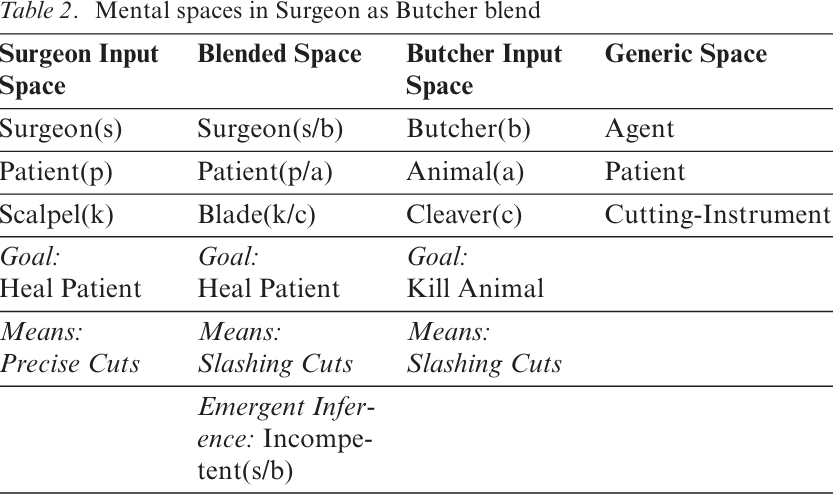
The fact that the inference of incompetence does not originate in the source domain of butchery is further suggested by the existence of other metaphoric uses of butcher– such as describing a military official as the butcher of Srebenica– that recruit structure and imagery from the butchery domain, but do not connote incompetence. Differences in the implications of the butcher metaphor in the domains of medicine and the military highlight the need for an account of their underlying conceptual origin.
Consequently, blending theory can address the meaning construction in metaphoric expressions that do not employ conventionalized mapping schemes. For example, the italicized portion of this excerpt from an interview with philosopher Daniel Dennet involves a metaphorical blend, “There’s not a thing that’s magical about a computer. One of the most brilliant things about a computer is that there’s nothing up its sleeve,” (Edge 94, November 19, 2001). The input domains here are Computers and Magicians, and the blend involves a hybrid model in which the computer is a magician. However, the connection between these two domains arises purely from the co-text of this example, as there is no conventional COMPUTERS ARE MAGICIANS mapping in English.
Blending can also be used to explain how a number of different kinds of mappings can be combined to explain the meaning of a particular example such as the following (from Grady, Oakley, and Coulson 1999):
With Trent Lott as the Senate Majority Leader, and Gingrich at the helm in the House, the list to the Right could destabilize the entire Ship of State.
This example involves an elaboration of the conventional Nation-as-Ship metaphor in which the Nation’s policies correspond to the ship’s course, leadership corresponds to steering the ship, and policy failures correspond to deviations from the ship’s course. The Nation-as-Ship metaphor is itself structured by the more abstract event structure metaphor described by Lakoff (1993). The source input is the domain of Ships, which projects an image of a ship on the water, as well as the concept of the helm to the blended space. The target input is the domain of 1996 American politics which projects particular elements, including Trent Lott and Gingrich, to the blend where they are integrated with the sailing scenario.
Grady et al.’s example describes the ship listing to the right. However, in the realistic domain of ships, neither the presence of one individual (Trent Lott) nor the beliefs of the helmsman are likely to cause the ship to list. The logic of this metaphoric utterance comes not from the source input, but rather from the target input in which the Senate Majority Leader and the Speaker of the House can affect national policies and the overall political orientation of government. Further, the standard association between conservatism and the right as against liberalism and the left is clearly not based on the ship model, as it is frequently encountered in other contexts. However, because the scenario in the blend involves spatial motion, the literal notion of rightward movement is integrated with the other structure in the blend to yield a cognitive model of a ship piloted by New Gingrich that lists to the right. This example thus demonstrates that while the linguistic system provides speakers with a set of coherent mappings between the source and target domains, speakers need not maintain this coherence in the models set up during the comprehension of utterances that exploit these conventionalized mappings.








