Metonymy as a usage event
Some properties of metonymy
Metonymy and implicature
We have shown that it is not always easy to distinguish metaphor and metonymy and that, for particular linguistic examples, there is not always a consensus whether they constitute metaphors or metonymies. Critics of present-day metaphor and metonymy theory, such as Haser (2005) and Leezenberg (2001), have challenged cognitive linguistics arguing that there is no clear conception of metaphor and metonymy in this framework.
Haser (2005: 17–18) claims that in the cognitive linguistic literature conceptually heterogeneous phenomena have been lumped together as “metonymy”. To a certain extent, this is true. With regard to metonymy, Haser (2005: 18) criticizes Panther and Thornburg (1999: 334) for not properly distinguishing between “meaning something different from what is said and meaning something in addition to what is said” in their approach to metonymy. Haser points out that, in a case of genuine metonymy, such as the German expression ein Glas trinken ‘drink a glass’, the container (the glass) stands for its liquid contents (water, milk, juice, etc.). Haser claims that Panther and Thornburg classify as metonymies phenomena that do not involve substitution of meaning but rather addition of meaning.
The pragmatic types of metonymy distinguished by Panther and Thornburg are illustrated by the following sentences (see e.g. Panther and Thornburg 2003; Panther 2005; Panther and Thornburg In Press):
(17) A lot of Ph.D.s have been written about this topic. (referential: DOCTORAL DEGREE FOR DOCTORAL THESIS)
(18) The President was clear on the matter. (predicational: MANNER OF SPEAKING FOR SPEAKING)1
(19) I would like you to close this window. (illocutionary: WISH FOR RE QUEST)
Consider now (20), which Panther and Thornburg regard as inducing a predicational metonymy resulting in the interpretation (21):
(20) He was able to finish his dissertation.
(21) He finished his dissertation.2
Haser (2005: 18) claims that the relation between (20) and (21) is one of addition rather than of substitution so that the almost automatic inference (21) from (20) would not be analyzable as a metonymic relation contrary to Panther and Thornburg’s analysis. Furthermore, Haser (rightly) points out that (21) entails (20). The entailment relation between target and source does, however, according to her, not hold in classical cases of metonymy as in (22), which metonymically evokes (23):
(22) She is listening to Schubert all day.
(23) She is listening to music composed by Schubert all day.
Obviously, (23) does not entail (22). From this fact Haser concludes that the relation between (22) and (23) is not of the same kind as that between (20) and (21). Haser draws the conclusion that since the relation between (22) and (23) is metonymic, the relation between (20) and (21) cannot be metonymic.
Haser’s argumentation is however not stringent. If one wants to establish target-source entailment as a criterion for non-metonymicity, what should be compared is the relation between the denotata of the nominal expressions Schubert and of its metonymic target ‘music composed by Schubert’– not the relation between the two propositions expressed by sentences (22) and (23), respectively. The metonymic target ‘music composed by Schubert’ expresses the underlying proposition ‘Schubert composed music’. From this latter proposition the proposition follows that Schubert existed.3 Thus, the relationship between was able to finish his dissertation and ‘finished his dissertation’ in (20) and (21) is analogous to that between the existential presupposition ‘Schubert existed’ (following from Schubert) and the proposition ‘Schubert composed music’ (following from music composed by Schubert), in (22) and (23), respectively. Just as ability is a prerequisite for action, the existence of a person is a prerequisite for that person to be a composer. Table 1 summarizes these analogies.
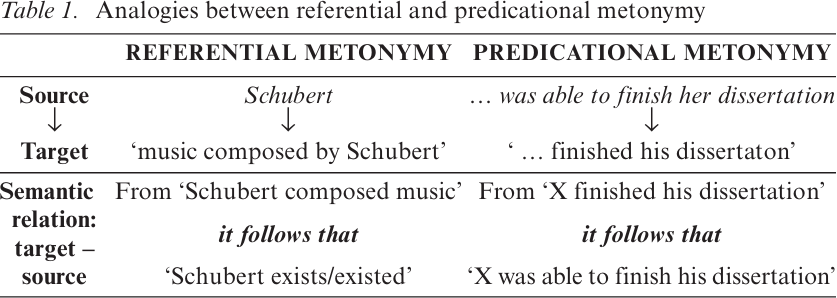
More generally, nobody has ever suggested, to my knowledge, that a metonymic target must not entail its source. Why non-entailment from target to source should be a condition for metonymicity remains unclear. I do not see any reason for introducing such a condition as a defining criterion of metonymy.
Another problem with Haser’s approach is her claim that the target of (20), i.e. (21), adds meaning to what is said, whereas in her view a genuine metonymy does not add meaning but substitutes one meaning for another. Consider the expression drink a glass again, which everybody regards as a metonymical expression. One condition for employing this metonymy crucially involves the use of a glass; drinking directly from the tap or from one’s cupped palms does not count as “drinking a glass”. One might object that drink a bottle (of juice) does not necessarily, and even not normally, mean that the drinker drinks from a bottle. However, the bottle as a container is still crucially involved, because if somebody drinks directly from the juice barrel, this activity will not count as drink a bottle even if the drinker consumes the quantity contained in a bottle. To come back to drink a glass, the metonymic meaning can be paraphrased as ‘drink (approximately) the quantity of liquid contained in a glass and, most probably, from a glass’. The point is that there is not just substitution of one meaning for another but meaning elaboration of the source concept ‘glass’ (as a container).4 The source meaning is a conceptual component of the target meaning. This is also what Panther and Thornburg assume for cases of predicational metonymy such as (20) and (21): The source meaning expressed by (20) becomes an integrative part of the target meaning expressed by (21). The metonymic reading induced by (20) can be paraphrased as ‘was able to finish his dissertation and actually managed to finish his dissertation’. The meaning component ABILITY is combined with the meaning component SUCESSFUL ACTION in the metonymic target, but ABILITY becomes a backgrounded meaning component whereas the SUCESSFUL ACTION sense is conceptually prominent.
In conclusion, the problems that Haser has with Panther and Thornburg’s metonymy theory are based on a false presumption, viz. that these authors regard “added” meanings as metonymies. Target meanings are not additions, but elaborations of the source meanings, which remain a conceptual part of the target meaning.
Another related point of Haser’s critique concerns the relation between metonymy and implicature. Implicature, she seems to assume, is added conceptual material, on top of what is said by the speaker, whereas metonymy is presumably a substitution relation. I believe this to be a fictitious opposition that collapses on closer inspection. Take a standard implicature based on the Gricean maxim of quantity such as SOME +> NOT ALL (as is common, the symbol ‘+>’ is used here to represent the implicature relation). This looks like a case of addition, but the overall (including the implicated) meaning of some could alternatively be formulated as meaning elaboration: SOME +> SOME & NOT ALL.5 Furthermore, the NOT ALL component seems to be a conceptually prominent meaning in most cases whereas the meaning component some is more backgrounded (but still activated). Consider the following utterance:
(24) At midnight, some of the guests left the party.
In many contexts, in utterances like (24) the meaning that not all guests left the party (and probably most did not leave it) is conceptually prominent. The conceptual link between SOME and NOT ALL is by many speakers felt to be so tight that the two meanings are almost indistinguishable. Conceptual tightness of source and target senses is also a property of metonymy.
There are thus some interesting analogies between metonymy and implicature, which have led some scholars to assume that metonymic principles actually underlie many implicatures (see e.g. Barcelona 2003: passim; Ruiz de Mendoza Ibañez and Peña 2005: 274).
1. This example I have taken from Brdar and Brdar-Szabó (2003: 241). The metonymy where the manner of action stands for the action itself has been explored in some detail from a cross-linguistic perspective by the same authors (Brdar-Szabó and Brdar 2002).
2. I now think that the metonymic relation is better described as obtaining between ‘be able to’ (source meaning) and ‘manage to’ (target meaning), but this change is irrelevant to the argument made by Haser.
3. Whether there is a separate relation of semantic presupposition that is distinct from entailment is controversially discussed in the literature. For overviews, see Kempson (1975) and Wilson (1975).
4. Note that glass also involves a metonymically exploited relation between substance and container made of substance.
5. The idea that metonymy involves integration of the source meaning into the target meaning has also been put forward by Radden and Kövecses (2006).








