Three dogmas of embodiment: Cognitive linguistics as a cognitive science
A theoretical framework for doing Cognitive Linguistics as a cognitive science
The first challenge for developing a theoretical framework in which we can address such differing approaches is to propose the adoption of a simple and well-understood organizing criterion. Unfortunately, most previous proposals have generally accorded an ontological status, rather than an epistemological or methodological status, to the organization of their theoretic framework. Most such frameworks postulate “higher” and “lower” levels of cognition in ways which imply that the higher levels may be reduced to operations at the lower levels, ultimately arguing for the elimination of higher-levels of description in favor of lower levels of description (Churchland 1981, 1989). One exception is Posner and Raichle’s (1994) schematization of the levels of investigation in cognitive neuroscience, in which the primary emphasis is given to the methodologies used to investigate the phenomena rather than their ontological status. Similarly, Edelman (1992) points out that in the physical sciences, phenomena are operationally grouped in levels according to the physical scale of the methodology that is being used to study the phenomena. Thus the most basic organizing criterion of this theoretic framework is the scale of the relative physical sizes at which we can measure the embodied phenomena which produce the different kinds of socio-cultural, cognitive or neural events to be studied.
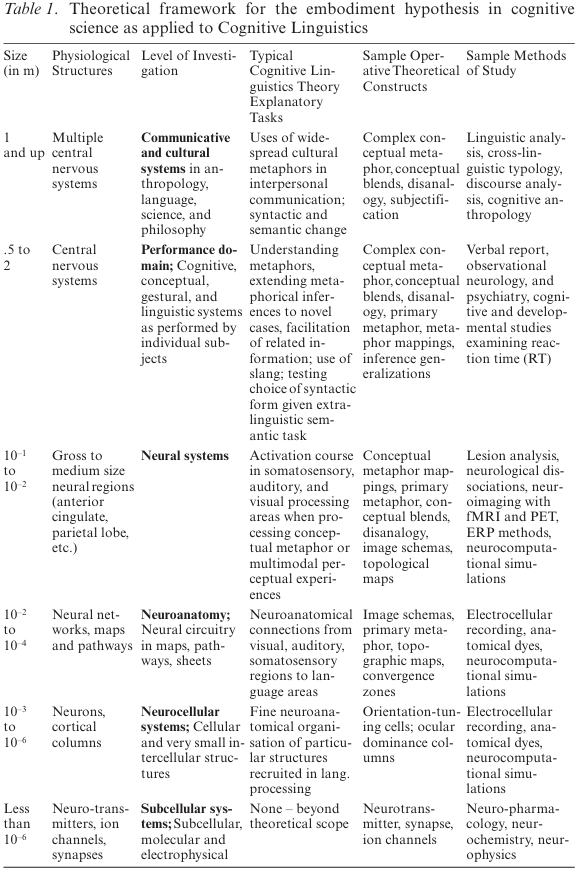
In Table 1, physical size is mapped on the y-axis, providing a relative distribution of the “higher to lower” methodological levels of cognitive processes. A general name for each level is indicated by boldface type in the first column. To provide clarification, the next column provides examples of what the relevant physiological structures are at a given physical scale. For example, at the communicative, cultural and social level we study spatial language as it is used between people, and hence the relevant physiological structures are multiple central nervous systems; alternatively, it is possible to measure one individual’s (and hence one central nervous system’s) performance on a similar set of linguistic tasks. Similarly we can examine, with even more granularity, relative changes in cerebral blood flow to regions of the brain in response to spatial linguistic tasks; or we can construct neurocomputational models of those brain regions. However, Posner and Raichle’s key insight is that it is important to consider how the basic inquiry change changes given the different tasks and methods at various levels of investigation. All methodologies have constraints and freedoms which limit or enhance their scope of investigation and define the theoretical constructs that they develop, and these are a product of the physical scale at which the measurement is taking place. The final two columns acknowledge this by specifying some of the relevant theoretic constructs and the various methodologies operative at each level of investigation.
This framework can be used to situate the wide methodological array of studies on various topics of interest to cognitive linguists, such as metaphor, mental imagery, categorization, frames of reference, emotions, and so on. This type of theoretical framework is now fairly common within much of cognitive science, but Cognitive Linguistics has been slow to give explicit attention to the problem of how we are to theoretically situate and reconcile these different levels of investigation (see Table 1 below).
I have included just a single level of cultural and communicative analysis, but by no means should this be taken as indicative of its importance relative to the other levels. Of course, one could argue for a multiplicity of levels embedded within this one, though they might not be clearly differentiated from one another in terms of physical scale. In choosing to include a general level situated at a meter and up on the physical size axis I mean to emphasize only that human beings should be considered not simply in terms of physiological size, but also in terms of the standard scale of their interactional distance in speaking and interacting with one another. At this level of the framework the “physiological structures” column reads “Multiple Central Nervous Systems”, but that awkward term is intentionally inadequate so as to emphasize that the physiology is less relevant here– what primarily matters on this level are the social and cultural interactions between human beings. Investigations at the cultural level are occasionally given short shrift by some versions of embodied cognitive science, but generally this has been and should remain a strong thrust of future research in Cognitive Linguistics.
Note also that difficult phenomena such as cultural and linguistic norms, or individual consciousness and awareness, are situated at the physical scale at which they are measured and observed, rather than attempting to place them on (or reduce them to) a lower level of investigation. Nonetheless, it is certainly possible and sometimes useful to ask, for example, how long the neural auditory processing of a phonemic slip takes before impacting conscious speech, or how the linguistic norm of forming the English past tense might be performed in a neurocomputational model. However, research in embodied cognitive science should not seek to reduce such phenomena to another level but should instead bridge across these levels in important ways– for example, the linguistic corpora used to train the neurocomputational model should be based on naturalistic recordings of an actual child’s utterances rather than text harvested from internet newsgroups, and so on.
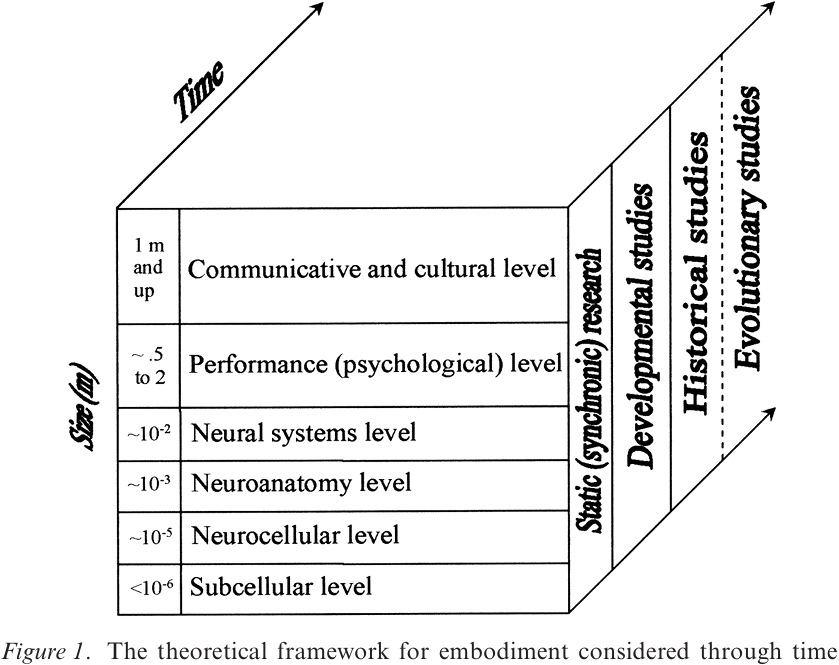
While the table depicting the theoretic framework is designed to give an overview of the relationship between body, brain and culture, this representation is not as illustrative for issues pertaining to evolutionary, developmental and historical time scales, which may be considered at any of these levels. However, this failing is more a limitation of the imagery of a two-dimensional table than of the theoretic framework itself. If we were to add another axis for time perpendicular to the surface plane of the chart, we could imagine this framework as a rectangular solid (Figure 1). Embodiment is not temporally static, and when we strip away the veneer– a finely detailed veneer, to be sure– of synchronic studies, we see that those results are the result of processes of learning and development, and of history and evolution.