

Grammar


Tenses


Present

Present Simple

Present Continuous

Present Perfect

Present Perfect Continuous


Past

Past Simple

Past Continuous

Past Perfect

Past Perfect Continuous


Future

Future Simple

Future Continuous

Future Perfect

Future Perfect Continuous


Parts Of Speech


Nouns

Countable and uncountable nouns

Verbal nouns

Singular and Plural nouns

Proper nouns

Nouns gender

Nouns definition

Concrete nouns

Abstract nouns

Common nouns

Collective nouns

Definition Of Nouns


Verbs

Stative and dynamic verbs

Finite and nonfinite verbs

To be verbs

Transitive and intransitive verbs

Auxiliary verbs

Modal verbs

Regular and irregular verbs

Action verbs


Adverbs

Relative adverbs

Interrogative adverbs

Adverbs of time

Adverbs of place

Adverbs of reason

Adverbs of quantity

Adverbs of manner

Adverbs of frequency

Adverbs of affirmation


Adjectives

Quantitative adjective

Proper adjective

Possessive adjective

Numeral adjective

Interrogative adjective

Distributive adjective

Descriptive adjective

Demonstrative adjective


Pronouns

Subject pronoun

Relative pronoun

Reflexive pronoun

Reciprocal pronoun

Possessive pronoun

Personal pronoun

Interrogative pronoun

Indefinite pronoun

Emphatic pronoun

Distributive pronoun

Demonstrative pronoun


Pre Position


Preposition by function

Time preposition

Reason preposition

Possession preposition

Place preposition

Phrases preposition

Origin preposition

Measure preposition

Direction preposition

Contrast preposition

Agent preposition


Preposition by construction

Simple preposition

Phrase preposition

Double preposition

Compound preposition


Conjunctions

Subordinating conjunction

Correlative conjunction

Coordinating conjunction

Conjunctive adverbs


Interjections

Express calling interjection


Grammar Rules

Passive and Active

Preference

Requests and offers

wishes

Be used to

Some and any

Could have done

Describing people

Giving advices

Possession

Comparative and superlative

Giving Reason

Making Suggestions

Apologizing

Forming questions

Since and for

Directions

Obligation

Adverbials

invitation

Articles

Imaginary condition

Zero conditional

First conditional

Second conditional

Third conditional

Reported speech


Linguistics

Phonetics

Phonology

Linguistics fields

Syntax

Morphology

Semantics

pragmatics

History

Writing

Grammar

Phonetics and Phonology

Semiotics


Reading Comprehension

Elementary

Intermediate

Advanced


Teaching Methods

Teaching Strategies

Assessment
Dichotic listening
المؤلف:
George Yule
المصدر:
The study of language
الجزء والصفحة:
164-12
26-2-2022
1838
Dichotic listening
An experimental technique that has demonstrated a left hemisphere dominance for syllable and word processing is called the dichotic listening test. This technique uses the generally established fact that anything experienced on the right-hand side of the body is processed in the left hemisphere, and anything on the left side is processed in the right hemisphere. As illustrated in Flaherty’s (2004) description at the beginning of this chapter, a stroke in the right hemisphere resulted in paralysis of the left leg. So, a basic assumption would be that a signal coming in the right ear will go to the left hemisphere and a signal coming in the left ear will go to the right hemisphere.
With this information, an experiment is possible in which a subject sits with a set of earphones on and is given two different sound signals simultaneously, one through each earphone. For example, through one earphone comes the syllable ga or the word dog, and through the other earphone at exactly the same time comes da or cat. When asked to say what was heard, the subject more often correctly identifies the sound that came via the right ear. This is known as the right ear advantage for linguistic sounds. The process involved is best understood with the help of the accompanying illustration. (You’re looking at the back of this head.)
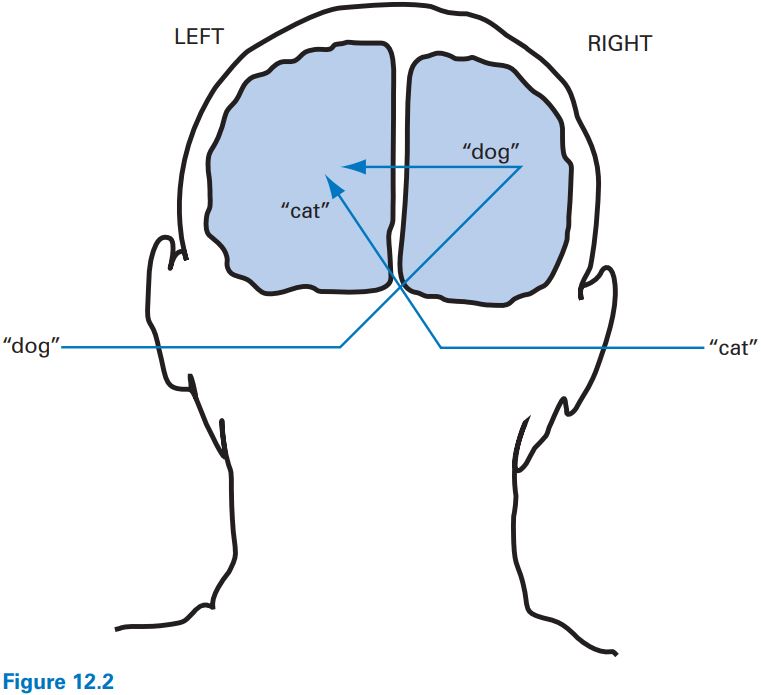
In this process, the language signal received through the left ear is first sent to the right hemisphere and then has to be sent to the left hemisphere (language center) for processing. This non-direct route takes longer than a linguistic signal received through the right ear and going directly to the left hemisphere. First signal to get processed wins.
The right hemisphere appears to have primary responsibility for processing a lot of other incoming signals that are non-linguistic. In the dichotic listening test, it can be shown that non-verbal sounds (e.g. music, coughs, traffic noises, birds singing) are recognized more often via the left ear, meaning they are processed faster via the right hemisphere. So, among the specializations of the human brain, the right hemisphere is first choice for non-language sounds (among other things) and the left hemisphere specializes in language sounds (among other things too).
These specializations may actually have more to do with the type of processing, rather than the type of material, that is handled best by each of the two hemispheres. The essential distinction seems to be between analytic processing, such as recognizing the smaller details of sounds, words and phrase structures in rapid sequence, done with the “left brain,” and holistic processing, such as identifying more general structures in language and experience, done with the “right brain.”
الاكثر قراءة في Linguistics fields
اخر الاخبار
اخبار العتبة العباسية المقدسة
الآخبار الصحية

"المهمة".. إصدار قصصي يوثّق القصص الفائزة في مسابقة فتوى الدفاع المقدسة للقصة القصيرة
(نوافذ).. إصدار أدبي يوثق القصص الفائزة في مسابقة الإمام العسكري (عليه السلام)
قسم الشؤون الفكرية يصدر مجموعة قصصية بعنوان (قلوب بلا مأوى)


