UNMARKED FOCUS AND MARKED FOCUS
In normal, unemphatic discourse, it is customary to start our message from what we think our hearer knows and progress to what s/he does not know. In other words, the unmarked distribution starts with the Given and progresses towards the New. This is often called the principle of end-focus.
The neutral position for information focus is therefore towards the end of the information unit. In grammatical terms, this usually means that unmarked (end-)focus falls on the last non-anaphoric lexical item or name in the clause, as in the above exchange. Items which occur after the tonic can be taken as Given and are always unstressed, like about it here:
Pete’s just COMPLAINED about it.
Given - - - - New - - - - - - - - Given
Here, the words after complained are both grammatical rather than lexical words: that is, they have a largely grammatical meaning. Pronouns such as it always refer to something known, unless they are contrastive and therefore marked. In the following example, the second use of WANT is anaphoric (the notion of ‘wanting’ occurs in the question), and is therefore not marked. Instead, DON’T is marked:
A. Don’t you WANT it then? B. No, I DON’T want it.
When the focus of information is placed on the last non-anaphoric lexical item in the clause, almost the whole clause may be New or just one part of it. For example, Jane dropped the COFFEE-POT could be intended to mean that it was just the coffee-pot and not something else that Jane dropped; or the whole unit could contain new information. The amount of New material can be verified by formulating questions. In answer to the first, only the coffee-pot would be New and the rest Given (and probably ellipted in speech), while in answer to the second, the whole unit would represent new information:
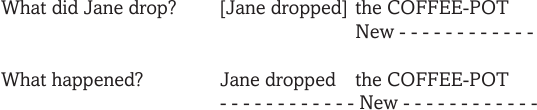
Marked focus occurs when the tonic is placed on any other syllable than the tonic syllable of the last non-anaphoric lexical item. Marked focus is used for the purpose of contrasting one item with another, as in 1 and 2, or to add an emotive overlay, as in 3:
1 SHE didn’t make the phone call, ROBERT did.
2 The kids didn’t SIT on the sofa, they JUMPED on it.
3 I’m SO THIRSTY!
The first would be used in a context in which the speaker assumes that the hearer knows they are talking about someone making a phone call (‘make the phone call’ is Given information). As contrastive focus treats the focused element as New information, both she and Robert are treated as New, even though both must be identifiable in the context.
Focus can fall on other, non-lexical items such as pronouns, prepositions and auxiliaries, again with an implied contrast or correction. The following examples illustrate some of the possibilities of marked focus. When auxiliaries receive focus it is meanings such as those of polarity contrast (i.e. positive/ negative) or tense which are presented as New or important information:
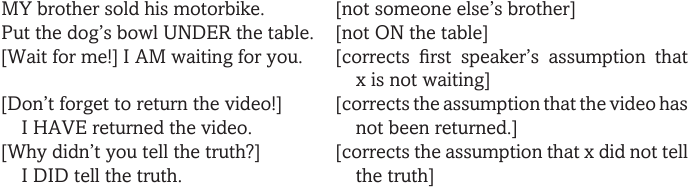
Whether for emotive reasons or for the purpose of emphasizing or contrasting, it can happen that a single tone group contains more than one nucleus. The fall-plus-rise or the rise-plus-fall tones often accompany focusing of this kind.
//It was QUITE exciting REALLY.//
//I DO wish you’d shut UP.//








