Metonymy as a usage event
Some properties of metonymy
Prototypical metonymy
I will argue for a notion of metonymy that is wider than the one usually taken for granted in classical rhetoric. A typical traditional definition of metonymy is found e.g. in the Oxford English Dictionary (OED), where it is described as a “figure of speech which consists in substituting for the name of a thing the name of an attribute of it or of something closely related”. According to this characterization, metonymy is the result of a substitution of one linguistic sign for another linguistic sign. In addition, at least if one takes the term thing literally, the authors of the OED entry seem to imply that metonymy typically, or even exclusively, applies to referential expressions, i.e. noun phrases or proper names referring to “thing-like” entities such as objects, persons, etc. An example from the OED dating back to 1625 is given in (1):
(1) 1625 Gill Sacr. Philos. ii. 156 Shebet signifies either a staffe, a truncheon, or Scepter, and so by a metonymia it may signifie authority.
Although SCEPTER FOR AUTHORITY is indeed a universally agreed upon example of metonymy, there is a general consensus among cognitive linguists that metonymy is a much broader conceptual phenomenon than assumed in classical rhetoric (see especially the contributions in Barcelona 2000; Dirven and Pörings 2002). This broader conception of metonymy can be traced backed to at least Roman Jakobson (2002: 42–43), who developed his approach to metaphor and metonymy in the 1950s. Jakobson distinguishes between relations of similarity and relations of contiguity, which manifest themselves in the two dimensions of meaning and (syntactic) position, respectively. Words that occur in similar positions exemplify what is known as the paradigmatic axis of language, whereas words occurring contiguously in a syntactic arrangement exemplify the syntagmatic axis. As to similarity and contiguity of meaning, Jakobson reports a psychological test in which children were asked to provide spontaneous verbal responses to the stimulus word hut. Some subjects showed a predilection for words that were either similar or opposite in meaning such as cabin, hovel (synonyms), den, burrow (called metaphors by Jakobson), palace (antonym). Other subjects preferred semantically contiguous concepts, as exemplified in words like thatch, litter, and poverty. According to Jakobson, the former subjects, whose responses were based on similarity (and contrast) manifested a metaphoric mode of thinking whereas the latter, whose thinking relied on semantic contiguity, a metonymic mode of reasoning.
At first sight, Jakobson’s view seems to be at odds with both the rhetorical tradition and cognitive linguistic theories of metonymy. Jakobson relates metonymy to the syntagmatic axis of language, but in cognitive accounts of metonymy it is quite common to regard metonymy as an operation of substitution, i.e. a paradigmatic relation, a view that is reflected in the notation X FOR Y, which is commonly used for notating metonymies. However, on closer inspection, Jakobson’s conception of metonymy is compatible with the substitution view. The crucial distinction involved here is that between positional similarity/contiguity and semantic similarity/contiguity. In Jakobsonian terms, one could say that metonymy involves semantic contiguity, which manifests itself as positional similarity. A simple referential metonymy such as Mary is not in the phone book substitutes ‘Mary’s name’ (the metonymic target) for the metonymic vehicle Mary. The metonymic operation occurs in a specific syntactic position in the sentence and is therefore paradigmatic, but the relation between the metonymic source and its target is one of semantic contiguity.
In principle, Jakobson’s conception of metonymy is not restricted to referential metonymy and it is thus quite compatible with cognitive linguistic views of metonymy. However, at least as far as his examples of semantic contiguity are concerned, Jakobson’s approach to metonymy is far too unconstrained. Consider e.g. the words that were associatively elicited in the experiment mentioned above from the stimulus word hut: thatch, litter, and poverty. None of these words seems to be able to be used metonymically for ‘hut’:
(2) *The old man lived in a little thatch/litter/poverty. (for ‘hut’)
As pointed out above, the present author views metonymy not only as a referential shift phenomenon, but assumes that metonymic operations are active also on the levels of predication and illocution (see e.g. Panther 2005). In line with other cognitive approaches, especially Radden and Kövecses (2006), I regard metonymy as a cognitive operation through which one concept (the source) provides access to another concept (the target). Furthermore, I assume that the target meaning resulting from a metonymic shift is an elaboration of the source meaning. The metonymic shift can be regarded as a substitution operation, but one in which the source meaning does not vanish but remains part of the conceptual structure of the target meaning.2 What I regard to be the typical metonymic relation is diagrammed in Figure 1, which is explained in more detail below.
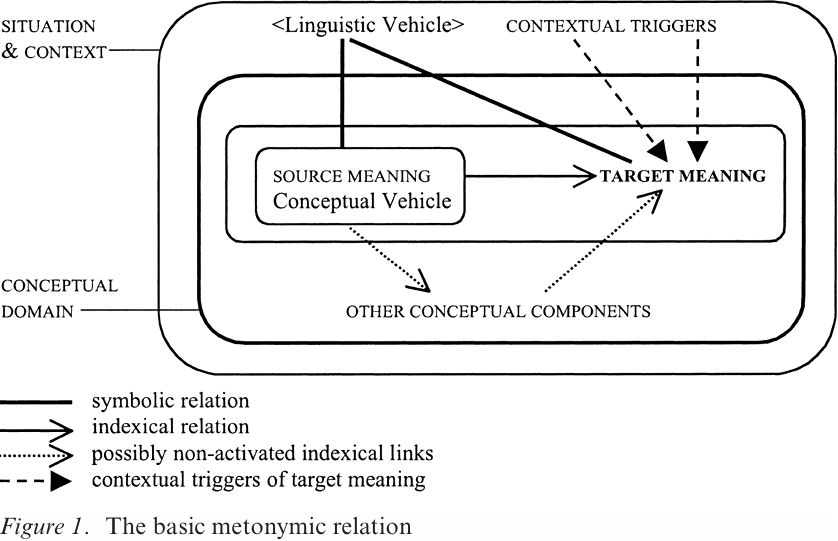
An adequate analysis of metonymy in usage events must take into account that metonymies are embedded in a larger situational and linguistic context.3 In Figure 1, context (both situational and textual) is indicated by the most inclusive thin-lined rectangle. Discontinuous arrow lines are used to represent the influence of contextual factors on the interpretation of metonymies. Note also the possible influence of ‘other conceptual components’, e.g. encyclopedic knowledge, on the interpretation of metonymy. That context and encyclopedic background knowledge must play a role in the interpretation of an expression as metonymic is evident from examples like the following:
(3) Paul Auster is on the second floor.
Suppose that Mary is in the New York Public Library and overhears a conversation in which (3) is uttered. Obviously, there are various factors that have an influence on whether Mary interprets (3) metonymically or non-metonymically. First, there is the context of the utterance. If Mary hears a library user ask the person at the circulation desk Where are Paul Auster’s novels? and the answer is (3), then it is obvious that Paul Auster is to be interpreted metonymically as ‘Paul Auster’s books’. Second, there is the factor of encyclopedic knowledge. If Mary overhears utterance (3) in isolation and does not know who Paul Auster is, she might simply interpret the utterance as stating something about a man called ‘Paul Auster’. If however she has a richer knowledge frame about Paul Auster as a novelist, script writer, essayist, etc., i.e., if there are “additional conceptual components” that Mary can activate (see Figure 1), a metonymic interpretation of Paul Auster is likely, but– even then– not necessarily enforced. Given that Mary is in a library, and again on the basis of her knowledge about Paul Auster and public libraries, she might infer that Paul Auster, the person, is giving a reading of his latest novel on the second floor. The analysis of utterance (3) thus demonstrates that metonymy interpretation may involve an intricate interplay of contextual factors (including the linguistic context, the situational context, and the world knowledge of the language user).
Returning to Figure 1, the thick-lined rectangle immediately contained within the thin-lined rectangle represents the conceptual domain or frame within which the metonymic operation takes place. For reasons to be clarified below I leave open the question here whether this frame constitutes a “single” domain or whether it contains other domains. In cognitive linguistics, metonymy is often characterized as an operation that occurs within a single domain– in contrast to metaphor, which supposedly involves cross-domain mappings (see e.g. Croft 2002; Ruiz de Mendoza Ibañez and Otal Campo 2002). Since the difficulties in establishing a set of operational criteria for identifying a “single” domain– in contrast to “separate” domains– are considerable, I prefer– at least, for the time being– a semiotic definition of metonymy, relying on Charles S. Peirce’s well-known trichotomy of signs, i.e. symbols, icons, and indices. I assume that conceptual metonymy, and by extension linguistic metonymy, involves an indexical relationship. In a linguistic metonymy, a linguistic form, which I call linguistic vehicle, denotes a source meaning. The relation between linguistic vehicle and source meaning is in general symbolic (indicated by a thick line in Figure 1), i.e. there is no “natural” connection between the form (linguistic vehicle) and its (literal) content. The source meaning, in turn, functions as a conceptual vehicle (alternatively, a ‘thought vehicle’) that provides cognitive access to the target meaning.4 The conceptual vehicle is thus a signifier that indexically evokes its signified, i.e. target meaning.5 The link between source meaning and target meaning can thus be thought of as a semiotic relation, viz. an indexical relation. In the framework adopted here, indexicality is a ‘pointing-to’ relation between one concept and another concept.6 In other words, different from the usually arbitrary (symbolic) relation between linguistic vehicle and source meaning, the relation between source meaning and target meaning is motivated.7 In Figure 1 the indexical relation between the conceptual vehicle and the target meaning is indicated by an open-headed arrow. As already pointed out above, Figure 1 also encapsulates the idea that the identification of the metonymic target meaning may be dependent on other conceptual components in the conceptual domain. Their potential contribution to the identification of the target meaning is symbolized by dotted-lined arrows. It should be borne in mind that the target conceptually integrates the source meaning, allocating it a backgrounded status.
Another important property of metonymy graphically represented by means of bold type in Figure 1 is the conceptual prominence of the target. In other theories, e.g. Croft (2002), this corresponds roughly to what he calls ‘domain highlighting’, i.e., an originally backgrounded subdomain within a domain becomes foregrounded through the metonymic operation.8 The property of conceptual prominence holds for prototypical cases of metonymy. Some cases that, in the literature on metonymy, are cited as typical examples of metonymy are consequently classified as more peripheral in my approach:
(4) Bush invaded Iraq.
Sentence (4) is usually regarded as a typical example of referential metonymy of the type CONTROLLER FOR CONTROLLED (cf. Lakoff and Johnson 1980: 38). However, it is clearly a source-prominent metonymy: the target, i.e. troops, air force, etc. that were actively involved in the invasion of Iraq remain indeterminate and backgrounded (see Panther 2005: 371–274 for detailed discussion).
The conception of metonymy presented here is, in some respects, different from the theories of metonymy developed by researchers such as Antonio Barcelona, William Croft, Francisco Ruiz de Mendoza, Günter Radden and Zoltán Kövecses. It is also, at least partially, at odds with Lakoff and Johnson’s (1999) approach to metaphor and metonymy. To list two differences very briefly:
i. In other theories, metonymy is regarded as linking one subdomain to another subdomain within the same domain (e.g. Barcelona 2002; Croft 2002); as a mapping from a subdomain to its containing matrix domain, or vice versa (e.g. Ruiz de Mendoza Ibáñez and Otal Campo 2002); or as a mapping from part to whole, whole to part, or part to part (Radden and Kövecses 2006). In the present approach, metonymy is regarded as a means of semantic enrichment or elaboration. This means that through a metonymic operation a source concept is expanded so that, as a result, the target concept is construed as conceptually more complex. At the same time, the source concept is an integrative part of the target concept.
ii. The approach advocated here assumes that the metonymic relation is contingent, i.e. not any meaning that is mentally accessible from a certain conceptual reference point gives rise to a metonymic relation. More precisely, I do not regard relations that are conceptually necessary as possible metonymies. In other words, mental access of concepts based on semantic entailment and semantic presupposition is not considered to be a mode of metonymic reasoning here.
Contingence as a fundamental property of metonymy has been emphasized in publications such as Panther and Thornburg (2003) and Panther (2005). The notion of contingence, as used in the above-cited publications, has sometimes been misunderstood. Contingence means simply that the metonymic relation per se is defeasible or cancelable (which distinguishes it from entailment). Contextual factors may however override defeasibility of the metonymic relation and more or less enforce (coerce) a metonymic interpretation. For example, in an utterance such as The bathtub is overflowing, the noun phrase the bathtub is metonymically elaborated into something like ‘the water in the bathtub’. The above utterance thus metonymically conveys ‘The water in the bathtub is overflowing’. This interpretation is virtually enforced or coerced by the context (here the predicate expression is overflowing), but this fact does not invalidate the point that the metonymic relation between the source meaning ‘bathtub’ and the target ‘water (in the bathtub)’ is incidental, i.e. logically not necessary. No doubt, there is a tight (factual) relation between bathtubs and water in that the primary function of bathtubs is for people to take baths in. Nevertheless, bathtubs can be used for many other purposes. In contrast, the relation between e.g. broccoli and vegetable is hyponymic and therefore– in the taxonomy of vegetables– necessary by definition. The sentence They had broccoli with their meal entails ‘They had a vegetable with their meal’, but broccoli is not a metonym for ‘vegetable’ (see Bierwiaczonek 2005 for an analogous argument). In this connection, note that for Charles S. Peirce an indexical relation is related to its “object” not by “rational necessitation” but by “blind fact” (see fn. 3). If it is assumed that metonymy is a case of indexicality, the contingence of the metonymic relation follows automatically.
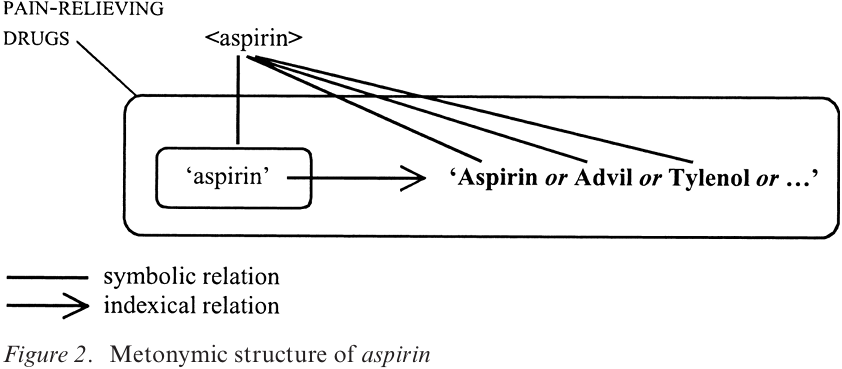
A case that, at first sight, seems to be based on a hyponymic relation between source and target is given by Radden and Kövecses (2006: 11).9 These authors posit a metonymy MEMBER OF A CATEGORY FOR THE CATEGORY that they claim accounts for uses of aspirin for ‘pain-relieving tablet’. Obviously, under one construal, the meaning of aspirin entails ‘pain-relieving tablet’.10 I agree with Radden and Kövecses that there is a real metonymy here, but it seems that it is not captured by the metonymic principle MEMBER OF A CATEGORY FOR THE CATEGORY.11 Notice first that the relation between the concepts ASPIRIN and PAIN-RELIEVER is not one of meaning elaboration, which I claim is a typical characteristic of metonymy, because the feature PAIN-RELIEVER is already a part of the definition of (one sense of) aspirin. The metonymic relation is between ASPIRIN and its co-hyponyms, i.e. other pain-relievers (including aspirin itself). The paraphrase given by Radden and Kövecses, viz. ‘any [italics mine, K.-U.P.] pain-relieving tablet’, is quite revealing in this respect. It amounts to saying ‘aspirin or any medication that has the same effect as aspirin’. In other words, what is evoked metonymically is not the superordinate category/class PAIN-RELIEVER, but, via co-hyponymic extension, any member of this category/class (see Figure 2 below).
That metonymy is a matter of contingence rather than conceptual necessity is also advocated by Carita Paradis. She contrasts sentences such as (5) with sentences of type (6) (Paradis 2004: 246):
(5) The red shirts won the match.
(6) The court had to assume that the statement of claim was true.
The noun phrase the red shirts in (5) metonymically indexes ‘the team wearing the red shirts’, but this target meaning is not entailed by the meaning of the linguistic vehicle. In (6), as Paradis points out, the intended target meaning is something like STAFF (i.e. the personnel working in the court), but this meaning is a facet of the overall meaning of court, the other three facets being ADMINISTRATIVE UNIT, BUILDING, and INTERIOR OUTFIT (251). According to Paradis, individual facets are entailed by the overall meaning of a lexical item. This might be too strong a statement, but it is certainly a default assumption (generalized conversational implicature in terms of Levinson 2000) that a court is staffed (with judges and other personnel). However, the same kind of connection does not obtain between the concepts ‘red shirts’ and ‘team wearing red shirts’. The difference between metonymy and facets, as has been pointed out by a number of linguists, is also reflected in grammatical structure. In the case of metonymy, it is usually the target meaning that, because of its conceptual prominence (highlighting), determines grammatical and/or distributional properties of a sentence, whereas a switch from one lexical facet to another within a sentence usually goes unnoticed and is not considered to be anomalous.
(7) I listened to some/*a Mozart last Sunday.
(8) The red shirts, who/*which delivered a great game last Saturday, have qualified for the Champions’ League.
(9) Put this heavy book back on the shelf; it is rather unreadable. (Cruse 2000: 114)
(10) The court, which is located on Russell Square, has ruled in Mary’s favor.
In (7), Mozart is metonymically interpreted as ‘music composed by Mozart’ and it is interpreted as an abstract SUBSTANCE that determines the choice of some over the determiner a, which requires a noun with the feature COUNTABLE. Thus the metonymic target determines the grammatical structure of the noun phrase some Mozart. Similarly, in (8) it is the conceptual nature of the target ‘team wearing red shirts’ that determines the selection of the relative pronoun who, excluding the choice of which. Sentences (9) and (10) are examples of facet shifting. Sentence (9) starts out with the reading of book as PHYSICAL OBJECT and, in the second clause, switches to the facet CONTENT. In (10), the overall meaning of court is first narrowed down to the facet BUILDING motivating the use of the relative pronoun which and then interpreted as STAFF (e.g. ‘judge’) under the influence of the verb form has ruled.
To summarize the main points, I have based my characterization of metonymy on the semiotic notion of indexicality. This is not necessarily incompatible with a definition of metonymy in terms of single domainhood, but it seems extremely difficult to establish criteria that would allow one to distinguish reliably between separate conceptual domains and single conceptual domains. In the case of (8) above, one can view red shirts as belonging to the domain of clothing, which is relatable to, but also separate from, the domain of humans (or the narrower domain of athletes). It is difficult to pin down the notions ‘single domain’ and ‘separate domains’ in a way that does not seem to be more or less ad hoc. Nevertheless these notions are considered by many scholars to be essential in telling metaphor apart from metonymy.
2. In saying that the source meaning of a metonymy is part of the target meaning, I do not claim that the target meaning necessarily entails or semantically includes the source meaning, although this possibility is not excluded.
3. Cognitive linguists have not contributed much to the elucidation of discourse functions of metonymy (i.e. metonymies in use or as “usage events”). Notable exceptions are Ruiz de Mendoza Ibáñez and Pérez Hernández (2003), who argue that metonymy is part of what is said (explicatures), and Barcelona (2003), who proposes an analysis of jokes and anecdotes in terms of metonymic inferences.
4. In Panther and Thornburg (1998), a distinction is made between ‘indexical’ (‘point-to’) relations and metonymic relations proper. In the former case, the relation between source and target is relatively loose (conceptually distant); in the latter it is relatively tight (conceptually close). The notion of conceptual distance between source and target is, I believe, a valid one; however, the terms ‘point-to’ or ‘indexical’ are somewhat misleading because they suggest that metonymy is not indexical. I assume that all of metonymic reasoning is indexical.
5. Peirce proposes the following definition for index: “ … what is an index, or true symptom? It is something which, without any rational necessitation, is forced by blind fact to correspond to its object.” (‘Telepathy’, CP 7.628, 1903) [Source: Bergman and Paavola 2003].
6. Francisco Ruiz de Mendoza (p.c.) argues that the assumption that metonymy is an indexical relation implies that metonymy is an exclusively referential phenomenon, which would contradict my claim that metonymy occurs on the predicational and illocutionary levels as well. I believe that this contradiction does not arise if one assumes that metonymy indexically relates concepts, not real-world objects or referents. I have not found any mention of metonymy in Peirce’s writings, but Peirce describes metaphor as an iconic relation (more precisely as a ‘hypoicon’) (see Buchler 1955: 105).
7. For the relevance of motivation in linguistics, see Radden and Panther (2004).
8. I would like to thank Francisco Ruiz de Mendoza for having pointed out to me (p.c.) that in Croft’s (2002) approach a metonymic shift involves shifting prominence from a primary domain to a secondary subdomain. For example, an intrinsic feature of Proust is that he is a person; a less central feature is his literary work. But it is exactly this latter feature that can be metonymically exploited to refer to ‘Proust’s work’ in sentences like Paul has read most of Proust (for a critique of Croft’s approach, see Ruiz de Mendoza Ibáñez 2000).
9. I refer here to the latest, as yet unpublished, revision of Radden and Kövecses’ (1999) seminal article.
10. Aspirin also has other medical applications, e.g. as a blood-thinner or a preventive medication for heart conditions. Thus aspirin belongs to other taxonomies as well.
11. It also seems that aspirin is not a member of the category of pain relievers, but rather it is a subcategory of the category of pain relievers. In terms of extension, the set of aspirin tablets is a proper subset of the set of pain relievers.








