Metonymy as a usage event
Some properties of metonymy
Primary metaphors
Lakoff and Johnson (1999: 45–73), who rely on e.g. Grady (1998), assume the existence of a set of metaphorical primitives that they call ‘primary metaphors’. Primary metaphors are supposedly based on experiential correlations, which are originally indistinguishable for the child and become only experientially and conceptually dissociated at a more advanced age. This dissociation is a prerequisite for their development into primary metaphors. Lakoff and Johnson (1999: 54–55) assume that a primary metaphor arises via a neurally instantiated correlation between (1) a sensorimotor operation […] and (2) subjective experiences or judgment […]. The conflation of these two is the simultaneous activation of their respective neural networks.
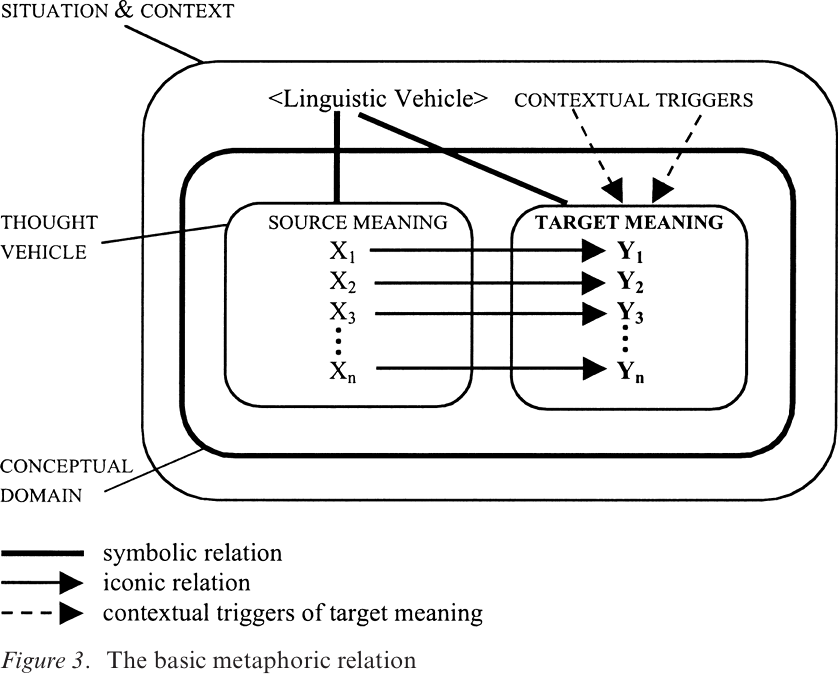
Examples given by Lakoff and Johnson for such primary metaphors are, among others, AFFECTION IS WARMTH, CLOSENESS IS INTIMACY, HAPPY IS UP, STATES ARE LOCATIONS, PURPOSES ARE DESTINATIONS, and KNOWING IS SEEING.1 I want to defend the idea that these correlations are first and foremost the experiential basis for conceptual metonymy, which, in turn, may become the basis for the construction of metaphors (see also Radden 2002, who develops a similar argument).
Let us consider the experiential correlation between CLOSENESS and INTIMACY in more detail. Given this correlation, it is not surprising, that people spontaneously infer that two people who are located close to each share a feeling of intimacy (of course, this is a cancelable inference). On the linguistic level this is reflected in utterances such as
(12) Mary and Peter sat close to each other and watched the sun set behind the mountains.
From (12) one might spontaneously infer that there is, temporarily at least, a relationship of intimacy between Mary and Peter. This inference is a piece of metonymic reasoning: Peter and Mary’s spatial position relative to each other is taken as an index of the intimate feelings they share. The metonymy involved may be called EFFECT FOR CAUSE. All of the properties of metonymy apply in this example: In particular, there is a tight experiential, and, on the cognitive level, conceptual, connection between source and target and the relation between closeness and intimacy is not necessary, i.e., it is in principle defeasible. One could easily say:
(13) Mary and Peter sat close to each other that evening, but that does not mean that they like each other.
In fact, in other situations, spatial closeness of two humans could also be an indication of aggression, intimidation, and the like.
It thus seems that, on the cognitive and semiotic level, the experiential correlation between closeness and intimacy is metonymic rather than metaphoric. What happens when spatial closeness does not apply, as in example (14)?
(14) Mary and Peter were/felt very close that evening, although she was in America and he was in Europe.
In (14), the source SPATIAL CLOSENESS of the two participants is not factual. This counterfactuality might be the reason why Lakoff and Johnson would assume that (14) is metaphoric rather than metonymic. In this case, there clearly is no CAUSE-EFFECT relationship between intimacy and spatial proximity, and one could therefore argue that the relationship must be metaphoric. However, the use of close in (14) is ultimately motivated by the world knowledge that CLOSENESS is a fairly reliable indicator of INTIMACY. In conclusion then, it appears that the experiential correlations observed by Grady, Lakoff and Johnson, and others, are the basis for metonymy before they are possibly used as metaphorical expressions.
Barcelona (2002: 234–236) discusses some aspects of this important issue with respect to such expressions as (15) and (16):
(15) She is in the pits.
(16) Mike is in low spirits.
Since Lakoff and Johnson’s book Metaphors We Live By (1980), cognitive linguists have been used to regarding these as metaphorical sentences based on the conceptual metaphor SAD IS DOWN. The rationale for viewing them as metaphors comes from the assumption that the dimension of verticality (UP VS. DOWN) constitutes a separate conceptual domain from the domains HAPPY and SAD, respectively. But the previous discussion should have made it abundantly clear that this assumption rests on shaky ground. Barcelona (2002: 235) notes quite rightly that, since expressions of sadness are often conveyed through linguistic vehicles that literally denote a vertical downward orientation or location, one could, contrary to Lakoff and Johnson, assume that the dimension VERTICALITY is part of the domain SADNESS. Utterances (10) and (11) would then have a metonymic basis. I believe that Barcelona’s conclusion is correct– perhaps not because the domain VERTICALITY is a subdomain of the domain SADNESS but because DOWN is experientially related to SAD– as evinced e.g. in drooping shoulders and down-turned corners of the mouth– and the former can therefore be used as a thought vehicle to indexically access the latter. There is thus a metonymic basis for these metaphors exemplified by (15) and (16) (see also Radden 2002: 414–416 for the same view).
1. As an aside, it should be noted that for some of these examples it is hard to see how they involve a correlation between a sensorimotor operation and subjective experience or judgment. For example, closeness, as a spatial relation, does not seem to be describable as a “sensorimotor operation”.








