0
settings
الوضع الليلي
moon
انماط الصفحة الرئيسية arrow
EN
1
المرجع الالكتروني للمعلوماتية

Grammar

Tenses

Present

Present Simple

Present Continuous

Present Perfect

Present Perfect Continuous

Past

Past Simple

Past Continuous

Past Perfect

Past Perfect Continuous

Future

Future Simple

Future Continuous

Future Perfect

Future Perfect Continuous

Parts Of Speech

Nouns

Countable and uncountable nouns

Verbal nouns

Singular and Plural nouns

Proper nouns

Nouns gender

Nouns definition

Concrete nouns

Abstract nouns

Common nouns

Collective nouns

Definition Of Nouns

Animate and Inanimate nouns

Nouns

Verbs

Stative and dynamic verbs

Finite and nonfinite verbs

To be verbs

Transitive and intransitive verbs

Auxiliary verbs

Modal verbs

Regular and irregular verbs

Action verbs

Verbs

Adverbs

Relative adverbs

Interrogative adverbs

Adverbs of time

Adverbs of place

Adverbs of reason

Adverbs of quantity

Adverbs of manner

Adverbs of frequency

Adverbs of affirmation

Adverbs

Adjectives

Quantitative adjective

Proper adjective

Possessive adjective

Numeral adjective

Interrogative adjective

Distributive adjective

Descriptive adjective

Demonstrative adjective

Pronouns

Subject pronoun

Relative pronoun

Reflexive pronoun

Reciprocal pronoun

Possessive pronoun

Personal pronoun

Interrogative pronoun

Indefinite pronoun

Emphatic pronoun

Distributive pronoun

Demonstrative pronoun

Pronouns

Pre Position

Preposition by function

Time preposition

Reason preposition

Possession preposition

Place preposition

Phrases preposition

Origin preposition

Measure preposition

Direction preposition

Contrast preposition

Agent preposition

Preposition by construction

Simple preposition

Phrase preposition

Double preposition

Compound preposition

prepositions

Conjunctions

Subordinating conjunction

Correlative conjunction

Coordinating conjunction

Conjunctive adverbs

conjunctions

Interjections

Express calling interjection

Phrases

Sentences

Clauses

Part of Speech

Grammar Rules

Passive and Active

Preference

Requests and offers

wishes

Be used to

Some and any

Could have done

Describing people

Giving advices

Possession

Comparative and superlative

Giving Reason

Making Suggestions

Apologizing

Forming questions

Since and for

Directions

Obligation

Adverbials

invitation

Articles

Imaginary condition

Zero conditional

First conditional

Second conditional

Third conditional

Reported speech

Demonstratives

Determiners

Direct and Indirect speech

Linguistics

Phonetics

Phonology

Linguistics fields

Syntax

Morphology

Semantics

pragmatics

History

Writing

Grammar

Phonetics and Phonology

Semiotics

Applied Linguistics

Reading Comprehension

Elementary

Intermediate

Advanced

Teaching Methods

Teaching Strategies

Assessment

قم بتسجيل الدخول اولاً لكي يتسنى لك الاعجاب والتعليق.

Metonymy as a usage event Metonymy as usage events: two case studies Red hot doorbuster

المؤلف:  Klaus-Uwe Panther

المصدر:  Cognitive Linguistics: Current Applications and Future Perspectives

الجزء والصفحة:  P172-C1

2026-11-16

20

+

-

20

Metonymy as a usage event

Metonymy as usage events: two case studies

Red hot doorbuster

As a second case study, I discuss in some detail the expression red hot doorbusters found in the advertising section of a local American newspaper (see Photo 1 below). This expression exhibits a much more complex conceptual structure than the expression Pearl Harbor. There is not only metonymy involved in this case but metaphor as well. The importance of context in the interpretation of a fully specified meaning and the role of metonymy and metaphor as guiding conceptual principles towards a specific interpretation is demonstrated.


A photograph of the advertisement is found below.1 For heuristic reasons I assume a language user who is not familiar with the word door-buster, i.e. encounters the term for the first time, but recognizes the word as containing the free morphemes door (noun), bust (verb), and the derivational morpheme-er, which has been shown to exhibit a high degree of polysemy (see Panther and Thornburg 2001, 2002) (see Photo 1 below).


What kind of information would help a reader who is not familiar with the expression doorbuster to work out the intended meaning ‘extremely low prices for desirable products sold for a limited time’ or ‘desirable products at extremely low prices for a limited sales period’? The interpretative work of the reader is first of all facilitated by the linguistic context, in particular what follows the expression red hot doorbusters. The noun phrase these specials has as its coreferential antecedent red hot door-busters. The term special is well entrenched in English and is found in ordinary dictionaries with the meaning ‘a lower price than usual for a particular product for a short period of time’ (Longman Dictionary of Contemporary English, 2003) (LDCE), s.v. special). It is actually, for all practical purposes, synonymous with the expression red hot doorbuster. Moreover, the restricted time period of the sale is redundantly conveyed by the verb phrase won’t last long.
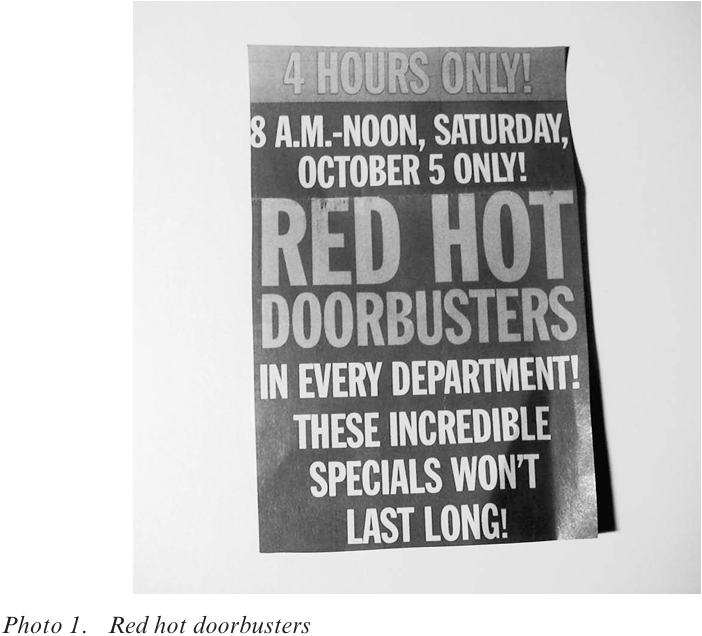


In what follows, I analyze the meanings of red hot and doorbusters. In Red hot, some reflections on the conceptual structure of red hot; In (Red hot) doorbuster, analyzes this meaning in conjunction with the metonymic and metaphoric structure of doorbusters.


1. By necessity Photo 1 is in black and white. In the original ad the words “red hot doorbusters” are in orange against a red field; the words “4 hours only!” are against a blue field.


اخر الاخبار

اشترك بقناتنا على التلجرام ليصلك كل ما هو جديد

