Metonymy as a usage event
Metonymy as usage events: two case studies
Red hot doorbuster
Red hot
The adjectival expression red hot is a well-entrenched lexical item. It has at its syntactic head hot, which is modified by red. The compound expression is literally applied to objects or substances such as poker, metal, and rock. The attribute red denotes the effect of extreme heat; a red-hot object or substance exhibits a glowing or shining red color. However, the meaning component SHINY RED often gives way to the meaning VERY HOT, i.e. ‘extremely high on the heat scale’ in utterances like Be careful with these plates– they’re red hot (LDCE). The target meaning of red hot as a modifier of doorbusters is– to put things simply– something like ‘very desirable’. I contend that this meaning comes about through metonymic elaboration of the source meaning and metaphoric mapping. First, the metonymic elaboration in the source domain is an inference from the modifier red to an intensifying meaning ‘very, highly, extremely’, i.e. an endpoint on a scale of intensity. If something is red hot (visual stimulus), then it is easily inferred to be very hot. Second, red hot also suggests, e.g. in the context of iron poker, a high degree of salience in terms of visibility. These two metonymically derived meaning components are then metaphorically mapped onto the conceptual entities VERY DESIRABLE and HIGLY SALIENT ON PRICE SCALE, a meaning component that is reinforced by doorbuster. The latter actually narrows down HIGHLY SALIENT ON THE PRICE SCALE to the LOW END OF THE PRICE SCALE, i.e. ‘inexpensive’ and ‘affordable’.
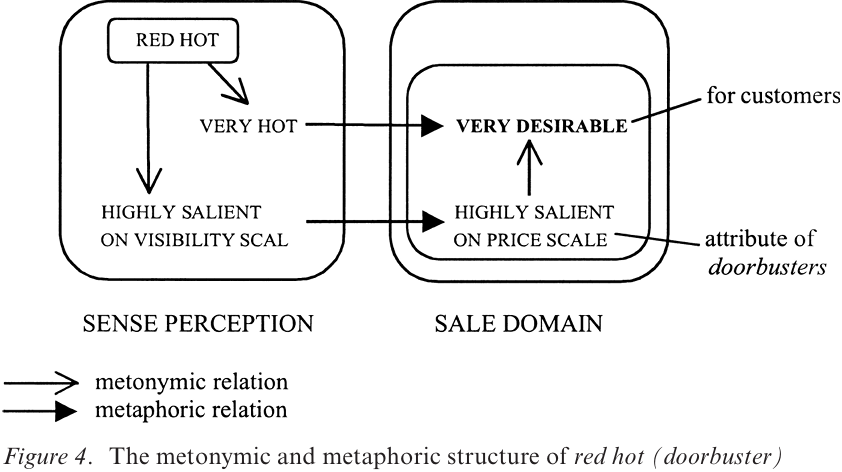
The conceptual structure of red hot (doorbusters) is diagrammed in Figure 4. At the most general level, there is a metaphoric mapping from the domain of SENSE PERCEPTION to the SALE domain. Both the source and the target domain are inferentially elaborated; it is worth noting that the target domain contains a metonymic inference from CAUSE to EFFECT: the desirability of the sale object is caused by the highly salient feature LOW PRICE.
The EFFECT FOR CAUSE metonymy is necessary in order to reconcile the (target) meanings of red hot ‘very exciting’ and doorbusters ‘cheap prices for products temporarily on sale’. Cheap prices are not intrinsically “exciting”; they are meant to cause excitement in the customer. Thus door-buster has an impact on the conceptual structure of the target domain of its modifier red hot.
From a different perspective, which integrates the notion of scale (left implicit in Figure 4), the figurative meaning of red hot as a modifier of doorbuster can be represented as relating three scales: a heat scale (in the source domain), a desirability scale and a price scale, the latter two inversely and causally related to each other in the target domain.1 These scales focus on endpoints. In the source domain, the modifier red metonymically intensifies the degree of heat encoded in hot. The heat scale is metaphorically mapped onto a desirability scale in the target domain. High heat corresponds to high desirability. The base desire in desirability is here understood as denoting not only a propositional attitude, but also, in the context of frantic consumerism, a strong emotion. Temperature words are quite systematically used in English and other languages to describe emotional states; there is thus a generic metaphor (which itself might be metonymically motivated) for the use of red hot. In the target domain, as already noted, there is a remarkable inverse relationship between the desirability scale and the price scale. A high value on the desirability scale corresponds to a low value on the price scale, and vice versa. Moreover, as previously mentioned, the two scales are causally related: desirability is (at least partially) caused by the reduced cost of the sales item and thus a strong incentive for customers to buy a product. This inverse (causal) relationship is indicated by a dotted arrow in Figure 5 (see Red hot doorbuster ,(Red hot) doorbuster).
1. This alternative analysis as well as Figures 5 and 6 were developed with Linda Thornburg. Much of Red hot doorbuster would not have been possible without her competence as a native speaker of English and her expertise as a linguist. I am grateful to her for inspiring ideas during the writing of this article.








