Conceptual blending in thought, rhetoric, and ideology
Conceptual blending
Conceptual blending theory offers a general model of meaning construction in which a small set of partially compositional processes operate in analogy, metaphor, counterfactuals, and many other semantic and pragmatic phenomena (Coulson and Oakley 2000, 2006; Fauconnier and Turner 1998, 2002). In this theory, understanding meaning involves the construction of blended cognitive models that include some structure from multiple input models, as well as emergent structure that arises through the processes of blending. Discussed at length in Fauconnier and Turner (2002), blending theory describes a set of principles for combining dynamic cognitive models in a network of mental spaces (Fauconnier 1994), or partitions of speakers’ referential representations.
Mental spaces contain partial representations of the entities and relationships in any given scenario as perceived, imagined, remembered, or otherwise understood by a speaker. Mental spaces (Fauconnier 1994) can be thought of as temporary containers for relevant information about a particular domain. Spaces are structured by elements that represent each of the discourse entities, and simple frames to represent the relationships that exist between them. Frames are hierarchically structured attribute-value pairs that can either be integrated with perceptual information, or used to activate generic knowledge about people and objects assumed by default. Cultural models are a special kind of frame that deals with socially relevant topics. Finally, mappings are abstract correspondences between elements and relations in different spaces. For example, in a tale about the life of a butterfly, we might have one mental space to represent a time in the past, and one for the present. We could then posit two elements, b in the Past Space, and b’ in the Present Space. Elements b and b’ would be linked via an identity mapping to represent the fact that they are the same individual. However, the properties of the Past b would be those of a caterpillar, while the properties of Present b’ would be those of a butterfly.
A development of mental space theory, conceptual blending is intended to account for cases in which the content of two or more mental spaces is combined to yield novel inferences. Central to conceptual blending theory is the notion of the conceptual integration network, an array of mental spaces in which the processes of conceptual blending unfold. These networks consist of two or more input spaces structured by information from discrete cognitive domains, a generic space that contains structure common to the inputs, and a blended space that contains selected aspects of structure from each input space along with any emergent structure that arises out of the imaginative processes of blending. The first process is called composition, and involves the juxtaposition of information from different spaces; completion, as in pattern completion, occurs when part of a cognitive model is activated and results in the activation of the rest of the frame. Finally, elaboration is an extended version of completion that results from mental simulation, or various sorts of physical and social interaction with the world as construed with blended concepts.
Blending involves the activation of cognitive models in integration networks, the establishment of partial mappings between models in the network’s different spaces, and the projection of conceptual structure from space to space. Take, for example, the blended concept of a “snowflake kid”, as described in a BreakPoint Online article, published on a pro-life Christian association’s website (Morse 2005). Snowflake kids are children conceived through in vitro fertilization and subsequently implanted in unrelated “adoptive” mothers with the help of organizations such as the Snowflake Frozen Embryo Adoption agency. This agency allows infertile couples the opportunity to be implanted with embryos leftover from fertility clinics, and serves to rebut the case of biologists who advocate the use of such embryos for scientific research. Debate over the legitimacy of research with human embryos is quite fierce in the United States due to a lack of consensus over their moral status.
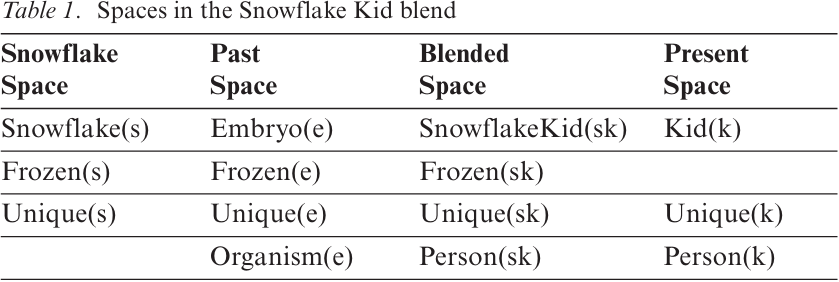
As described by Coulson and Pascual (2006), the “snowflake kid” concept is a blend with three input spaces, the domain of snowflakes, the past, and the present. Each column in the table below shows the information represented in a mental space in the integration network for “snowflake kid”. Corresponding predicates and arguments are listed in the same row, and a blank cell in the table represents the absence of a mapping (see also Broccias, this volume)1. The snowflake s in the Snowflake Space is linked to the embryo e in the Past Space via an analogy mapping, in that both are easily construed as being frozen as well as unique. Further, e in the Past Space is linked to the kid k in the Present Space by identity. The cognitive model in the blended space derives some of its structure from each of the input spaces.
Part of the rhetorical efficacy of this blend derives from compression. Compression is an operation in blending theory by which relationships that obtain between spaces are understood in a single mental model (Fauconnier and Turner 2002). For example, one might use two mental spaces to represent the different properties of an individual at two different points in time, such as that of the caterpillar and butterfly discussed above. Compression is used to construe the situation in a single cognitive model in a blended space. In the snowflake kid blend, for example, the mapping between the embryo e in the Past Space and the Kid k in the Present Space are compressed in the blend as the two different developmental stages are conflated.
The compression of embryo and child into a single entity in the Blended Space facilitates the application of certain frames that might otherwise be marked due to the ambiguous moral properties of embryos. For example, whereas the personhood of the embryo element in the Past Space is the subject of controversy between two ideological camps, the snowflake kid in the Blended Space is unambiguously a person, having inherited this property from the Present Space. Consequently, the embryo-kid blend affords the possibility of evoking frames (such as murder) whose application in the Past Space is controversial but whose application in the Blended Space is less so due to properties the embryonic snowflake kid has inherited from the kid in the Present Space.
Moreover, at least as described on the BreakPoint website, “Snowflake Kid” does not simply exploit the access principle in mental space theory (Fauconnier 1994), whereby an element in one mental space, i.e. the embryo in the Past Space, is described with language indisputably applicable in another, i.e. the kid in the Present Space. A snowflake kid differs from a normal kid in being frozen and in being extremely small. Further, the framing of a snowflake kid differs quite a bit from the scientific treatment of the microscopic embryos used in scientific research. For example, Morse (2005) describes the embryos as “tiny humans … stored in liquid nitrogen tanks,” and refers to genetically related frozen embryos as “siblings” who “remain in these frozen orphanages.”
1. Note that there is no particular theoretical significance to the use of tables as opposed to circles (as in Fauconnier and Turner 2002) to outline conceptual integration networks. They are notational variants. Many people find tables easier to produce and comprehend, however.








