









Grammar
Tenses
Present

Present Simple
Present Continuous
Present Perfect
Present Perfect Continuous
Past
Past Simple
Past Continuous
Past Perfect
Past Perfect Continuous
Future
Future Simple
Future Continuous
Future Perfect
Future Perfect Continuous
Parts Of Speech
Nouns
Countable and uncountable nouns
Verbal nouns
Singular and Plural nouns
Proper nouns
Nouns gender
Nouns definition
Concrete nouns
Abstract nouns
Common nouns
Collective nouns
Definition Of Nouns
Animate and Inanimate nouns
Nouns
Verbs
Stative and dynamic verbs
Finite and nonfinite verbs
To be verbs
Transitive and intransitive verbs
Auxiliary verbs
Modal verbs
Regular and irregular verbs
Action verbs
Verbs
Adverbs
Relative adverbs
Interrogative adverbs
Adverbs of time
Adverbs of place
Adverbs of reason
Adverbs of quantity
Adverbs of manner
Adverbs of frequency
Adverbs of affirmation
Adverbs
Adjectives
Quantitative adjective
Proper adjective
Possessive adjective
Numeral adjective
Interrogative adjective
Distributive adjective
Descriptive adjective
Demonstrative adjective
Pronouns
Subject pronoun
Relative pronoun
Reflexive pronoun
Reciprocal pronoun
Possessive pronoun
Personal pronoun
Interrogative pronoun
Indefinite pronoun
Emphatic pronoun
Distributive pronoun
Demonstrative pronoun
Pronouns
Pre Position
Preposition by function
Time preposition
Reason preposition
Possession preposition
Place preposition
Phrases preposition
Origin preposition
Measure preposition
Direction preposition
Contrast preposition
Agent preposition
Preposition by construction
Simple preposition
Phrase preposition
Double preposition
Compound preposition
prepositions
Conjunctions
Subordinating conjunction
Correlative conjunction
Coordinating conjunction
Conjunctive adverbs
conjunctions
Interjections
Express calling interjection
Phrases
Sentences
Clauses
Part of Speech
Grammar Rules
Passive and Active
Preference
Requests and offers
wishes
Be used to
Some and any
Could have done
Describing people
Giving advices
Possession
Comparative and superlative
Giving Reason
Making Suggestions
Apologizing
Forming questions
Since and for
Directions
Obligation
Adverbials
invitation
Articles
Imaginary condition
Zero conditional
First conditional
Second conditional
Third conditional
Reported speech
Demonstratives
Determiners
Direct and Indirect speech
Linguistics
Phonetics
Phonology
Linguistics fields
Syntax
Morphology
Semantics
pragmatics
History
Writing
Grammar
Phonetics and Phonology
Semiotics
Reading Comprehension
Elementary
Intermediate
Advanced
Teaching Methods
Teaching Strategies
Assessment

Embedding, iteration, and succession
 المؤلف:
Bernd Heine and Tania Kuteva
المؤلف:
Bernd Heine and Tania Kuteva
 المصدر:
The Genesis of Grammar
المصدر:
The Genesis of Grammar
 الجزء والصفحة:
P270-C6
الجزء والصفحة:
P270-C6
 2026-03-20
 289
289




+
-
20
Embedding, iteration, and succession
As we noted above, embedding recursion ((7a) = (1b)) is not the only recursive mechanism responsible for discrete infinity in language use; there are two additional mechanisms corresponding to our definition of recursion in (1a), namely iteration (7b) and succession (7c).
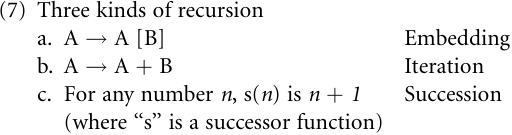
Iteration may take various forms; most commonly it is additive (‘A and B’) or alternative (‘A or B’). Its status vis-à-vis embedding recursion is unclear. The main positions surfacing from the literature are that iteration (a) is an instance of recursion on the same level as embedding recursion; (b) is a special instance of embedding recursion; or else (c) that the two are mutually exclusive mechanisms. The fourth possibility, namely that embedding recursion is included in iteration, does not seem to have found any noticeable support (but see Davidson 2004). In much of the literature on this subject it does not become clear which of these alternatives is implied, and quite a number of authors use the term recursion indiscriminately for both mechanisms.1 There are reasons for doing so: Both are generative in nature and, hence, both may lead to discrete infinity, and many manifestations of embedding recursion can also be framed in terms of models based on iteration.
At the same time there are also reasons to keep the two apart. First, their effect on language structure is different: Embedding recursion results in conceptual and linguistic subordination or hierarchy, while iteration leads to coordination (or conjunction). Second, there are recursive structures (e.g. center-embedding) that cannot be handled appropriately by iteration models. And third, the two also differ in the range of linguistic phenomena they are associated with. For example, iteration is not restricted to the noun phrase or the clause; it is also a productive mechanism of the verb phrase (e.g. He came in, sat down, took the newspaper, and...), and it is a grammaticalized characteristic of serial verb constructions.
Succession is the kind of recursion that underlies numerosity; thus, (7c) generates units such as the following: s(4) = 5, s(5) = 6,forexample1 + 4 = 5, 1 + 5 = 6, etc. The ontological status of succession and, more generally, of numerical cognition is far from clear (see below).
The only reason for reducing the term recursion to embedding recursion is that this is the use that is commonly implied in discussions on language evolution.
1 For Dougherty (2004), for example, recursion includes coordination, subordination, and embedding, and Goldin-Meadow (1982: 54) defines recursion in a way that is not uncommon in linguistics: ‘‘Recursion provides a language user with the means for expressing more than one proposition in a single sentence.’’
 الاكثر قراءة في Linguistics fields
 اخر الاخبار
اخبار العتبة العباسية المقدسة

الآخبار الصحية


مواضيع ذات صلة
 قسم الشؤون الفكرية يصدر كتاباً يوثق تاريخ السدانة في العتبة العباسية المقدسة
 "المهمة".. إصدار قصصي يوثّق القصص الفائزة في مسابقة فتوى الدفاع المقدسة للقصة القصيرة
 (نوافذ).. إصدار أدبي يوثق القصص الفائزة في مسابقة الإمام العسكري (عليه السلام)






