Linearity issues
The validity of the Beer–Lambert law should be established for each drug under the measure ment conditions to be used over an appropriate concentration range. For single-beam instruments, the absorbance range for precise measure ments is between about 0.3 and 0.6 absorbance units, the optimum being at 0.43 absorbance units. For double-beam spectrophotometers, the optimum range lies between 0.6 and 1.2 absorbance units. Five or more standard solutions, with absorbances that span the working range, should be measured in duplicate in a matched pair of cells against the solvent as reference; the residual absorbance difference between the cells when filled with solvent (the cell constant) should be subtracted from each individual measurement and checked regularly.
The linearity of an analytical method is determined by mathematical treatment of the absorbance data of the standard solutions across the claimed range of the method. The treatment is normally a calculation of a regression line y ax b, with y being the absorbance and x the concentration, by the method of least squares. The linearity is usually expressed by means of a correlation coefficient r, where:
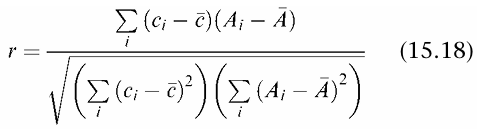
for all n points with i from unity to n. When r=1, there is a perfect correlation. Usually, r values better than 0.995 can be obtained.
The intercept should not differ significantly from zero. If a significant non-zero intercept is obtained, it should be demonstrated that there is no effect on the accuracy of the method. Linearity should be evaluated graphically in addition to or alternatively to a mathematical evaluation. The evaluation is made by visual inspection of a plot of absorbance A as a function of analyte concentration c. If any systematic positive or negative deviation is found, additional points should be inserted and the linear working range established.








