Pharmacology of drugs in saliva
Cocaine
Cocaine parent drug is the major analyte found in saliva after cocaine use (DiGregorio et al. 1992). In unstimulated saliva, cocaine is ion trapped in saliva and the saliva: plasma ratio may be 5 or greater (Schramm 1993; Schramm et al. 1993). In stimulated saliva, the saliva: plasma ratio ranges from 0.5 to 3.0 (Cone and Menchen, 1988; Cone and Weddington 1989; Jenkins et al. 1995; Cone et al. 1997). Cocaine appears in saliva immediately after drug admin istration by intravenous injection (Fenko et al. 1990). Benzoylecgonine and ecgonine methyl ester appear in saliva within 15 minutes of cocaine administration and are found in saliva at concentrations similar to those found in blood. Schramm et al. (1993) reported a saliva: plasma ratio of approximately 2.5 for benzoylecgonine. Jenkins et al. (1995) reported saliva: plasma ratios for benzoylecgonine that ranged from 0.02 to 0.66. Norcocaine and para-hydroxycocaines may be found in saliva after cocaine administration. Jufer et al. (2000) reported a saliva: plasma ratio of 8.7 (range 3.8–13.2) for cocaine, 3.7 (2.3–5.1) for ecgonine methyl ester, 0.4 (0.3–0.5) for benzoylecgonine, 10.3 (5.6–13.6) for norcocaine and 6.1 (2.4–10.8) for para-hydroxy cocaine. Cocaethylene is found in saliva when ethanol is ingested concurrently with cocaine. In a rat model, Barbieri et al. (1994) reported a saliva: plasma ratio of 1.3 for cocaethylene after cocaethylene administration. Jenkins et al. (1995) reported that the pyrolysis product of cocaine, AEME, was detected in oral fluid collected after smoking of cocaine, but not in plasma. Thompson et al. (1987) reported that cocaine was found in saliva immediately after intra venous doses of cocaine and that saliva and plasma cocaine concentrations paralleled each other. Saliva cocaine concentrations correlated with the physiological and behavioural effects of the drug. Cocaine saliva: plasma ratios ranged from 0.36 to 9.74. Cone and Weddington (1989) reported detection of cocaine equivalents by immunoassay for 5–10 days after abstinence in heavy cocaine addicts and GC-MS confirmation for 1–2 days. In a more recent study of cocaine and metabolite elimination patterns, Moolchan et al. (2000) measured cocaine, benzoylecgonine and ecgonine methyl ester in saliva of admitted cocaine abusers for 12 hours. In the later specimens, metabolites predominated, as is consistent with their longer half-lives in the body. Saliva terminal half-lives were 7.9h for cocaine, 9.2h for benzoylecgonine and 10h for ecgonine methyl ester. Cone et al. (1988) reported the correlation of saliva and plasma cocaine concentrations after intravenous cocaine administration with an average half-life of cocaine of 34.7 min in saliva and 34.9min in plasma. Jenkins et al. (1995) reported a detection time for cocaine in saliva of up to 8 hours after intravenous injection and 12 hours after smoking cocaine. Cone et al. (1997) reported mean detection times of cocaine in saliva of 3.92 hours after intravenous administration, 5.67 hours after insufflation and 3.17 hours after smoking cocaine. Jenkins et al. (1995) followed cocaine and metabolites in saliva after smoking and intra venous administration of cocaine. They showed that after smoking, cocaine and pyrolysis products of cocaine persisted in saliva for up to 6 hours. Cone et al. (1997) compared cocaine appearance in saliva after intravenous, intranasal and smoked administration and found that both the intranasal and smoking routes produced elevated saliva: plasma ratios of cocaine.
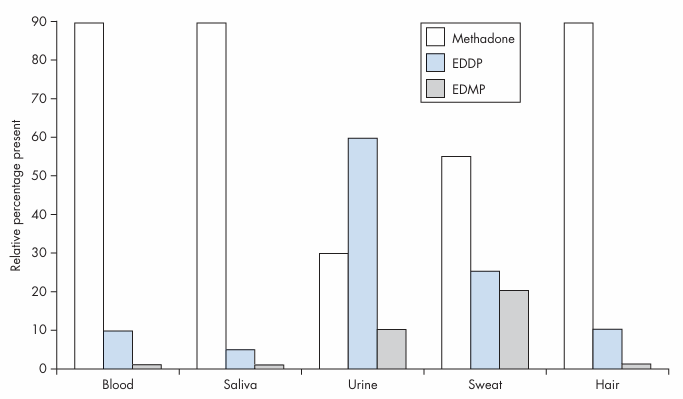
Figure 1 Metabolic profile of methadone in blood, saliva, urine, sweat and hair (EDDP, 3-ethylidene-1,5-dimethyl 3,3-diphenylpyrrolidine; EDMP, 2-ethyl-5-methyl-3,3-diphenylpyrroline).








