







Grammar
Tenses
Present

Present Simple
Present Continuous
Present Perfect
Present Perfect Continuous
Past
Past Simple
Past Continuous
Past Perfect
Past Perfect Continuous
Future
Future Simple
Future Continuous
Future Perfect
Future Perfect Continuous
Parts Of Speech
Nouns
Countable and uncountable nouns
Verbal nouns
Singular and Plural nouns
Proper nouns
Nouns gender
Nouns definition
Concrete nouns
Abstract nouns
Common nouns
Collective nouns
Definition Of Nouns
Animate and Inanimate nouns
Nouns
Verbs
Stative and dynamic verbs
Finite and nonfinite verbs
To be verbs
Transitive and intransitive verbs
Auxiliary verbs
Modal verbs
Regular and irregular verbs
Action verbs
Verbs
Adverbs
Relative adverbs
Interrogative adverbs
Adverbs of time
Adverbs of place
Adverbs of reason
Adverbs of quantity
Adverbs of manner
Adverbs of frequency
Adverbs of affirmation
Adverbs
Adjectives
Quantitative adjective
Proper adjective
Possessive adjective
Numeral adjective
Interrogative adjective
Distributive adjective
Descriptive adjective
Demonstrative adjective
Pronouns
Subject pronoun
Relative pronoun
Reflexive pronoun
Reciprocal pronoun
Possessive pronoun
Personal pronoun
Interrogative pronoun
Indefinite pronoun
Emphatic pronoun
Distributive pronoun
Demonstrative pronoun
Pronouns
Pre Position
Preposition by function
Time preposition
Reason preposition
Possession preposition
Place preposition
Phrases preposition
Origin preposition
Measure preposition
Direction preposition
Contrast preposition
Agent preposition
Preposition by construction
Simple preposition
Phrase preposition
Double preposition
Compound preposition
prepositions
Conjunctions
Subordinating conjunction
Correlative conjunction
Coordinating conjunction
Conjunctive adverbs
conjunctions
Interjections
Express calling interjection
Phrases
Sentences
Clauses
Part of Speech
Grammar Rules
Passive and Active
Preference
Requests and offers
wishes
Be used to
Some and any
Could have done
Describing people
Giving advices
Possession
Comparative and superlative
Giving Reason
Making Suggestions
Apologizing
Forming questions
Since and for
Directions
Obligation
Adverbials
invitation
Articles
Imaginary condition
Zero conditional
First conditional
Second conditional
Third conditional
Reported speech
Demonstratives
Determiners
Direct and Indirect speech
Linguistics
Phonetics
Phonology
Linguistics fields
Syntax
Morphology
Semantics
pragmatics
History
Writing
Grammar
Phonetics and Phonology
Semiotics
Reading Comprehension
Elementary
Intermediate
Advanced
Teaching Methods
Teaching Strategies
Assessment


MATERIAL PROCESSES OF DOING AND HAPPENING FORCE
 المؤلف:
Angela Downing
المؤلف:
Angela Downing
 المصدر:
ENGLISH GRAMMAR A UNIVERSITY COURSE
المصدر:
ENGLISH GRAMMAR A UNIVERSITY COURSE
 الجزء والصفحة:
P162-C5
الجزء والصفحة:
P162-C5
 2026-05-20
 38
38




+
-
20
MATERIAL PROCESSES OF DOING AND HAPPENING
FORCE
The notion of agency is a complex one, which includes such features as animacy, intention, motivation, responsibility and the use of one’s own energy to initiate or control a process. In central instances, all these features will be present. In non-central instances, one or more of these features may be absent. If we say, for example, that the horse splashed us with mud as it passed we do not imply that the horse did so deliberately. We do not attribute intentionality or responsibility or motivation to the horse in this situation. We might call it an ‘unwitting Agent’.
The higher animals, and especially pets, are often treated grammatically as if they were humans. Nevertheless, rather than devise a different term for every sub-type of agency we will make just one further distinction: that between animate and inanimate Agents. This is useful in order to account for such natural phenomena as earthquakes, lightning, electricity, avalanches, the wind, tides and floods, which may affect humans and their possessions. They are inanimate, and their power or energy cannot therefore be intentional. They can instigate a process but not control it. This non-controlling entity we call Force; it will include such psychological states as anxiety, fear or joy.
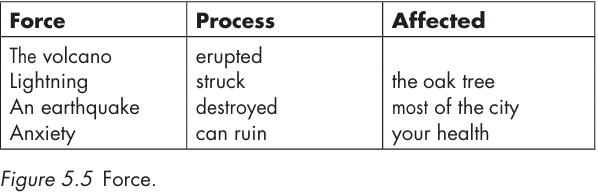
In the following description, the subject in italics realizes the role of Force and most of the verbs encode material processes:
The cold crept in from the corners of the shanty, closer and closer to the stove. Icy-cold breezes sucked and fluttered the curtains around the beds. The little shanty quivered in the storm. But the steamy smell of boiling beans was good and it seemed to make the air warmer.
(Laura Ingalls Wilder, The Long Winter)
 0
0
 0
0
 الاكثر قراءة في Linguistics fields
 اخر الاخبار
اخبار العتبة العباسية المقدسة

الآخبار الصحية


مواضيع ذات صلة
 قسم الشؤون الفكرية يصدر كتاباً يوثق تاريخ السدانة في العتبة العباسية المقدسة
 "المهمة".. إصدار قصصي يوثّق القصص الفائزة في مسابقة فتوى الدفاع المقدسة للقصة القصيرة
 (نوافذ).. إصدار أدبي يوثق القصص الفائزة في مسابقة الإمام العسكري (عليه السلام)






