









Grammar
Tenses
Present

Present Simple
Present Continuous
Present Perfect
Present Perfect Continuous
Past
Past Simple
Past Continuous
Past Perfect
Past Perfect Continuous
Future
Future Simple
Future Continuous
Future Perfect
Future Perfect Continuous
Parts Of Speech
Nouns
Countable and uncountable nouns
Verbal nouns
Singular and Plural nouns
Proper nouns
Nouns gender
Nouns definition
Concrete nouns
Abstract nouns
Common nouns
Collective nouns
Definition Of Nouns
Animate and Inanimate nouns
Nouns
Verbs
Stative and dynamic verbs
Finite and nonfinite verbs
To be verbs
Transitive and intransitive verbs
Auxiliary verbs
Modal verbs
Regular and irregular verbs
Action verbs
Verbs
Adverbs
Relative adverbs
Interrogative adverbs
Adverbs of time
Adverbs of place
Adverbs of reason
Adverbs of quantity
Adverbs of manner
Adverbs of frequency
Adverbs of affirmation
Adverbs
Adjectives
Quantitative adjective
Proper adjective
Possessive adjective
Numeral adjective
Interrogative adjective
Distributive adjective
Descriptive adjective
Demonstrative adjective
Pronouns
Subject pronoun
Relative pronoun
Reflexive pronoun
Reciprocal pronoun
Possessive pronoun
Personal pronoun
Interrogative pronoun
Indefinite pronoun
Emphatic pronoun
Distributive pronoun
Demonstrative pronoun
Pronouns
Pre Position
Preposition by function
Time preposition
Reason preposition
Possession preposition
Place preposition
Phrases preposition
Origin preposition
Measure preposition
Direction preposition
Contrast preposition
Agent preposition
Preposition by construction
Simple preposition
Phrase preposition
Double preposition
Compound preposition
prepositions
Conjunctions
Subordinating conjunction
Correlative conjunction
Coordinating conjunction
Conjunctive adverbs
conjunctions
Interjections
Express calling interjection
Phrases
Sentences
Clauses
Part of Speech
Grammar Rules
Passive and Active
Preference
Requests and offers
wishes
Be used to
Some and any
Could have done
Describing people
Giving advices
Possession
Comparative and superlative
Giving Reason
Making Suggestions
Apologizing
Forming questions
Since and for
Directions
Obligation
Adverbials
invitation
Articles
Imaginary condition
Zero conditional
First conditional
Second conditional
Third conditional
Reported speech
Demonstratives
Determiners
Direct and Indirect speech
Linguistics
Phonetics
Phonology
Linguistics fields
Syntax
Morphology
Semantics
pragmatics
History
Writing
Grammar
Phonetics and Phonology
Semiotics
Reading Comprehension
Elementary
Intermediate
Advanced
Teaching Methods
Teaching Strategies
Assessment

Grammatical evolution Layers
 المؤلف:
Bernd Heine and Tania Kuteva
المؤلف:
Bernd Heine and Tania Kuteva
 المصدر:
The Genesis of Grammar
المصدر:
The Genesis of Grammar
 الجزء والصفحة:
P298-C7
الجزء والصفحة:
P298-C7
 2026-03-25
 340
340




+
-
20
Grammatical evolution
The reconstructions were meant to provide a general outline of grammatical evolution, and to this end we discussed a network of pathways of grammaticalization. We wish to explore what this network can tell us about language evolution.
Grammatical evolution
Layers
The pathways were described in terms of a sequence of six layers of evolution, which are reproduced in Table 7.1. In this table, we also propose a scenario of grammatical innovations on the basis of the structural properties characterizing the various layers.
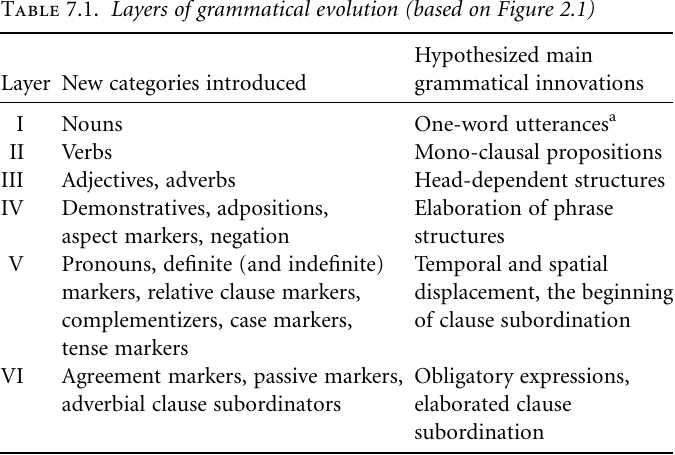
a That we hypothesize that at layer I there were one-word utterances can by no means be taken to lend support to the ‘‘holistic hypothesis’’ that we mentioned in “The present approach”: There is neither evidence to suggest that such utterances would have been semantically complex, nor that they were of a kind that would have allowed for a segmentation process whereby complex but unanalyzable signals were broken down into words and syntactic structures.
The only parameter we used for distinguishing these layers was the relative degree of grammaticalization that a given category exhibits vis-à-vis less or more strongly grammaticalized categories of the same overall pathway. To determine the exact diachronic significance of these layers is a matter of future research. One problem such research will face is that grammaticalization proceeds at different paces in different domains of grammar and/or in different languages. This may mean, for example, that a given category can be more strongly grammaticalized in domain D1 or in language L1 than another category in domain D2 or language L2 although it belongs to a less grammaticalized layer than the latter category. The classification that we present in Table 7.1 therefore has to be taken with care.
Another problem concerns the internal nature of layers, as can be illustrated by the following example. The categories discussed under layer V include definite markers and case markers. More recent research (König forthc.) has shown that there is a pathway from definite markers (sometimes in combination with some other marker) to case markers, most of all to subject or ergative case markers. This pathway appears to be unidirectional; there is no evidence suggesting a development from case morpheme to definite article. Furthermore, as we showed in “Clause subordination Expansion”, there is a unidirectional pathway from case markers to complementizers, even though both are hypothesized to belong to layer V. Such examples suggest that the internal structure of the various layers is more complex than portrayed here, in that not all pathways making up a layer necessarily exhibit the same relative degree of grammaticalization. However, the layers that have been distinguished are impressively supported by some body of crosslinguistic data and we will now use them to formulate some tentative hypotheses on the development from early language to modern languages.
Layer I On the basis of the reconstructions proposed in “Nouns and verbs” we assume that at layer I there was only one kind of category, namely ‘‘nouns’’, that is, time-stable, referential units expressing primarily thing-like con cepts.1 Assuming that this reflects a significant stage in the evolution of language this implies that language structure at this stage was associated with one-word utterances (see below), conceivably also with sequences of such utterances.2
Bickerton (2005: 7) asserts that ‘‘a verbless protolanguage seems intrinsically implausible.’’ One may wonder whether this is a credible position. That it is possible to establish communication by means of one-word utterances without verbs is suggested, for example by observations on agrammatic patients and children at the one-word stage of language acquisition. And there are a number of modern communication systems, all of them restricted linguistic systems, that may be used to a considerable extent without verbs. One example is volunteered by Bickerton himself (1990: 118–22). In his discussion of pidgins, he describes two varieties, namely Hawaiian pidgin English and Russonorsk (which was used in trading contacts between Russian and Scandinavian sailors). He observes on the former that ‘‘verbs may be missing altogether’’, and on the latter that ‘‘[T]he longest utterance, Big expensive flour on Russia this year, contains no verb.’’ Another example can be found in untutored late second language acquisition by adult immigrant workers who did not receive explicit instruction in the host language: The first phase of development, referred to as the pre-basic variety, is characterized by noun-based utterance organization consisting essentially of nominal structures without verbs, where the meaning of words is highly context-dependent (Klein and Perdue 1992; Perdue 1996; Benazzo 2006). While our methodology does not allow for any elaboration on this issue, it would seem plausible to assume that the meaning of nominal utterances at layer I was propositional in nature, and that it was highly context-dependent. Thus, a nominal utterance N may have been used in appropriate contexts to express propositional contents, such as (I see) N, (Give me) N, or (There is) N; however, this is no more than a possibility—one that remains conjectural without any further empirical support.3
Another question that arises is whether the entities making up layer I were exclusively common nouns or whether they may also have included proper nouns (or names). This is an issue that has been the subject of controversy: Whereas Hurford (2003) argues that there were no proper names in earlier forms of human language, Bickerton (2005) maintains that his ‘‘protolanguage’’ already had both common nouns and proper nouns. Grammaticalization theory does not provide any clues on this issue, except for the following observation: As we saw, common nouns are one of the main sources of functional categories, while proper nouns do not normally undergo processes of grammaticalization.4 However, not all common nouns undergo grammaticalization, only a small portion of them do; accordingly, this observation is of little help in deciding on this issue.
Aitchison (1998: 24–5) suggests that language very likely began ‘‘messy’’, and only gradually neatened itself up. Structure began to emerge when there were preferences on how to arrange existing items, which became habits, which again may have turned into rules. This characterization is in accordance with findings on grammaticalization: There is abundant cross-linguistic evidence to show that the emergence of new categories is somehow ‘‘messy’’ in its early stages: There is variation but no new structure, there are use patterns but no categories. It is out of this variation that new use patterns evolve, that is something that comes close to Aitchison’s habits, and some of these use patterns may develop further into stable, conventionalized categories (see Heine and Kuteva 2005, ch. 2). Accordingly, the emergence of noun-like units was presumably no more than the peak of the iceberg surfacing from the cognitive and communicative activities making up the earliest forms of human linguistic communication.
Layer II Layer II was also an essentially lexical stage of language evolution, characterized by the presence of two kinds of categories, namely nouns and verbs.5 This implies, first, that there were time-stable concepts for thing-like phenomena, and conversely non-time-stable concepts describing actions or events (cf. Aitchison 1996); but there is no way of telling how many members each of these categories included, that is, what the size of the lexicon at that layer was. Second, this also implies that there were means of combining the two, that is, that it was possible to form noun–verb combinations, let us say, mono-clausal verb-argument constructions. There is no evidence to conclude that at layer II it was already possible to use a verb with more than one argument; but the presence of at least two constitutents suggests that there may have been some principle of linear arrangement of these constitutents (see “Word order”).
Thus, at layer II there must have been some rudimentary form of grammar, but there were no items whose primary function it was to express relations among words, that is, there was no morphology or—in the words of Bernard Comrie (1992: 209; see also 2002)—there was at best ‘‘a language with isolating morphological structure’’, where the only productive means of syntax must have been word order. Whether the introduction of word order marked the beginning of grammaticalization in language evolution is an issue that requires further research.6 While it is possible that there were notions for conceptual relations such as spatial orientation or possession, there were no grammaticalized means to express them.
Casey and Kluender (1998: 74–6) argue that both deaf children with impoverished language input and some trained non-human primates may represent an intermediate form of communication in the evolution of language. In fact, layer II appears to be suggestive of what we tentatively referred to in “An elementary linguistic system?” as an elementary linguistic communication system, reflected in the behavior of homesigners, twins’ language speakers, and isolated children and in the abilities to be found in some non-human animals, having structural characteristics such as the ones listed in (42) of “An elementary linguistic system?” (see also Johansson 2002: 122, 2005). But, as we also saw, layer II is unlike anything that one commonly finds in stable or expanded pidgins. Whether such an elementary linguistic system may have constituted a distinct stage—one that stands out in the evolution of language and could be meaningfully related to notions such as ‘‘protolanguage’’, ‘‘proto-grammar’’, or ‘‘pre-grammar’’ (e.g. Calvin and Bickerton 2000: 137; Hurford 2003: 53; Bickerton 1990, 1995, 2005; Givo̒n 1995, 2002a, 2005)—is an issue that cannot be answered satisfactorily on the basis of findings of grammaticalization.
Layer III Once there is a noun–verb distinction, many other design features can collect around it (Jackendoff 2002: 259), and grammaticalization now becomes the driving force of grammatical evolution. The third layer of development was marked by the emergence of new word categories via the grammaticalization of nouns and verbs, namely adjectives and adverbs. Since these categories are functionally dependent on the categories of layers I and II, we hypothesize that this was the stage where the first phrasal structures arose, namely noun–adjective and verb–adverb constructions.7
Such a process can be observed quite commonly in modern languages. What is needed for a new grammatical category such as adjectives to evolve is, for example, simply to have a combination of two lexical nouns: Once this combination is used frequently enough over an extended period of time, one of the nouns may gradually assume an auxiliary function, turning into a grammatical modifier of the other. For example, as we noted in “The first layer: nouns”, in a number of languages, combinations of two nouns, N1 + N2,where one of the nouns denotes a plant, a plant part, or a metal, have given rise to adjectival (color) modifiers, as in English, where plant parts such as orange or pink, or metal names such as bronze, brass, or silver, have acquired properties of color adjectives, as in an orange cup, a pink dress.
Our reconstruction thus implies that sentence structure preceded phrase structure in time. And this innovation would mark the beginning of head-dependent structures,8 that is, of hierarchical syntactic organization. And since hierarchical head-dependent structures can give rise to recursive structures, where one category is embedded in another category of the same type—in accordance with rule (1b) of “What is recursion? A definition”, it is possible that this innovation led to the introduction of recursion in language structure. This does not necessarily mean, however, that recursion as a cognitive principle was not already in place before layer III; our concern here, is exclusively with morphosyntactic exponents of recursion.
Recursion in language structure is, as we argue, most of all a product of noun modification on the one hand and clause subordination on the other. In accordance with our scenario of grammatical evolution that we proposed in "A scenario of evolution" (Figure 2.1 in “A scenario of evolution”) we therefore hypothesize that it emerged at the earliest at layer III, when modifying categories such as adjectives and adverbs made their appearance. In clause combining this must have happened much later, namely at layer V (see below).
Layer IV Layer IV does not seem to have been characterized by dramatic syntactic innovations: It led essentially to an elaboration of phrase structure. The introduction of demonstratives and adpositions meant an elaboration of the already existing head-dependent phrase structure centering around the noun. Demonstrative categories are believed to belong to the earliest materials to evolve in language (see, e.g., Diessel 2005: 24) and, in fact, they are among the first functional categories to appear; the evidence that we were able to access suggests, however, that their appearance cannot reasonably have preceded layer IV. And in the same way as the noun phrase, layer IV also affected the verb phrase: The rise of verbal aspect marking and negation made it possible to manipulate verbal predications. However, discourse structure remained restricted to non-embedded mono-clausal predications.
Layer V The hypothetically set up layer V is associated with the most dramatic changes in language structure. First, it introduced formal means for presenting multi-propositional contents, more particularly clause subordination, as is suggested by the availability of relative and complement clause subordinators. Second, the introduction of pronouns and definite markers allowed for displaced reference: Rather than being restricted to referents accessible within the immediate speech situation, it was now possible to refer to temporally and spatially displaced participants (Givo̒n 2002b: 32). And finally, with the introduction of tense markers, events and states could now be represented as detached from the here-and-now.
Clause subordination, must therefore have arisen only at a more advanced stage of evolution, that is, well after phrase structure was already in place. Note, however, that we are restricted here to the emergence of the morphosyntactic means used for subordination; this does not necessarily mean that at some earlier layer it had not already been possible to express subordination by juxtaposing sentences.
Thus, layer V could have brought about another significant innovation in the development of human language. Evidence from primatology and ontogeny has been taken to suggest that in the earliest forms of human language, communication was overwhelmingly about here-and-now, I-and-you, and this-and-that reference,9 that is, about the immediate speech situation and that there were no operations for perspective shifting (Givo̒n 2002b: 32–3). While a number of non-human animals have been found to show object permanence in the sense that they are able, for example, to refer to objects in their absence (“Some cognitive abilities of animals Concepts”), it is safe to assume that expressions for displaced reference, that is, reference to participants, states, and events that are outside of the immediate speech situation, were not characteristic of the earliest forms of language that are accessible via grammaticalization theory; it is only at layer V that categories that may be taken to be suggestive of concepts relating to perspective shifting, such as tense markers, pronouns, definiteness markers, relative clause markers, and complementizers are attested.
And the introduction of recursion in the structure of clause combining must also have taken place at layer V, when early language users developed the ability to form relative clauses and complement clauses. At the earliest stages in the rise of recursive structures there may have been only simple recursion, but the information that is available is not sufficient to determine whether this was so and at what stage human language acquired productive recursion.
Layer VI The final layer VI led most of all to an obligatory marking of functional categories. It meant on the one hand that optional means of expressing agreement or distinctions of argument structure that may already have existed became obligatorily encoded, and that clause combining became increasingly more complex. Subordination of adverbial clauses was possible to some extent already at layer V, but it now became a fully-fledged means of embedding. And with the emergence of formal markings for passive constructions, there were now grammaticalized means for manipulating discourse participants in utterances. Thus, layer VI represents a stage in evolution that marks the transition from early language to the modern languages as we find them today.
Discussion For a better understanding of this scenario, three points need to be emphasized. First, our methodology provides access only to linguistic expressions, while the question of what kinds of concepts may have been distinguished by early language speakers is quite a different issue.10 For example, it is possible that speakers as early as layer II had functional concepts for, say, negation or tense and aspect, but that these concepts were expressed by lexical means, as is still possible today: There are verbs such as ‘fail’, ‘reject’, ‘stop (doing)’, ‘ignore’, etc. that can be used to render the notion of negation, or ‘finish’, ‘stay’, etc. to express aspect distinctions. Our scenario is able to show how such concepts over time turned into regularly used grammatical expressions but not when they first appeared in human evolution.
Second, the hypotheses presented are based on regularities in grammatical evolution rather than on typological comparisons. For example, whereas most languages distinguish the categories of layers I through IV,11 there are quite a number of languages that lack a number of the categories figuring in layers Vand VI—a situation nicely summarized by Li thus:
Many languages in the world have little or no grammatical agreement, derivation, inflection, declension, tense, number, gender, case, and many languages with long histories of both written and spoken traditions rely primarily on some word order conventions and grammatical particles with little or no morphology as their gram mar. The Chinese language family is but one of numerous examples. (Li 2002: 92)
This situation may be due to a number of factors (see “Problems” on Riau Indonesian). One possibility is that such morphology did exist at some earlier stage in the development of these languages but was subsequently lost; for example, it is possible that the Chinese language family had most or all of the categories of layers Vand VI at some earlier stage of its development. Alternatively, it is equally possible that such categories never existed in the Chinese language family or in some other languages. To decide which of these alternatives applies is beyond the scope of linguistic methodology, including that of grammaticalization theory. Accordingly, our reconstruction of the categories of layers V and VI is based on the analysis of languages that distinguish the relevant categories. Chinese would therefore not be among the languages that are of use to reconstruct categories of agreement, gender, or case.
And third, we are concerned here with the development of individual functional categories rather than with the evolution of languages as wholes. Accordingly, it would be futile to try to locate a given language along the scale of layers distinguished: In the same way as grammaticalization produces new functional categories it may lead to the decline and eventual loss of such categories. The English language is a case in point: In the course of its history over the last millennium, it lost much of its strongly grammaticalized morphology that it had inherited from early Indo-Euro pean times, including its case system and most of its agreement structures.
The scenario presented above is generally in agreement with that proposed by Givo̒n (2002a, 2005), which is also based on observations on grammaticalization even if he includes a wide range of other phenomena in addition. Givo̒n hypothesizes that grammatical morphology arises overwhelmingly from lexical words, hence this presupposes the prior existence of a well-coded lexicon. He goes on to propose the following major lines of language evolution (Givo ´n 2002a: 158–9), which are substantiated by the reconstructions discussed above:
(a) iconic syntax before arbitrary syntax;
(b) manipulative before declarative speech-acts;
(c) one-word before two-word before longer clauses;
(d) simple clauses before complex clauses;
(e) mono-propositional before multi-propositional discourse.
Our scenario also shows similarities to alternative hypotheses that have been proposed on language evolution (e.g. Smith 2006). Thus, layer I can be likened to Jackendoff’s (2002: 238 V.) stage I of single-word utterances consisting of ‘‘palaeo-lexical’’ or ‘‘defective’’ lexical items. And layer II may be likened to Calvin and Bickerton’s (2000: 136–7) stage 2 situation, where there were categories of agent, theme, and goal which ‘‘were exapted to produce a basis for sentence structures,’’ or to Jackendoff’s (2002: 238 V.) hypothesized stage II of language evolution, characterized by the concatenation of symbols into larger utterances and the innovation of a large lexicon. Note also that in Jackendoff’s hypothesized protolanguage there was ‘‘no grammatical differentiation of parts of speech, only Object words versus Action words. There is no inflection for case and agreement, and no use of pronouns and other proforms’’, but there were semantically defined notions like agent and patient (Jackendoff 2002: 255).
No attempt is made here to relate our scenario to these alternative hypotheses, however, especially to Bickerton’s notion of a protolanguage,12 for the following reasons. First, our goal is a more limited one, it is not, for example, concerned with human biological evolution. Second, our hypothesis is based on grammaticalization theory, that is, on regularities of grammatical change—hence it can be falsified with reference to this theory. Falsification is more difficult in the case of the former two hypotheses, which rest on observations on a range of different phenomena (see Bickerton 1990, 1995; Calvin and Bickerton 2000; Jackendoff 2002: 240), but do not take diachronic generalizations into account.
12 What Bickerton (1990, 2005) calls protolanguage is a structure that he claims to have characterized the speech of Homo erectus (or Homo ergaster) about 1.6 million years ago. Protolanguage, he argues, had vocal labels corresponding to concepts, but it had no true syntax, and no, or hardly any, grammatical items, and the arrangement of elements in an utterance was determined by pragmatic rather than syntactic mechanisms.
And third, our reconstruction suggests that language evolved gradually in an incremental fashion, constantly acquiring new grammatical use patterns and categories, and becoming increasingly more complex (see also Pinker 1994; Jackendoff 2002). There is no convincing evidence for something like ‘‘protolanguage’’ as standing out as a distinct stage in this evolution. If in fact there was a more salient stage then more likely it would have been located somewhere around layer V, when some more dramatic innovations were made, as we saw above. And even this stage falls out naturally from the preceding stages, being an elaboration of previous structures via parameters of grammaticalization—parameters that we hypothesize to have been essentially the same from the beginning of human language up to the modern languages as we find them today.
But there is an alternative hypothesis that strikingly resembles the one proposed here, even though it is based on a different perspective. Noting that human languages possess four salient features that are relatively independent of one another, Johansson (2002, 2005, 2006) argues that these features must have arisen successively in language evolution. In accordance with these features, languages are:
(a) Structured: there are some rules ordering sequences of items;
(b) Hierarchical: there are levels of structures within structures;
(c) Flexible: words can be moved around, sentences can be restructured;
(d) Recursive: structures may contain substructures, where the latter are ‘‘incarnations’’ of the former.
Confronting this classification with a number of different communication systems, Johansson maintains that these features are suggestive of differential levels of linguistic elaboration, and he finds support for an implicational scale where (d) presupposes (c), (c) presupposes (b), and (b) presupposes (a).13
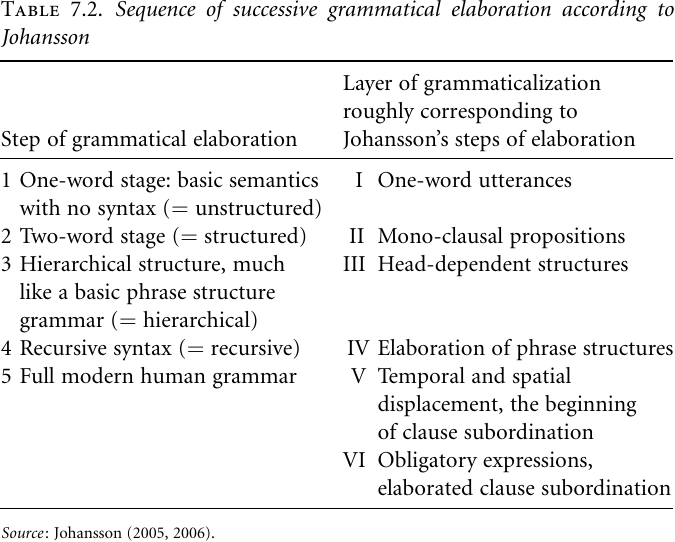
On the basis of these features he proposes a five-stage model of successive grammatical elaboration, as depicted in Table 7.2. This table shows that there are significant correspondences with the scenario of grammaticalization of Table7.1. in Grammatical evolution Layers, While the status of feature(c) in this model does not become entirely clear, it would seem that, overall, the sequence postulated by Johans son captures a major line of progression in the grammaticalization of language structure, namely one leading from elementary utterances without internal structure to structural relations among word units, subsequently to complex, hierarchical structures, and finally to clause subordination and recursive syntax.14
And Johansson’s model is also in agreement with another reconstruction that we proposed above, namely that the language-like abilities of non-human animals can be located roughly at layer II of language evolution: Johansson (2002: 122; 2005: 233–40) suggests that stage 2 of Table 7.2 very likely is within the reach of chimpanzees, involving nothing but activating already existing capabilities.
1 Maggie Tallerman and Jim Hurford (p.c.) rightly point out that a category ‘‘noun’’ does not make much sense unless contrasted with other kinds of word categories. We are restricted here to the application of grammaticalization theory, which is concerned with the reconstruction of basic linguistic categories, and ‘‘noun’’, that is, a category referring to thing-like entities, is one of these categories. What exactly the reconstruction of a category ‘‘noun’’ means with reference to the pragmatic situation that may have characterized linguistic behavior at layer I is a question that is open to further research (see below).
2 An anonymous referee of this work rightly points out that if in fact it was possible to combine utterances then there was already word order at layer I.
3 An anonymous referee of this work makes the important observation that lexical nouns are useful for referring to entities that are not immediately accessible, whereas pronouns, demonstratives, and other pointing devices are characteristic for talking about the here-and-now. Conceivably early language speakers made extensive use of gestures for deictic and other communicative purposes, but our methodology does not allow for any insights on this matter.
4 There is one notable exception that we pointed out in “The noun channel”: In the Chadic language Lele, the noun a̒là ‘God’ was grammaticalized to an adversative conjunction ‘but’ (Frajzyngier 1996: 81–3).
5 We noted that the evidence for distinguishing layers I and II is of a different nature than the one that we are using in the case of all other stages: While grammaticalization deals with grammatical forms, the distinction between I and II concerns the structure of how these forms are presented, rather than the forms themselves— hence, the evidence is circumstantial rather than direct; we therefore marked the evolution from noun to verb in Figure 2.1 in “A scenario of evolution “ with a dotted line.
6 To the extent that word order is a grammatical device that is based for example on a conceptual transfer from temporal and spatial relations to the linear arrangement of utterances and their parts it can be said to be a manifestation of grammaticalization.
7 This hypothesis is in accordance with Jackendoff’s (2002: 252) observation that word order on the clausal level precedes that of the phrasal level: ‘‘The provision of headed phrases in grammar allows principles of word order to be elaborated into principles of phrase order.’’
8 That a head-dependent structure in the form of part–whole relationships was conceptually present at the latest some 10,000 to 15,000 years ago might be suggested by rock engravings made by hunter-gatherers of the Upper Paleolithic depicting animal bodies without head, or body parts without body.
9 An anonymous reviewer of an earlier version of this book draws attention to the following issue that needs more attention in future research: Modern everyday communication is also overwhelmingly about the here-and-now and the linguistic categories employed are more likely to be pronominals and other pointing devices rather than, for example, lexical nouns. This would seem to suggest that pronominals might have been a fairly early acquisition of early language speakers.
10 We are grateful to Fritz Newmeyer (p.c.) for having drawn our attention to this problem.
11 There are a few exceptions; for example, not all languages distinguish adjectives as a morphosyntactic category.
13 Concerning a similar procedure of reconstruction, based on logical dependence among hypothesized stages underlying language origin, see Bierwisch (2001).
14 Fritz Newmeyer (p.c.) suggests that the linguistic dividing line between Homo erectus and H. sapiens may have been between step 2 and step 3.
 الاكثر قراءة في Linguistics fields
 اخر الاخبار
اخبار العتبة العباسية المقدسة

الآخبار الصحية


مواضيع ذات صلة
 قسم الشؤون الفكرية يصدر كتاباً يوثق تاريخ السدانة في العتبة العباسية المقدسة
 "المهمة".. إصدار قصصي يوثّق القصص الفائزة في مسابقة فتوى الدفاع المقدسة للقصة القصيرة
 (نوافذ).. إصدار أدبي يوثق القصص الفائزة في مسابقة الإمام العسكري (عليه السلام)






