The velaric airstream mechanism
Velarically initiated sounds have two closures in the vocal tract. One of these is the back of the tongue against the velum (hence the name ‘velaric’) and the other closure is further forward: usually the front of the tongue, but it is also possible to make a bilabial closure. In between these two closures there is a cavity filled with air; and this cavity can expanded, so that when the forward closure is released air flows into the vocal tract. It is also possible to compress the air in the cavity and force it out, but such sounds are not known to occur in any of the world’s languages. The IPA treats all velarically initiated sounds as ingressive.
To make a velarically initiated sound, start off by making a [k] sound silently. Do not release the velar closure; leave the back of the tongue in contact with the velum. Now make another closure: while keeping the [k] closure, make a dental closure as well,  , with the tongue against the back of the upper teeth. Make sure that the sides of the tongue are pressed firmly against the upper teeth. (We could transcribe this gesture as
 .) What you will have now is a cavity between the roof of your mouth and the upper surface of the tongue: the tongue should have a concave shape (that is, the midpoint of the tongue will be lower than the sides of the tongue). There should be a pocket of air trapped between the upper surface of the tongue and the roof of the mouth, with the sides of the tongue making a seal around the edges. While holding these closures, you should be able to breathe in and out normally: this shows that the velum is lowered, and that the velaric airstream is independent of the pulmonic airstream.
Now, while holding the two closures, tense your tongue and pull it downwards without releasing either of the closures. At this point, the cavity will expand, and so the pressure of the air within the cavity between the two closures will decrease. You will probably be able to feel the pressure on your tongue, as if it is being sucked. Release the front closure but retain the velar closure. What happens now is that air rushes in to the cavity, and a noise is made: this will probably be a very familiar sound, because it is the click [I]. This sound is typically produced English by speakers many times in a conversation: you have probably seen it in written form as ‘tut-tut’ or ‘tsk’.
Sounds like this are often called ‘clicks’ – shorthand for the longer more technical description: velarically initiated ingressive plosives, or suction stops. No words of English contain them so they are not phonemes of English. But, as is well known, they do occur in English speech.
They are ingressive because when the forward closure is released, the pressure between the forward closure and the velar closure is lower than the air pressure outside; so once the closure is released, air moves into the vocal tract. It is possible to produce velarically initiated sounds with egressive airflow, by pushing the tongue upwards to the hard palate and squeezing air out of the cavity, or letting it out by withdrawing the tongue’s contact from the upper surfaces of the mouth. These sounds are not known to occur in the world’s languages, although a velarically initiated, bilabial egressive plosive or trill can be used in English to mean something like ‘nothing’, or ‘I have no idea’ (‘and I don’t care’).
In learning to produce clicks in phonetics classes, students commonly allow the tongue to plop down on to the floor of the mouth. This produces a secondary sound known as a percussive. Percussives are sounds made when two articulators strike each other, but there is no airstream necessarily involved in producing the noise. When Englishspeaking children mimic the sound of a horse walking on a road, they often make a sequence of click + percussive, which mimics the ‘clip clop’ of the horse’s feet. In producing clicks, it is important to try to eliminate any percussive element.
Clicks can be produced at a range of places of articulation. In English, the commonest ones are probably dental [I], bilabial [◎] and alveolar lateral [II; other possibilities include palatoalveolar  and alveolar [!].
Clicks are complex articulations, but in their simplest form, we can think of them as a velar plosive accompanied by another complete closure which is released before the velar closure. It is quite possible to produce more complex click articulations by changing the ‘accompaniments’ that go with them. For instance, it is possible to produce a click with voicing, by combining velar closure and voicing: so instead of voicelessness at the same time as velar closure, [k], as the accompaniment, we have voicing and velar closure, [g]. Voicing and nasality are also combinable with clicks. These are easier to produce than might be thought. Start off by making a protracted [ŋ] sound, and simultaneously start to make a clicking sound: this should be easy to do, because the airstream needed for clicks is located forward of the velum, so air can flow through the nasal cavities while a click is being made. The resulting sound can be transcribed  .
.
It has become usual to think of clicks as ‘click + accompaniment’ (a point of view that originated in the work of Ladefoged and Traill 1994), and it is common to transcribe clicks in two parts: the first part describing the velar (or uvular) articulation (as e.g. [k g ŋ], the second part describing the click type. The two parts are joined with a ‘tie bar’,  . So a fuller transcription of the click [I] (the ‘tut’ of English) would be
  .
.
Figure 10.1 shows a spectrogram of a click (from extract (5) below). Point 1 marks the release of the forward closure, in this case a dental closure. This closely resembles the burst of the release of [t]: it has most energy higher up in the frequency range.
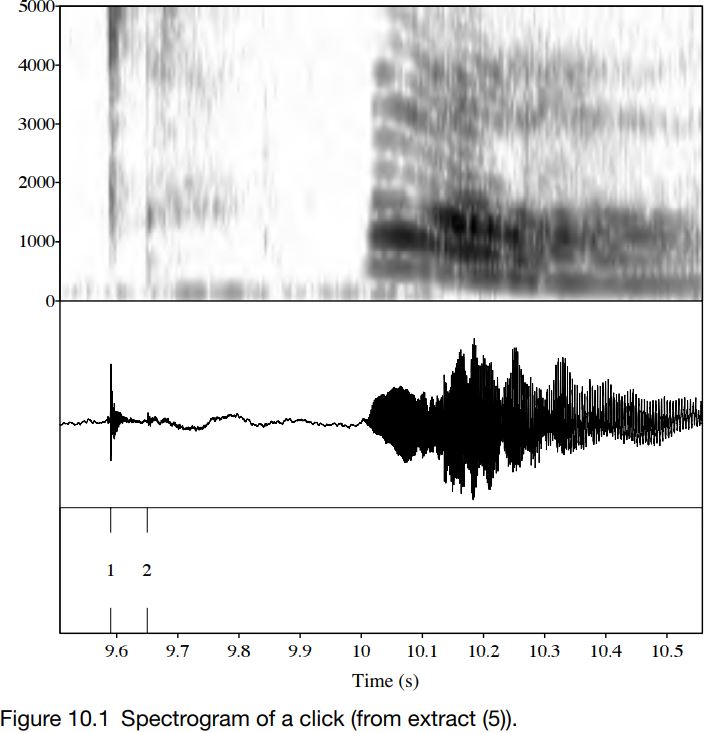
Notice that there is a transient burst followed by a longer period of noise. Very soon after that comes the second release, that of the velar closure. This is marked 2. Notice the centre of energy is very different: around 1500 Hz. This is consistent with the kind of burst we find for velars. After the release of the velar closure there is a lot of ingressive aspiration noise, which is the sound of air entering the vocal tract; and then the particle ‘ah’. This spectrogram, then, shows clearly the two releases associated with the velaric airstream mechanism.








