







Grammar
Tenses
Present

Present Simple
Present Continuous
Present Perfect
Present Perfect Continuous
Past
Past Simple
Past Continuous
Past Perfect
Past Perfect Continuous
Future
Future Simple
Future Continuous
Future Perfect
Future Perfect Continuous
Parts Of Speech
Nouns
Countable and uncountable nouns
Verbal nouns
Singular and Plural nouns
Proper nouns
Nouns gender
Nouns definition
Concrete nouns
Abstract nouns
Common nouns
Collective nouns
Definition Of Nouns
Animate and Inanimate nouns
Nouns
Verbs
Stative and dynamic verbs
Finite and nonfinite verbs
To be verbs
Transitive and intransitive verbs
Auxiliary verbs
Modal verbs
Regular and irregular verbs
Action verbs
Verbs
Adverbs
Relative adverbs
Interrogative adverbs
Adverbs of time
Adverbs of place
Adverbs of reason
Adverbs of quantity
Adverbs of manner
Adverbs of frequency
Adverbs of affirmation
Adverbs
Adjectives
Quantitative adjective
Proper adjective
Possessive adjective
Numeral adjective
Interrogative adjective
Distributive adjective
Descriptive adjective
Demonstrative adjective
Pronouns
Subject pronoun
Relative pronoun
Reflexive pronoun
Reciprocal pronoun
Possessive pronoun
Personal pronoun
Interrogative pronoun
Indefinite pronoun
Emphatic pronoun
Distributive pronoun
Demonstrative pronoun
Pronouns
Pre Position
Preposition by function
Time preposition
Reason preposition
Possession preposition
Place preposition
Phrases preposition
Origin preposition
Measure preposition
Direction preposition
Contrast preposition
Agent preposition
Preposition by construction
Simple preposition
Phrase preposition
Double preposition
Compound preposition
prepositions
Conjunctions
Subordinating conjunction
Correlative conjunction
Coordinating conjunction
Conjunctive adverbs
conjunctions
Interjections
Express calling interjection
Phrases
Sentences
Clauses
Part of Speech
Grammar Rules
Passive and Active
Preference
Requests and offers
wishes
Be used to
Some and any
Could have done
Describing people
Giving advices
Possession
Comparative and superlative
Giving Reason
Making Suggestions
Apologizing
Forming questions
Since and for
Directions
Obligation
Adverbials
invitation
Articles
Imaginary condition
Zero conditional
First conditional
Second conditional
Third conditional
Reported speech
Demonstratives
Determiners
Direct and Indirect speech
Linguistics
Phonetics
Phonology
Linguistics fields
Syntax
Morphology
Semantics
pragmatics
History
Writing
Grammar
Phonetics and Phonology
Semiotics
Reading Comprehension
Elementary
Intermediate
Advanced
Teaching Methods
Teaching Strategies
Assessment

Koinés
 المؤلف:
David Hornsby
المؤلف:
David Hornsby
 المصدر:
Linguistics A complete introduction
المصدر:
Linguistics A complete introduction
 الجزء والصفحة:
280-13
الجزء والصفحة:
280-13
 2024-01-04
 2780
2780




+
-
20
Koinés
Koinés are new compromise varieties which emerge from contact between speakers of different varieties. Koinéization is driven primarily by two processes:
• Levelling – the retention of forms which are used by a large number of speakers
• Simplification – the retention of forms which are morphologically simple or more regular, and therefore easier for post-adolescent learners to acquire.
Two other contact outcomes need also to be mentioned. In the first, incomplete accommodation between speakers of different dialects results in the creation of interdialect forms. In northern France, for example, contact between speakers of dialect and standard French has produced new compromise regional French forms, which were present in neither:
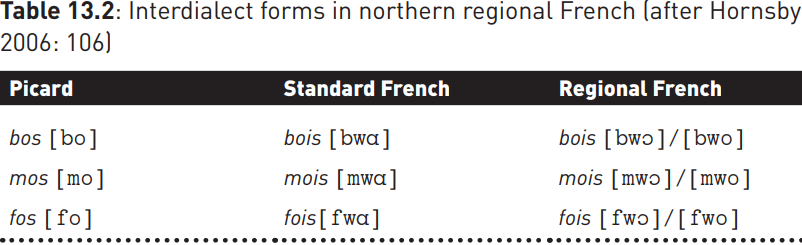
A similar compromise is evident in the lexical interdialect form take out, used in north-western England and the Midlands for a meal bought to be consumed off the premises. This form combines one element of the southern variant take away and one from the Scottish/north-eastern form carry out.
Finally, instead of being lost in the reduction process, variants can be reallocated to a new status. Trudgill suggests that this has happened in Norwich with three different variants of the ROOM vowel, originally associated with different parts of Norfolk:
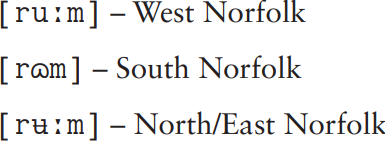
The population of Norwich grew exponentially during the nineteenth century, drawing in migrants from the rural hinterland, and bringing all of these Norfolk variants to the urban dialect mix. None, however, won out over the others: instead they were reallocated as social status markers within the city. The west Norfolk [u:] form, which corresponds to that of RP, has the highest status of the three, followed by south Norfolk  and finally the low-status north and east Norfolk form
  .
.
 الاكثر قراءة في Phonetics
 اخر الاخبار
اخبار العتبة العباسية المقدسة

الآخبار الصحية


مواضيع ذات صلة
 قسم الشؤون الفكرية يصدر كتاباً يوثق تاريخ السدانة في العتبة العباسية المقدسة
 "المهمة".. إصدار قصصي يوثّق القصص الفائزة في مسابقة فتوى الدفاع المقدسة للقصة القصيرة
 (نوافذ).. إصدار أدبي يوثق القصص الفائزة في مسابقة الإمام العسكري (عليه السلام)






