cardinal vowels
A set of standard reference points, devised by the British PHONETICIAN Daniel Jones (1881–1967), to provide a precise means of identifying the VOWEL sounds of a language. The cardinal vowel system is based on a combination of ARTICULATORY and AUDITORY judgements. Four theoretical levels of TONGUE height are recognized: (a) the highest position to which the tongue can be raised without producing audible FRICTION; (b) the lowest position the tongue is capable of achieving; (c) and (d), two intermediate levels, which divide up the intervening space into areas that are articulatorily and auditorily equidistant. Using the FRONT of the tongue, and without rounding the lips, four primary vowel types are produced, and these are given the symbols (from HIGH to LOW) [i], [e] [ε] and [a]. Using the BACK of the tongue, four more primary vowel types are recognized, symbolized as (from low to high)  , [o] and [u] – the last three involving lip-ROUNDING. In addition, each of these primary values is coded numerically, from 1 to 8 respectively.
By reversing the lip position, a secondary series of vowel types is produced: rounding the lips for the front vowels produces (from high to low) [y], [ø], [œ] and [Œ];  is the rounded equivalent of cardinal 5, and
  are the unrounded equivalents of cardinals 6, 7 and 8 respectively. The numerical code for the secondary series runs from 9 to 16. Two further cardinal vowels represent the highest point the centre of the tongue can reach: these are symbolized by
  for the unrounded vowel and by
  for the rounded vowel, coded 17 and 18 respectively. The entire system is usually shown in the form of the cardinal vowel diagram, or cardinal vowel quadrilateral, in which the aim is to give an approximate picture of the degree and direction of tongue movement involved. Additional lines help to delimit the area in which central vowel sounds are made. It should be emphasized that the cardinal vowels are not real vowels: they are invariable reference points (available as a recording), which have to be learned by rote. Once learned, phoneticians can use them in order to locate the position of the vowels of a LANGUAGE or to compare the vowels of different languages or DIALECTS. They can be sure that the vowels will all fall somewhere within the boundaries of the cardinal area. DIACRITIC marks can then be used to plot vowel
positions more accurately, e.g. a plus beneath the vowel means that the articulation is more advanced than the cardinal value (as in  ), a line beneath the vowel means that the articulation is more retracted (as in
  ).
).
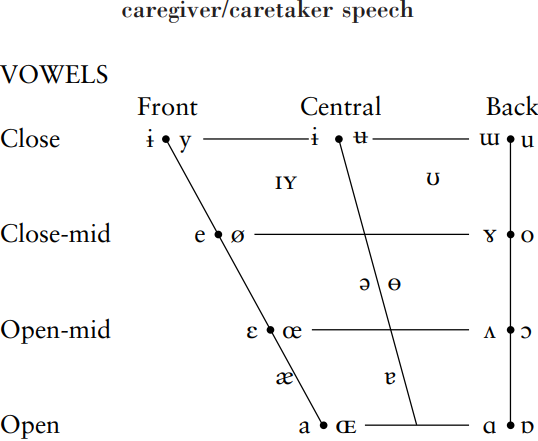
Several other suggestions have been made concerning the best way of dividing up the vowel articulation area, but Daniel Jones’s system is still the most widely used. Where symbols appear in pairs, the one to the right represents a rounded vowel.








