الوضع الليلي


 10:53:14
  2026-02-21
  1714
1714
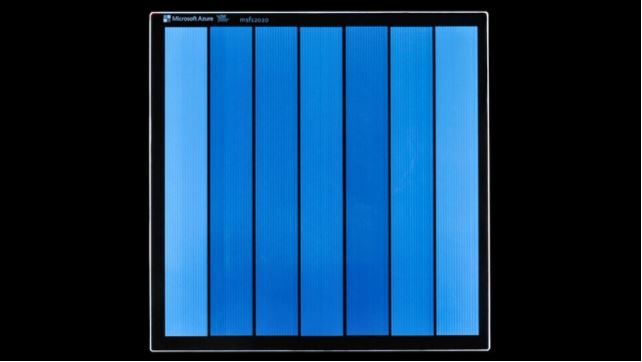
Scientists at Microsoft Research in the United States have demonstrated a system called Silica for writing and reading information in ordinary pieces of glass, which can store two million books' worth of data in a thin, palm-sized square.
In a paper published today in Nature, the researchers say their tests suggest the data will be readable for more than 10,000 years.
What tiny pulses of light can do
The new system, called silica, uses extremely short flashes of laser light to inscribe bits of information into a block of ordinary glass.
These pulses are called "ultrashort" for a reason. Each one lasts mere quadrillionths of a second (aka femtoseconds or 10–15 s).
To get your head around that: comparing ten femtoseconds to a single minute is like comparing one minute to the entire age of the universe.
These incredibly short flashes can be used to generate even shorter bursts of light lasting attoseconds (a thousandth of a femtosecond or 10–18 s).
These attosecond bursts can be used to observe the motion of electrons inside atoms and molecules – and in 2023, the Nobel Prize in Physics was awarded for pioneering work in this area, to Ferenc Krausz (coincidentally my former PhD supervisor), Anne L'Huillier, and Pierre Agostini.
Writing in glass
Femtosecond laser pulses also have a practical technological application. They can be used to make changes deep inside transparent materials such as glass.
These lasers produce light of a wavelength that normally passes through glass without interaction. However, when ultrashort pulses of this light are tightly focused on a particular region, it produces an intense electric field that alters the molecular structure of the glass in the focal zone.
This means only a tiny three-dimensional volume, often less than a millionth of a metre to a side, is affected. This is called a "voxel", which can be made at precisely controlled positions in the glass.
Decades of research
The idea of using laser-written voxels for three-dimensional data storage is not new.
Eric Mazur and co-workers at Harvard University in the US investigated volumetric optical storage back in the 1990s. Their groundbreaking work demonstrated that permanent data structures could be inscribed into common glass using femtosecond lasers.
In 2014, Peter Kazansky and colleagues at the University of Southampton in the UK reported data storage in fused quartz glass with a "seemingly unlimited lifetime". This helped to establish the idea of ultra-stable glass-based memory devices.
In 2024, Kazansky spun out a company called Spotonix to commercialise what they describe as "5D glass nanostructuring".
Their vision of a "5D memory crystal" even made its way into popular culture: a similar device appeared in the latest Mission Impossible film, The Final Reckoning, portrayed as a secure vault capable of containing a powerful but sinister AI.
A complete system
The Silica project does not claim to have made a new scientific breakthrough. Instead, the team presents the first comprehensive demonstration of a practical, real-world technology.
Their work brings together all the key elements of such a storage platform based on femtosecond lasers and glass. It includes encoding data, writing, reading, decoding, and error correction.
The work explores different strategies for reliability, writing speed, energy efficiency, and data density, and involves systematic assessments of the data lifetime.
The first consists of tiny elongated void-like features created by laser-driven "micro-explosions" inside the glass. These allow an extremely high storage density of 1.59 gigabits per cubic millimetre.
The second type involves making subtle changes in the local refractive index of the glass. These can be written faster, using less energy – but each cubic millimetre of glass can hold less data.
This method can write about 65.9 megabits per second, and the authors say this could be increased with more laser beams.
Finally, accelerated ageing experiments suggest that the written data, even in the case of the more sensitive phase voxels, could remain stable for more than 10,000 years. This vastly exceeds the lifetime of conventional archival storage media such as magnetic tape or hard drives.
The future
When I began my PhD in the late 1990s at the Vienna University of Technology, we were one of only a handful of laboratories worldwide that had the expertise to build lasers capable of generating femtosecond pulses.
Today, after decades of technological development, ultrafast lasers with the reliability, power, and repetition rates required for industrial use can be purchased off the shelf.
Reality Of Islam |
|
NASA has de
MIT researc
Researchers
Researchers
 9:3:43
2018-11-05
9:3:43
2018-11-05
10 benefits of Marriage in Islam
7:5:22
2019-04-08
benefits of reciting surat yunus, hud &
9:45:7
2018-12-24
advantages & disadvantages of divorce
11:35:12
2018-06-10
6:0:51
2018-10-16
3:43:50
2022-11-05
4:2:19
2022-10-10
a hero waters thirsty wild animals
9:4:9
2022-01-06
2:11:12
2022-10-15
8:4:21
2022-01-08
5:58:12
2021-12-18
7:34:7
2023-02-28
5:41:46
2023-03-18
| LATEST |
 HOME
HOME