الوضع الليلي


 11:38:32
  2026-04-23
  1457
1457
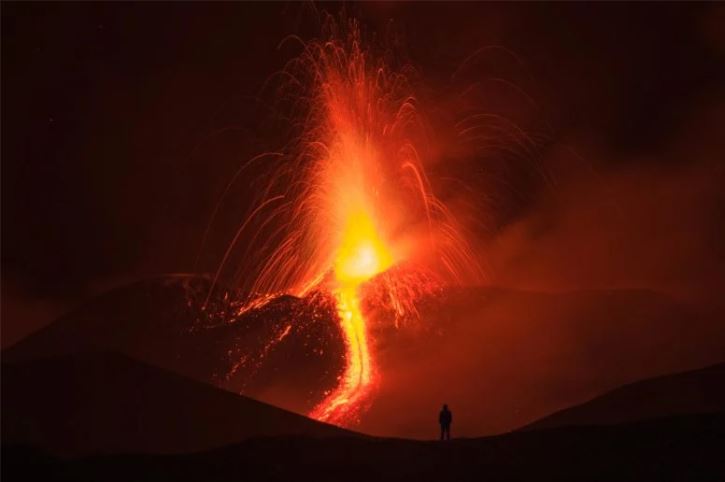
New research suggests Mount Etna forms from deep mantle magma pockets, possibly classifying it as a rare “petit-spot” volcano rather than a typical tectonic or hotspot volcano.
Mount Etna, located in Sicily, is the most active volcano in Europe. Yet scientists have long struggled to explain how it formed, as no existing geological model fully accounts for its origin. A new study from researchers at the University of Lausanne (UNIL) offers fresh insight into this mystery and suggests that Etna may be unlike any other volcano on Earth.
The volcano is more than 500,000 years old and rises over 3,000 meters (about 9,800 feet) above sea level along Sicily’s eastern coast. It erupts multiple times each year, making it both the most active and one of the most closely studied volcanoes in the world. Even so, its formation remains only partially understood, with no single geological process fully explaining its development.
In research published in the Journal of Geophysical Research—Solid Earth, scientists from the University of Lausanne, working with Anna Rosa Corsaro of the Istituto Nazionale di Geofisica e Vulcanologia in Catania, present a new hypothesis for how Mount Etna formed. Their work also provides insight into why the volcano erupts so frequently and may help improve volcanic hazard assessments by researchers at INGV in Catania, Italy.
How Volcanoes Typically Form
Volcanoes generally form when rock in the Earth’s mantle melts into magma, which then rises to the surface and solidifies. Scientists have traditionally identified three main ways this happens.
Why Mount Etna Defies Classification
Mount Etna does not fit neatly into any of these categories. Although it sits near a subduction zone, its chemical makeup resembles that of hotspot volcanoes, even though no hotspot exists nearby. According to the new study, Etna differs from typical volcanoes because its magma does not form just before eruptions. Instead, it is supplied by small amounts of magma already present in the upper mantle, about 80 kilometers (roughly 50 miles) below the surface.
This magma moves upward in bursts, driven by complex tectonic forces linked to the collision of the African and Eurasian plates. As the tectonic plate bends near the subduction zone, fractures open, allowing magma to rise through them, similar to liquid being squeezed out of a sponge.
Researchers suggest that Mount Etna may belong to a lesser-known fourth category of volcanoes called “petit-spot” volcanoes, first identified in 2006 by Japanese scientists. These small submarine volcanoes provide evidence that pockets of magma exist near the top of the mantle, an idea proposed decades ago, and show that such magma can form volcanoes under the right conditions.
“Our study suggests that Etna may have formed through a mechanism similar to the one that generates petit-spot submarine volcanoes,” explains Sébastien Pilet, Professor at the Faculty of Geosciences and Environment at the University of Lausanne and lead author of the study.
“This is unexpected, as such processes had previously only been observed in very small volcanic structures, typically rising no more than a few hundred meters. Mount Etna, by contrast, is a large stratovolcano, whose activity began around 500,000 years ago and which now towers more than 3,000 meters above sea level.”
Implications for Global Volcanism
The findings offer a new way to think about how volcanoes can form in different tectonic settings around the world.
To reach their conclusions, scientists analyzed rock samples from Mount Etna to trace how its lava chemistry has changed over roughly 500,000 years. Their results show that the composition of Etna’s magma has remained largely stable over time, even as tectonic conditions shifted.
Together, these observations indicate that the magma feeding Mount Etna has long existed in the upper mantle, with variations in eruption volume mainly driven by plate movements. This supports the idea that Etna’s activity is linked to the “petit-spot” mechanism.
Reality Of Islam |
|

Keeping sil
Two experim

Changing a
Plants are
 9:3:43
2018-11-05
9:3:43
2018-11-05
10 benefits of Marriage in Islam
7:5:22
2019-04-08
benefits of reciting surat yunus, hud &
9:45:7
2018-12-24
advantages & disadvantages of divorce
11:35:12
2018-06-10
6:0:51
2018-10-16
8:3:0
2018-06-21
8:30:23
2022-03-03
1:16:44
2018-05-14
9:50:37
2023-02-28
1:38:41
2021-12-08
2:2:13
2022-10-08
11:11:59
2023-02-01
5:41:46
2023-03-18
| LATEST |
 HOME
HOME