الوضع الليلي


 1:2:22
  2025-07-28
  1849
1849
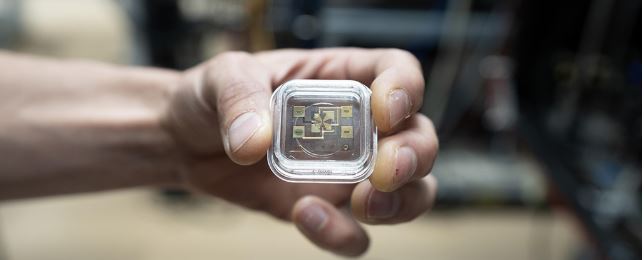
A clock built by a team led by researchers at the National Institute of Standards and Technology (NIST) has been estimated to be 41 percent more accurate than the previous timekeeping record holder.
By measuring the tiny vibrations of a trapped aluminum ion cooled to near absolute zero, the clock calculates seconds with a precision of 19 decimal places.
As well as breaking a record for accuracy (known in technical terms as systematic uncertainty), the clock is 2.6 times more stable than any other clock of its type.
"It's exciting to work on the most accurate clock ever," says physicist Mason Marshall, from NIST.
"At NIST we get to carry out these long-term plans in precision measurement that can push the field of physics and our understanding of the world around us."
The culmination of 20 years of work, the record-breaking clock's design relies upon an intimate knowledge of quantum physics, with every micromotion of the surrounding capable of throwing off the clock's ticking by minuscule amounts.
This was achieved by thickening the diamond wafer that made up the clock enclosure and the gold coatings of the electrodes inside, to further stabilize the electrical fields driving the necessary ticking of the clock.
Vital to the clock's reliability is the pairing of the aluminum with a charged magnesium atom; a 'buddy' ion that made the aluminum ion easier to control with laser light, giving the researchers the winning combination of accuracy and stability.
The laser came courtesy a neighboring lab 3.6 kilometers (just over 2 miles) away, with its own reputation for precision and stability.
Overall, the time required to gather enough data to measure a second – down to 19 decimal places – was reduced from three weeks to a day and a half.
"It's a big, complex challenge, because every part of the clock's design affects the clock," says NIST electrical engineer Daniel Rodriguez Castillo.
These clocks don't measure time in the same way as a watch, letting you know when it's time for bed (or time to get up). Instead they act as a reference point for timekeeping for calibrating other clocks, for using in experiments, and for probing the Universe around us. Knowing how long a second lasts is a crucial benchmark of physics.
This benefits all kinds of scientific fields, from searching for dark matter to testing Einstein's theory of relativity. What's more, the researchers think there's more to come – and that greater accuracy can be achieved through these atomic clocks by further improving system stability and ion control.
"With this platform, we're poised to explore new clock architectures – like scaling up the number of clock ions and even entangling them – further improving our measurement capabilities," says physicist Willa Arthur-Dworschack, from NIST.
Reality Of Islam |
|
NASA has de
MIT researc
Researchers
Researchers
 9:3:43
2018-11-05
9:3:43
2018-11-05
10 benefits of Marriage in Islam
7:5:22
2019-04-08
benefits of reciting surat yunus, hud &
9:45:7
2018-12-24
advantages & disadvantages of divorce
11:35:12
2018-06-10
6:0:51
2018-10-16
8:25:12
2022-03-09
8:4:21
2022-01-08
3:43:50
2022-11-05
a hero waters thirsty wild animals
9:4:9
2022-01-06
4:2:19
2022-10-10
7:6:7
2022-03-21
5:58:12
2021-12-18
5:41:46
2023-03-18
| LATEST |
 HOME
HOME