الوضع الليلي


 7:40:49
  2025-02-10
  1625
1625
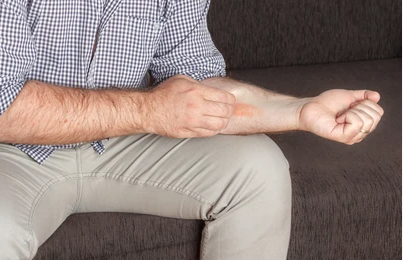
Scratching an itchy rash worsens inflammation by triggering pain-sensing neurons and activating mast cells, creating a damaging feedback loop.
While scratching helps remove bacteria, it ultimately harms the skin more than it helps. Scientists are now exploring new treatments to control inflammation without the negative effects of scratching.
Scratching an Itchy Rash: Why It Makes Things Worse
Your parents were right—scratching an itchy rash really does make it worse. Now, researchers have uncovered why. A new study published on January 30 in Science reveals how scratching increases inflammation and swelling in a mouse model of allergic contact dermatitis, a type of eczema.
“At first, these findings seemed to introduce a paradox: If scratching an itch is bad for us, why does it feel so good?” said senior author Daniel Kaplan, M.D., Ph.D., professor of dermatology and immunology at the University of Pittsburgh. “Scratching is often pleasurable, which suggests that, in order to have evolved, this behavior must provide some kind of benefit. Our study helps resolve this paradox by providing evidence that scratching also provides defense against bacterial skin infections.”
How Allergic Contact Dermatitis Triggers the Itch-Scratch Cycle
Allergic contact dermatitis occurs when the skin reacts to allergens or irritants — such as poison ivy or metals like nickel — resulting in an itchy, inflamed rash. While scratching may offer temporary relief, it actually triggers more inflammation, worsening symptoms and slowing down the healing process.
To figure out what drives this vicious cycle, Kaplan, first author Andrew Liu, student in Pitt’s Medical Scientist Training Program, and their team used itch-inducing allergens to induce eczema-like symptoms on the ears of normal mice and those that don’t get itchy because they lack an itch-sensing neuron.
When normal mice were allowed to scratch, their ears became swollen and filled with inflammatory immune cells called neutrophils. In contrast, inflammation and swelling were much milder in normal mice that couldn’t scratch because they wore tiny Elizabethan collars, similar to a “cone of shame” that a dog might sport after a visit to the vet, and in animals that lacked the itch-sensing neuron. This experiment confirmed that scratching further aggravates the skin.
The Role of Substance P: How Scratching Fuels Inflammation
Next, the researchers showed that scratching causes pain-sensing neurons to release a compound called substance P. In turn, substance P activates mast cells, which are key coordinators of inflammation that drive itchiness and inflammation via recruitment of neutrophils.
“In contact dermatitis, mast cells are directly activated by allergens, which drives minor inflammation and itchiness,” explained Kaplan. “In response to scratching, the release of substance P activates mast cells through a second pathway, so the reason that scratching triggers more inflammation in the skin is because mast cells have been synergistically activated through two pathways.”
Mast Cells: The Double-Edged Sword of Skin Defense
Mast cells are culprits in a range of inflammatory skin conditions and allergic reactions, but they’re also important for protecting against bacteria and other pathogens. As such, the researchers wondered if scratching-induced activation of mast cells could affect the skin microbiome.
In experiments led by coauthor Marlies Meisel, Ph.D., assistant professor of immunology at Pitt, the team showed that scratching reduced the amount of Staphylococcus aureus, the most common bacteria involved in skin infections, on the skin.
Scratching Might Help — But at a Cost
“The finding that scratching improves defense against Staphylococcus aureus suggests that it could be beneficial in some contexts,” said Kaplan. “But the damage that scratching does to the skin probably outweighs this benefit when itching is chronic.”
Now, the researchers are investigating new therapies for dermatitis and other inflammatory skin conditions such as rosacea and urticaria that suppress inflammation by targeting receptors on mast cells.
Reality Of Islam |
|
Scientists

NASA’
Mass spectr
As space ex
 9:3:43
2018-11-05
9:3:43
2018-11-05
10 benefits of Marriage in Islam
7:5:22
2019-04-08
benefits of reciting surat yunus, hud &
9:45:7
2018-12-24
advantages & disadvantages of divorce
11:35:12
2018-06-10
6:0:51
2018-10-16
8:30:23
2022-03-03
5:58:12
2021-12-18
2:33:4
2023-02-15
3:42:22
2021-12-24
10:43:56
2022-06-22
11:34:48
2022-06-29
2:5:14
2023-01-28
5:41:46
2023-03-18
| LATEST |
 HOME
HOME