

Grammar


Tenses


Present

Present Simple

Present Continuous

Present Perfect

Present Perfect Continuous


Past

Past Simple

Past Continuous

Past Perfect

Past Perfect Continuous


Future

Future Simple

Future Continuous

Future Perfect

Future Perfect Continuous


Parts Of Speech


Nouns

Countable and uncountable nouns

Verbal nouns

Singular and Plural nouns

Proper nouns

Nouns gender

Nouns definition

Concrete nouns

Abstract nouns

Common nouns

Collective nouns

Definition Of Nouns

Animate and Inanimate nouns

Nouns


Verbs

Stative and dynamic verbs

Finite and nonfinite verbs

To be verbs

Transitive and intransitive verbs

Auxiliary verbs

Modal verbs

Regular and irregular verbs

Action verbs

Verbs


Adverbs

Relative adverbs

Interrogative adverbs

Adverbs of time

Adverbs of place

Adverbs of reason

Adverbs of quantity

Adverbs of manner

Adverbs of frequency

Adverbs of affirmation

Adverbs


Adjectives

Quantitative adjective

Proper adjective

Possessive adjective

Numeral adjective

Interrogative adjective

Distributive adjective

Descriptive adjective

Demonstrative adjective


Pronouns

Subject pronoun

Relative pronoun

Reflexive pronoun

Reciprocal pronoun

Possessive pronoun

Personal pronoun

Interrogative pronoun

Indefinite pronoun

Emphatic pronoun

Distributive pronoun

Demonstrative pronoun

Pronouns


Pre Position


Preposition by function

Time preposition

Reason preposition

Possession preposition

Place preposition

Phrases preposition

Origin preposition

Measure preposition

Direction preposition

Contrast preposition

Agent preposition


Preposition by construction

Simple preposition

Phrase preposition

Double preposition

Compound preposition

prepositions


Conjunctions

Subordinating conjunction

Correlative conjunction

Coordinating conjunction

Conjunctive adverbs

conjunctions


Interjections

Express calling interjection

Phrases

Sentences


Grammar Rules

Passive and Active

Preference

Requests and offers

wishes

Be used to

Some and any

Could have done

Describing people

Giving advices

Possession

Comparative and superlative

Giving Reason

Making Suggestions

Apologizing

Forming questions

Since and for

Directions

Obligation

Adverbials

invitation

Articles

Imaginary condition

Zero conditional

First conditional

Second conditional

Third conditional

Reported speech

Demonstratives

Determiners


Linguistics

Phonetics

Phonology

Linguistics fields

Syntax

Morphology

Semantics

pragmatics

History

Writing

Grammar

Phonetics and Phonology

Semiotics


Reading Comprehension

Elementary

Intermediate

Advanced


Teaching Methods

Teaching Strategies

Assessment
Rapid anonymous observation
المؤلف:
David Hornsby
المصدر:
Linguistics A complete introduction
الجزء والصفحة:
227-11
2024-01-01
1280
Rapid anonymous observation
Ingenious techniques such as rapid anonymous observation were used in early variationist studies to overcome the Observer’s Paradox, i.e. the problem of obtaining ‘natural speech’ from informants who know they are under investigation. Sociolinguists have now largely abandoned the notion of ‘natural speech’, on the grounds that all speech is designed with an audience in mind.
The results, when collated and analyzed, showed a remarkable correlation between the status of the store and linguistic behavior, with most use of the prestigious (r)-1 variants occurring, in both environments, in the high-status Saks store and fewest in the lowest-status store, Klein’s. (r)-1 use increased consistently in the repeated ‘emphatic’ style, suggesting that speakers use more prestige variants when paying more attention to their speech.
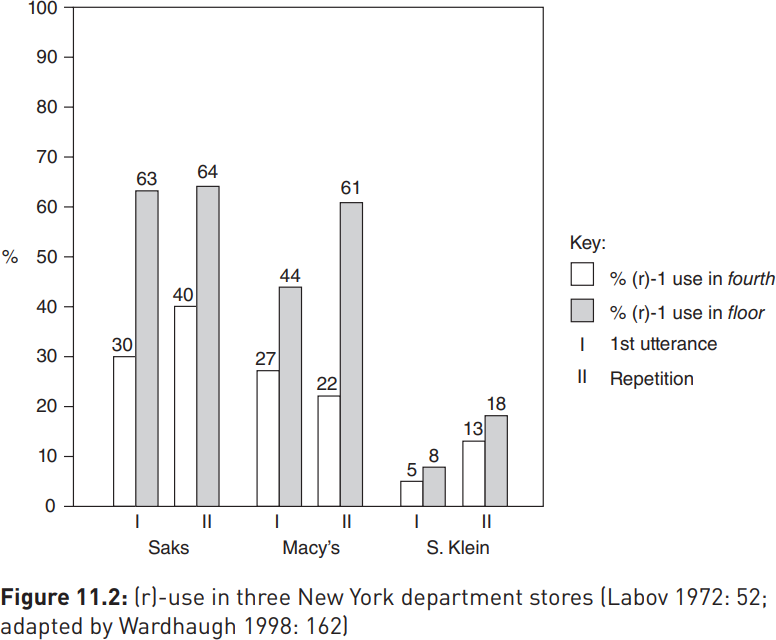
Labov’s technique of rapid anonymous observation had overcome the Observer’s Paradox and demonstrated a clear, quantifiable correlation between speech and social status. A question we need to ask here, though, is ‘whose social status?’. For all its advantages, rapid anonymous observation yields very little information about informants themselves, beyond that which can be reasonably guessed, for example sex and approximate age. We therefore know little about the shop assistants’ own socio-economic status but, perhaps surprisingly, there is little reason to suppose that it actually corresponded to that of the stores where they worked: indeed, on one criterion, that of pay level, Macy’s rather than Saks employees were believed to be of highest status. In all likelihood, the shop assistants’ speech was a better reflector of the status of their customers’ status than of the assistants themselves. The assistants, in other words, seemed to be ‘borrowing’ the status of their customers by accommodating to them. As we shall see, the concept of accommodation has important consequences for our understanding of linguistic change.
الاكثر قراءة في Phonetics
اخر الاخبار
اخبار العتبة العباسية المقدسة
الآخبار الصحية

قسم الشؤون الفكرية يصدر كتاباً يوثق تاريخ السدانة في العتبة العباسية المقدسة
"المهمة".. إصدار قصصي يوثّق القصص الفائزة في مسابقة فتوى الدفاع المقدسة للقصة القصيرة
(نوافذ).. إصدار أدبي يوثق القصص الفائزة في مسابقة الإمام العسكري (عليه السلام)


