Stationary phases and support materials
Polysiloxanes
Standard polysiloxanes (PSXs) are characterised by their repeating siloxane backbone in which each silicone atom has the potential to attach two functional groups, the type and amount of which distinguish the stationary phase and its properties (Fig. 1). The basic PSX is 100% methyl-substituted. When other groups are incorporated into the stationary phase, the amount is indicated as a percentage of the total substituent groups. For example, if 5% of silicon atoms contain two phenyl groups and the remaining 95% of silicon atoms are methyl substituted, this may be written as (5% diphenyl/95% dimethyl)-PSX, (5% phenyl/95% methyl)-PSX or simply (5% phenyl)-PSX. In some instances, two different groups are present on the same silicon atom, so a (10%cyanopropyl phenyl/dimethyl)-PSX contains a total of 5% cyanopropyl, 5% phenyl and 90% methyl residues (see Fig. 1).
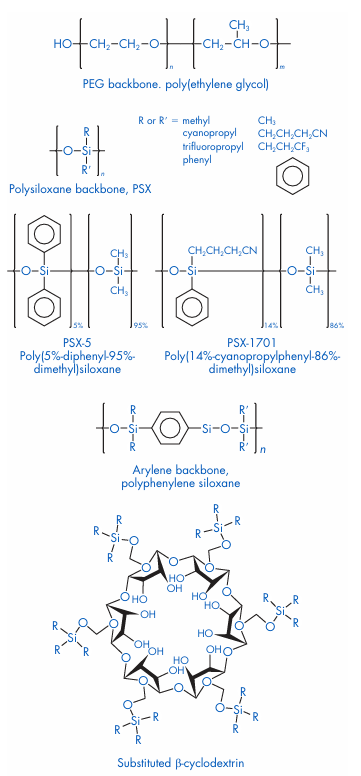
Figure 1 Structures of some common capillary GC stationary phases.
While PSXs are generally less polar in nature than PEGs, the substitution of polar residues for a proportion of the methyl groups confers added polarity to the column. Polar phases retain polar compounds more effectively than do nonpolar compounds, and vice versa. The 100% methyl substituted-PSX is often considered the ‘stand ard’ nonpolar phase, and has been used extensively in compilations of retention indices. This column is an ideal choice for starting a new application. However, substitution by n-octyl groups (up to 50%) renders the column extremely nonpolar, and similar to squalene. Substitution with up to 5% phenyl groups still furnishes an essentially nonpolar column with improved thermal stability. This phase has also been used for retention index (RI) work and is another good column with which to start a new application. Increasing the phenyl substitution to 20%, 35% or 50% yields columns classed as intermediate in polarity, which predictably retain aromatic compounds relative to aliphatic solutes. All these are available as bonded phases that can be solvent rinsed, are not damaged by organic acids or bases, and can tolerate small injections of water if sufficiently highly loaded, but are sensitive to strong inorganic acids and bases.
Substitution of cyanopropylphenyl groups (typically 6% or 14%) creates an intermediate polarity mixed phase with unique elution relative to simple phenyl substitution, but renders the column more susceptible to damage from oxygen, moisture and mineral acids. 50% substitution is specifically designed to separate cis- and trans-fatty acid methyl esters (FAMEs). However, even low-level bleeding of the stationary phase produces a high background signal with certain types of detector (nitrogen–phosphorus detector; NPD). Bleeding is the term given to the phenomenon wherein stationary phase degrades during analysis and elutes from the column. Depending on the nature of the stationary phase and the detector used, the degraded material may be detected and can contribute to the detector signal, potentially causing problems with the analysis. More polar columns are produced by substitution of bis-cyanopropyl and date, these are nonbonded columns, and should not therefore be rinsed with solvent. Trifluoro propyl/methyl-PSX is a mid-to-high polarity phase especially suited for otherwise difficult-to separate positional isomers. Its unique interactions with nitro, halogen, carbonyl and other electronegative groups give it application in the analysis of herbicides and pesticides. Increasing polarity in general is associated with some negative effects. Polar phases tend to have a narrower operating temperature range (higher minimum, lower maximum), are more prone to bleed at higher temperatures, are more sensitive to moisture and oxygen, and consequently have a shorter life expectancy than nonpolar phases. More recently, low-bleed arylene stationary phases (sometimes designated mass spectrometry or ‘ms’) have been introduced that have phenyl groups incorporated into the siloxane backbone (see Fig. 1). The incorporated phenyl groups confer additional strength to the backbone, which prevents the formation of cyclic fragments and associated ‘bleed’ at higher temperatures.








