Instrument calibration
Spectral resolution (spectral bandwidth)
In dispersive instruments, the spectral band width (SBW) is set by the entrance and exit slits of the monochromator. In the FTIR spectrometer, the ‘depth’ of the Fourier transformation sets SBW with typical values of 1 cm-1, 2 cm-1 and 4 cm-1 available in the spectrometer control software. The narrower the SBW the more faith fully are sharp absorption bands registered; however, the noisier the spectrum (less light), the more time (accumulations) is required to keep the noise level down. The British Pharmacopoeia (British Pharmacopoeia Commission 2007) recommends the following to ensure good spectral resolution:
For monochromator instruments, record the spectrum of a polystyrene film 35 μm in thick ness. The difference x [Fig. 1] between the percentage transmittance at the transmission maximum A at 2870 cm-1 and that at the trans mission minimum B at 2849.5 cm1 should be greater than 18. The difference y between the percentage transmittance at the transmission maximum C at 1589 cm-1 and that at the trans mission minimum D at 1583 cm1 should be greater than 10.
For Fourier-transform instruments, use suit able instrument resolution with the appropriate apodisation prescribed by the manufacturer. The resolution is checked by suitable means, for example by recording the spectrum of a poly styrene film approximately 35 μm in thickness. The difference between the absorbances at the absorption minimum at 2870 cm-1 and the absorption maximum at 2849.5 cm-1 is greater than 0.33. The difference between the absorbances at the absorption minimum at 1589 cm-1 and the absorption maximum at 1583 cm-1 is greater than 0.08. This recommendation is very specific for a 35 μm thick film of polystyrene.
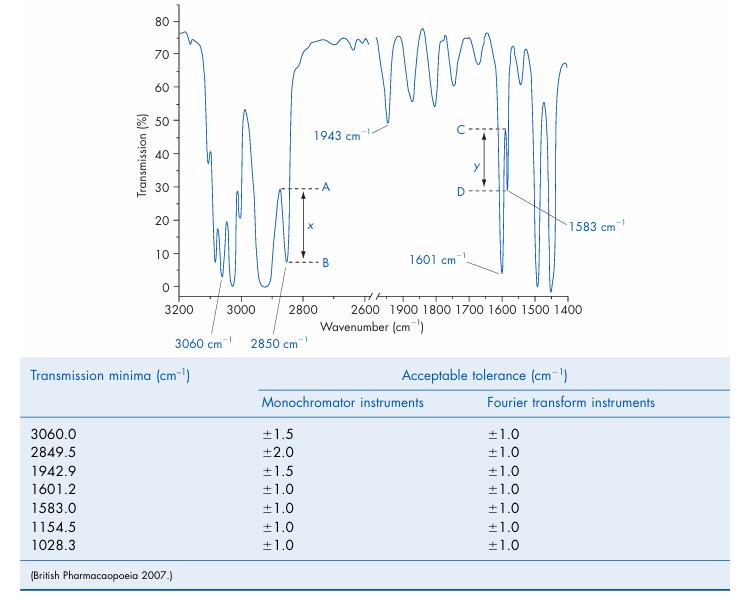
Figure 1 Zoomed-in regions of the IR spectrum of a 40 μm thick polystyrene film indicating the location of critical parameters. A whole spectrum is illustrated in Fig. 2.
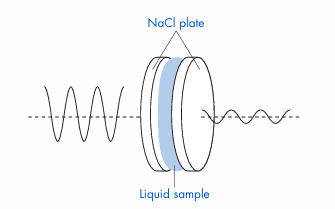
Figure 2 Liquid sample or Nujol mull sandwiched between two NaCl plates.








