APPLIED LINGUISTICS for BA Students in English
CLASSROOM MANAGEMENT
Classroom dynamics
A research in social psychology confirms what teachers know instinctively: a cohesive group works efficiently and productively (Argyle: 1972). A positive group atmosphere can have a beneficial effect on the morale, motivation, and self-image of its members, and thus significantly affect their learning by developing in them a positive attitude to the language being learnt to the learning process and to themselves as learners. Successful groups can be, as T. Douglas puts it “an instrument of behavioral or attitudinal change, an instrument of support and maintenance, a pool of resources, and an instrument to facilitate learning.” (Douglas: 1983)
An unsuccessful group can be described as follows:
- the individuals in the class do not cohere into a group,
- there is an uncomfortable, tense or negative atmosphere,
- some members of the group will not participate in group activities and some other members will tend to dominate group activities at the expense of shyer members,
- group members are not interested in each other and they are not self-reliant but dependent on the teacher,
- members of the group lack responsibility: they are reluctant to make an effort or to take the initiative.
A successful group will be one where:
- the group is cohesive and the members have a definite sense of themselves as a group,
- there is a positive and supportive atmosphere: members have a positive self-image which is reinforced by the group,
- group members are interested in each other and feel they have something in common,
- the group is self-reliant and has a sense of responsibility; it is able to overcome problems and difficulties without the teacher,
- the members of the group trust each other,
- group members are open-minded, flexible, receptive to new ideas, they empathize with each other.
In the following table two models of group life can be seen, one described by Tuckman (1965), and the other one presented by Hadfield (1992).
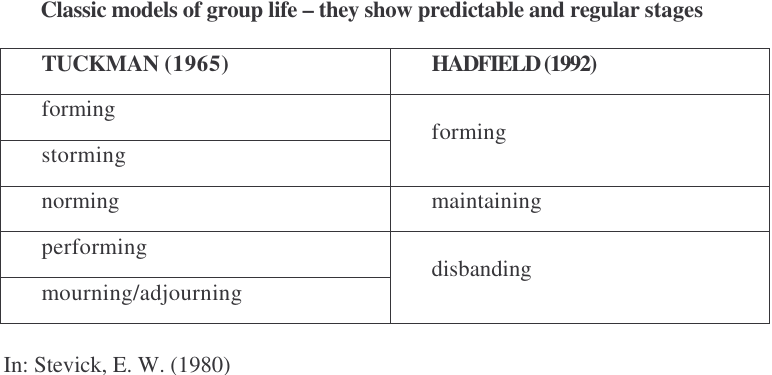
In both models three stages of group life can be distinguished: forming, maintaining and disbanding. Certain common goals and activities set by the teacher can help the students to form a group. Naturally a group consists of different persons with different ways of thinking. All of them will have various concepts and ideas about a task to perform. That is the stage of storming during which conflicts may arise among students. Tuckman called this phase storming stage. The period in the life of a group when conflicts are settled and handled properly is the norming stage of the group. Performing stage will give satisfaction to the group members, as they can perform something for which they have been preparing for a long time. After the peak time of group life all the members get exhausted so the group will disband. The memories and the conclusions of group activities will remain in the students for a long time.
What should teachers do to from group cohesion and what are the stages of group formation? Teachers must give a lot of role play activities, project work, competitions and further tasks requiring common efforts from the students. Learners must feel the responsibility for achieving the common goals and they have to select the right persons for the various jobs in the group. A task like this will develop their emphatic attitude.








