APPLIED LINGUISTICS for BA Students in English
CLASSROOM MANAGEMENT
Classroom interaction
Action and reaction are not interaction. The teacher follows his plan of action and acts according to plan, he gets students to repeat, makes them do exercises, organizes them for a game-type activity. The class react to the teacher’s actions in different ways. They repeat some things well, some things badly, they give some answers correctly, and make mistakes with others; they follow the teacher’s instructions with some activities, and fail to do with others. They demonstrate no apparent reaction. The teacher, however, fails to respond to these reactions. He does not probe the silence to see if it indicates understanding or confusion. He does not pick up the mistakes to see how he can correct them. He does not notice the confusion when he leaves the students to work in pairs.
Interaction is more than action followed by reaction. Interaction means acting reciprocally, acting upon each other. The teacher acts upon the class, but the class reaction modifies his next action and so on. The class reaction becomes in itself an action, evoking a reaction in the teacher, which influences his subsequent action. There is a constant pattern of mutual influence and adjustment. Interaction is a two-way process. It can be a positive state or a negative one. Every interaction situation has the potential for cooperation or conflict.
Interaction has different subtypes such as:
- Teacher – Student interaction
- Student – Teacher interaction
- Student – Student interaction
- Course book – Student interaction
- Course book – Teacher interaction
A special type of interaction is pedagogic interaction, the interaction of teaching and learning. This is a continuous, ever-changing process and the factors of context shift from minute to minute. The teacher acts upon the learners to cause a reaction. This reaction informs some action performed by the learners: a response to a question, an item in a drill, a word pronounced or spelt, a sentence written. The teacher studies this action and perceives in it the reaction to her original action. She in turn reacts and builds this into the subsequent action on the class and so on. This is illustrated in the figure below:
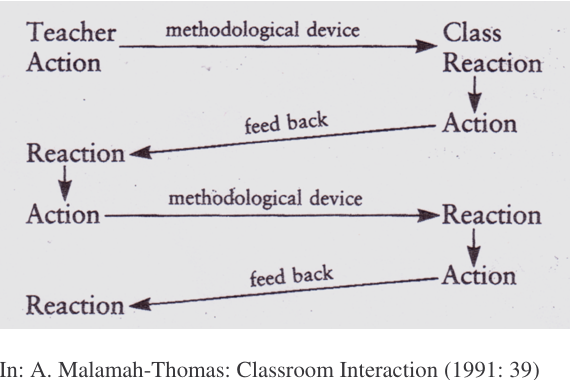
The teacher should constantly monitor the students’ reactions and take account of these reactions at every stage of the lesson. The learning even parallels the speech event. Pedagogic interaction parallels verbal interaction. Teaching acts can parallel speech acts.
Every utterance in a speech event consists of two factors: propositional content and communicative purpose. The propositional content refers to these aspects of the real world that the speaker wishes to make reference to. The communicative purpose refers to the speaker’s intention in making the utterance, the effect s/he wishes to create in the hearer.
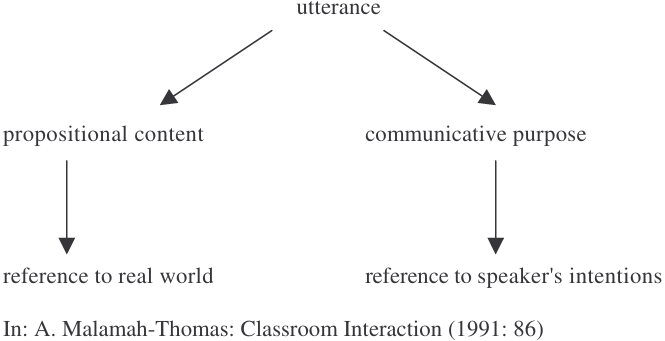
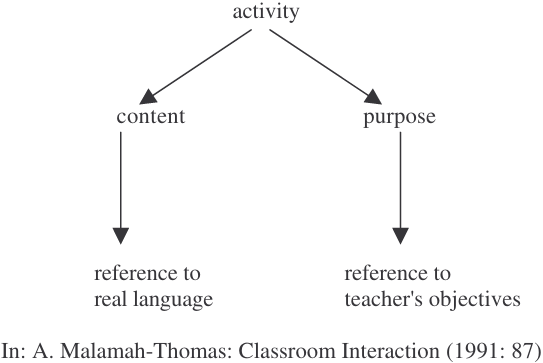
In a question: What are you laughing at? – the content is laughter and the cause of his laughter. The purpose is to get the person to stop laughing. Content of a methodological activity is the syllabus item or teaching point, the aspect of real language the teacher wishes to make reference to. Purpose refers to the teacher’s intention in employing the activity, the effect s/he wishes to create inn the learner.
Student – Student interaction can be developed in group context, that is the reason why we have to put an emphasis on classroom dynamics to be treated in the following part.








