APPLIED LINGUISTICS for BA Students in English
PARTICIPANTS OF LEARNING PROCESS
Learner types
The Age of Learners
The age of the students is a major factor in teachers’ decisions about how and what to teach. Learners of different ages have different needs, competences and cognitive skills. Some people say that children learn languages faster than adults do. Children are thought to pick up new languages effortlessly. Another belief is that adolescents are unmotivated. Adult learners can engage with abstract thought.
In the following table the basic differences among three age groups are presented.
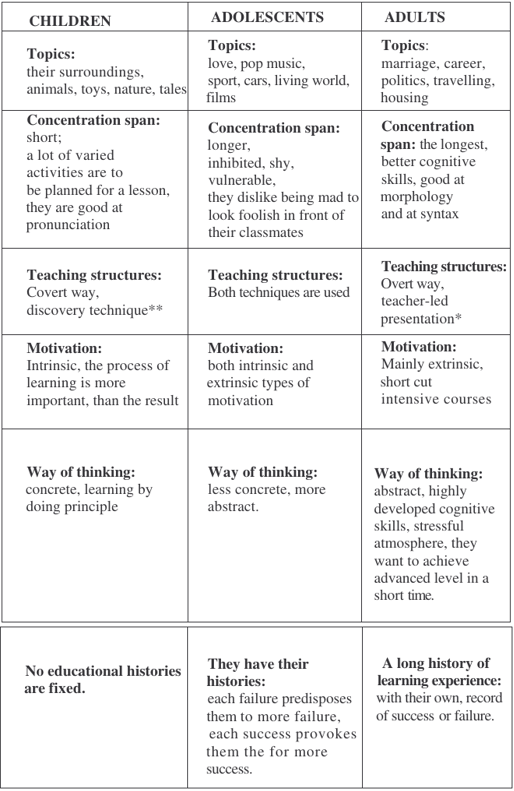
*TEACHER-LED PRESENTATION:
Lead in: the context is introduced and the meaning or the use of the new language is demonstrated
Elicitation: if students can produce the new language to see what problems students have
Explanation: teacher shows how the new language is formed
Accurate reproduction: students are asked to repeat and practice modal sentences Immediate creativity: to see if students have understood the structure
** DISCOVERY TECHNIQUE
Lead in: the context is introduced and the meaning or the use of the new language is demonstrated
Instead of Elicitation students work in pairs or individually and work on the task. Explanation: the teacher discusses with the students what they have found Practice.
Young learners (6-12 years)
- Children learn by doing – Concepts and language develop through engagement and involvement in doing things. Children’s way of thinking is concrete so we must not teach concepts to them but we have to develop manual skills through certain activities giving English instructions.
- Children need to make sense of the world – They can “grasp” meaning even if they do not fully understand language. Teachers are supposed to use English without explaining the grammatical rules.
- The process of learning is as important as the product – The activities in English classes must be attractive and enjoyable to the learners. Young learners cannot understand the point of learning a foreign language; they are interested in the games and activities in the lessons.
- There's nothing like success to succeed – Success will generate more success they will motivate learners intrinsically.
- Covert way of grammar teaching should be applied – Grammatical structures are presented and practiced in nursery rhymes, songs and tongue twisters. (Sárosdy-Gaál 1994: 11-14)
Adolescents (13-18 years)
- Search for individual identity – Peer approval may be more important for the student than the attention of the teacher.
- Adolescents may cause discipline problems – If the teacher manages to control them in a supportive and constructive way, they can be solved.
- Each failure predisposes them to more failure, each success provokes them for more success – Adolescents are very sensitive they can get more and more inhibited if they are hurt I their feelings.
- Both intrinsic and extrinsic types of motivation work with them – They enjoy age-relevant challenges but they are interested in extra scores for an entrance exam as well.
- Both covert and overt ways of grammar teaching can be applied – As this period is a transitory part in their lives, both ways can be useful. (Harmer 2003: 38-40)
Adults (18 – )
- They can engage with abstract thought – They like learning about the language and they are interested in the reasons for certain linguistic phenomena.
- They have a whole range of life experiences to draw on (eg. negative experience with learning Russian – Adults are not really confident because they have had a lot of failures while learning foreign languages so teachers should find new ways of motivation for them.
- They have expectations about the learning process so they are not open to new ways and methods.
- Adults are more disciplined than some teenagers; they are prepared to struggle on despite boredom.
- They are extrinsically motivated as they have clear understanding of why they are learning and what they want to get out of it.
- Overt way of grammar teaching can be applied as their cognitive skills are highly developed. On the other hand pronunciation is a weak point of adult learners as their organic basis of speech is not flexible at this age. (Harmer 2003: 40)








