









Grammar
Tenses
Present

Present Simple
Present Continuous
Present Perfect
Present Perfect Continuous
Past
Past Simple
Past Continuous
Past Perfect
Past Perfect Continuous
Future
Future Simple
Future Continuous
Future Perfect
Future Perfect Continuous
Parts Of Speech
Nouns
Countable and uncountable nouns
Verbal nouns
Singular and Plural nouns
Proper nouns
Nouns gender
Nouns definition
Concrete nouns
Abstract nouns
Common nouns
Collective nouns
Definition Of Nouns
Animate and Inanimate nouns
Nouns
Verbs
Stative and dynamic verbs
Finite and nonfinite verbs
To be verbs
Transitive and intransitive verbs
Auxiliary verbs
Modal verbs
Regular and irregular verbs
Action verbs
Verbs
Adverbs
Relative adverbs
Interrogative adverbs
Adverbs of time
Adverbs of place
Adverbs of reason
Adverbs of quantity
Adverbs of manner
Adverbs of frequency
Adverbs of affirmation
Adverbs
Adjectives
Quantitative adjective
Proper adjective
Possessive adjective
Numeral adjective
Interrogative adjective
Distributive adjective
Descriptive adjective
Demonstrative adjective
Pronouns
Subject pronoun
Relative pronoun
Reflexive pronoun
Reciprocal pronoun
Possessive pronoun
Personal pronoun
Interrogative pronoun
Indefinite pronoun
Emphatic pronoun
Distributive pronoun
Demonstrative pronoun
Pronouns
Pre Position
Preposition by function
Time preposition
Reason preposition
Possession preposition
Place preposition
Phrases preposition
Origin preposition
Measure preposition
Direction preposition
Contrast preposition
Agent preposition
Preposition by construction
Simple preposition
Phrase preposition
Double preposition
Compound preposition
prepositions
Conjunctions
Subordinating conjunction
Correlative conjunction
Coordinating conjunction
Conjunctive adverbs
conjunctions
Interjections
Express calling interjection
Phrases
Sentences
Clauses
Part of Speech
Grammar Rules
Passive and Active
Preference
Requests and offers
wishes
Be used to
Some and any
Could have done
Describing people
Giving advices
Possession
Comparative and superlative
Giving Reason
Making Suggestions
Apologizing
Forming questions
Since and for
Directions
Obligation
Adverbials
invitation
Articles
Imaginary condition
Zero conditional
First conditional
Second conditional
Third conditional
Reported speech
Demonstratives
Determiners
Direct and Indirect speech
Linguistics
Phonetics
Phonology
Linguistics fields
Syntax
Morphology
Semantics
pragmatics
History
Writing
Grammar
Phonetics and Phonology
Semiotics
Reading Comprehension
Elementary
Intermediate
Advanced
Teaching Methods
Teaching Strategies
Assessment

The demonstrative channel
 المؤلف:
Bernd Heine and Tania Kuteva
المؤلف:
Bernd Heine and Tania Kuteva
 المصدر:
The Genesis of Grammar
المصدر:
The Genesis of Grammar
 الجزء والصفحة:
P225-C5
الجزء والصفحة:
P225-C5
 2026-03-16
 258
258




+
-
20
The demonstrative channel
Presumably the most frequent source of markers introducing (restrictive) relative clauses is provided by demonstrative pronouns.1 The history of English that (Old English þæt, þe, later replaced by that), illustrates one major way in which this process may proceed (see O’Neil 1977; Hopper and Traugott 1993: 190 V.; van Gelderen 2004: 81 V. for detailed description). Note that both proximal and distal demonstratives may be used in this process. The process is in accordance with the main mechanisms of grammaticalization: desemanticization leads to a loss of the spatial deixis of the demonstrative, and decategorialization means that the demonstrative pronoun loses its inflectional variability and its freedom to occur on its own as an argument of the matrix clause and is restricted to introducing subordinate clauses, usually in a fixed position vis-à-vis the noun phrase to which it refers.
In Old Swedish, the transition from paratactic to hypotactic forms of clause combining is well documented. It was the masculine form sā of the demonstrative pronoun of Old Norse that was reinterpreted as a relative pronoun (Zeevaert 2006: 20–1). In the following example, there is still ambiguity between the (paratactic) demonstrative and the (hypotactic) use of sā as a non-restrictive relativizer:
(18) Old Norse (ca. 800 ad; Zeevaert 2006: 21)
stikuR karþi kubl þau aft auint sunu sin sa fial austr.
(i) ‘Stig made these monuments after his son Eyvind. He died in the east’. or
(ii) ‘Stig made these monuments after his son Eyvind, who died in the east.’
The rise of (restrictive) relative clauses based on this channel typically takes a form as paraphrased in (19), where two juxtaposed sentences, S1 and S2, are combined within one sentence and S2 is reinterpreted as a relative clause,2 roughly as illustrated in (19). The likely effects of this process are listed in (20). Note that the transition from demonstrative pronoun to relative pronoun is gradual, involving an intermediate stage where the relevant item is ambiguous in that it can be interpreted both with reference to a demonstrative and a clause subordinator; we saw this previously in our example in "The rise of new functional categories", another example will be provided in "The rise of a relative clause construction".
(19) From [S1 + S2] juxtaposition to S1 [S2] relativization
a. There is the car; that (one) I like.
b. There is the car [that I like].
(20) Reinterpretation processes in demonstrative-derived relative clauses
a. The demonstrative pronoun (DP) of S2 refers anaphorically (or cataphorically) to some
participant of S1.
b. The DP is grammaticalized to a relative clause marker.
c. S2 is grammaticalized to a relative clause.
d. The grammaticalization of the DP entails desemanticization (e.g. loss of spatial deixis)
and decategorialization (e.g. loss of morphosyntactic properties, or of the ability to be
used as a demonstrative attribute).
e. The DP tends to undergo erosion (e.g. loss of ability to receive stress).
f. The two clauses tend to be united under one intonation contour.
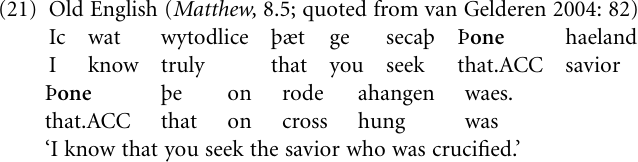
With the grammaticalization from demonstrative pronoun to relative clause marker in Old English, the latter could retain the case marking of its head noun, as in the following example, where the relative pronoun þone is accusative even though it functions as the subject of the relative clause:
Hopper and Traugott (2003: 197–9) discuss a number of additional properties characterizing the English that-construction, but these properties are crosslinguistically not generally relevant. For example, the pronominal element in the relative clause standing for the noun phrase that is coreferential with the matrix noun phrase may disappear in the course of grammaticalization, as it did in English, but there are languages where this did not happen even in tightly subordinated relative clauses. Furthermore, there are languages where the newly created relative clause marker has to be placed next to the noun phrase to which it refers, but there are other languages where this is not a requirement. This means that the relative clause marker can occur at quite some distance from its head noun phrase.
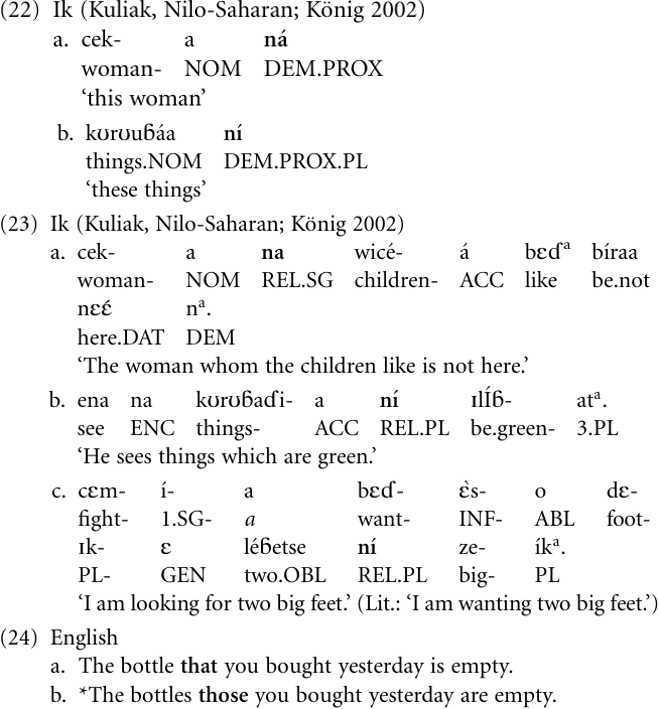
The Ik language of northeastern Uganda provides a typical example of this channel: The proximal demonstrative na, plural ni ‘this’ has developed into a relative clause marker; example (22) illustrates the former and (23) the latter function. As a demonstrative, it immediately follows the noun it determines, while as a relative clause marker it is placed at the end of the noun phrase, that is, after other modifiers. Thus, in (23c), it follows the numeral ‘two’.
Unlike its English counterpart that, the Ik item is less grammaticalized in that it has retained its number distinction, while the English item is decategorialized to the extent that it does not show number agreement with its head noun, hence (24a) is possible but not (24b).
Another example is provided by Classical Chinese. The item zhi was used exclusively as a demonstrative pronoun in the inscriptions of tortoise shells of the Shang Dynasty (c. sixteenth–eleventh century bc). Later on it was grammaticalized to a marker of relative clauses and associate and genitive phrases. The non-grammaticalized and the grammaticalized uses co-existed for several centuries (Shi and Li 2002: 6). But zhi is not the only Chinese demonstrative to have undergone a grammaticalization from demonstrative to relative clause marker.3 Another example is provided by di. Originally a demonstrative pronoun, it was first grammaticalized to mark relative clauses in the ninth century ad, undergoing erosion by losing its tone and changing to de. Shi and Li (2002: 13) describe the process as one of reanalysis, whereby the structure (25a) was reinterpreted as (25b), with di/de changing from forming a constituent with the following noun to forming a new constituent with the preceding relative clause.

To conclude, wherever there is historical evidence it shows that there is a unidirectional development from demonstrative to relative marker; conversely, we are not aware of any language where a relative clause marker has given rise to a demonstrative. And the process has the salient characteristics of grammaticalization, such as the bleaching out of demonstrative semantics (desemanticization) and loss of categorial properties characteristic of demonstratives.
1 Frajzyngier (1996: 336–42) claims a development from relative clause marker to demonstrative in some Chadic languages. The evidence presented, however, is such that we do not consider this to be an exception to the generalizations proposed here but rather as one that is in need of a more appropriate analysis.
2 Fritz Newmeyer (p.c.) argues that that in (19b) should be interpreted as a complementizer rather than a relativizer. For an account in the Minimalist framework, whereby the demonstrative starts out to occupy the specifier of a complement phrase and later, as a relativizer, becomes a head, see van Gelderen (2004: 81 V.).
3 We are ignoring here that, in addition to relative clause marking, the demonstratives also assumed other functions such as marking genitive phrase, associate phrases, etc.
 الاكثر قراءة في Linguistics fields
 اخر الاخبار
اخبار العتبة العباسية المقدسة

الآخبار الصحية


مواضيع ذات صلة
 قسم الشؤون الفكرية يصدر كتاباً يوثق تاريخ السدانة في العتبة العباسية المقدسة
 "المهمة".. إصدار قصصي يوثّق القصص الفائزة في مسابقة فتوى الدفاع المقدسة للقصة القصيرة
 (نوافذ).. إصدار أدبي يوثق القصص الفائزة في مسابقة الإمام العسكري (عليه السلام)






