Grassmannian
The Grassmannian  is the set of
  -dimensional subspaces in an
  -dimensional vector space. For example, the set of lines
  is projective space. The real Grassmannian (as well as the complex Grassmannian) are examples of manifolds. For example, the subspace
  has a neighborhood
  . A subspace
  is in
is in  if
if  and
and  and
and  . Then for any
  , the vectors
  and
and  are uniquely determined by requiring
  and
and  . The other six entries provide coordinates for
  .
.
In general, the Grassmannian can be given coordinates in a similar way at a point  . Let
. Let  be the open set of
  -dimensional subspaces which project onto
  . First one picks an orthonormal basis
  for
for  such that
  span
span  . Using this basis, it is possible to take any
  vectors and make a
  matrix. Doing this for the basis of
  , another
  -dimensional subspace in
  , gives a
  -matrix, which is well-defined up to linear combinations of the rows. The final step is to row-reduce so that the first
  block is the identity matrix. Then the last
  block is uniquely determined by
  . The entries in this block give coordinates for the open set
  .
.
If  is the standard basis of
  , a basis of
  is given by the
  vectors
  ,
,  . If
. If  is a basis of a subspace
  of dimension
  of
of  ,
,  corresponds to a point
  of
of  , whose coordinates are the components of
  with respect to the basis of
  given above. These coordinates are the so-called Grassmann coordinates of
  .
.
A different choice of the basis of  yields a different
  -tuple of coordinates, which differs from the original
  -tuple by a nonzero multiplicative constant, hence it corresponds to the same point.
The Grassmannian is also a homogeneous space. A subspace is determined by its basis vectors. The group that permutes basis vectors is  . The matrix that fixes
  is a diagonal block matrix, with a
  nonsingular matrix in the top left, and a
  invertible matrix in the lower right.
  acts transitively on the Grassmannian
  . Let
. Let  be the stabilizer (or isotropy) of
  . Then
  is the subgroup of
  consisting of matrices
 ![A=[a_(i,j)]](https://mathworld.wolfram.com/images/equations/Grassmannian/Inline65.gif) such that
such that  for all
  ,
,  such that
  and
and  .
.  is isomorphic to
  .
.
The tangent space to the Grassmannian is given by  matrices, i.e., linear maps from
  to the quotient vector space
  .
.
The elements  are the
  -minors of the
  matrix whose
  th row contains the components of
  with respect to the basis
  . It corresponds to a linear transformation
  whose range is
  . In general, the range of such a linear transformation has dimension
  iff the corresponding
  matrix has rank
  .
.
Let  be the subset of
  defined by the condition that all the
  -minors of the matrix
 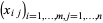 (which can be viewed as a sequence of
  coordinates) be equal to zero, and one
  -minor be nonzero. The Grassmannian
  can be viewed as the image of the map
  which maps each matrix of
  to the sequence of its
  -minors.
It as an algebraic projective algebraic variety defined by equations called Plücker's equations. It is a nonsingular variety of dimension  .
.
REFERENCES:
Fulton, W. Schubert Varieties and Degeneracy Loci. New York: Springer-Verlag, 1998.
Harris, J. "Grassmannians and Related Varieties." Lecture 6 in Algebraic Geometry: A First Course. New York: Springer-Verlag, pp. 63-71, 1992.
Kleiman, S. and Laksov, D. "Schubert Calculus." Amer. Math. Monthly 79, 1061-1082, 1972.
Shafarevich, I. R. Basic Algebraic Geometry, Vol. 1, 2nd ed. Berlin: Springer-Verlag, pp. 42-44, 1994.








