
Basic spectrometry: Natural line width
 المؤلف:
A. Roy, D. Clarke
المؤلف:
A. Roy, D. Clarke
 المصدر:
Astronomy - Principles and Practice 4th ed
المصدر:
Astronomy - Principles and Practice 4th ed
 الجزء والصفحة:
P 229
الجزء والصفحة:
P 229
 17-8-2020
 2167
2167
Basic spectrometry: Natural line width
The transitions from one energy level to another are not instantaneous and, as a consequence, the radiation absorbed or emitted does not occur at a unique frequency. The natural spread of any generated line depends on the ‘lifetimes’ of the excited states of the particular atom. A short lifetime produces narrow lines—as the lifetime increases the natural spread of the line increases.
If the Heisenberg uncertainty principle is applied, the energy of a given state cannot be assigned more specifically than
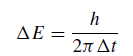
where Δt is the lifetime of the state. Consequently, any assembly of atoms produces a spectral line in emission or absorption with a spread in frequency such that
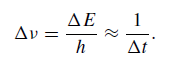
A typical excited atomic state may have a lifetime ∼10−8 s and, in the visible spectral domain (∼550 nm), this provides a wavelength spread ∼1·6 × 10−5 nm or 0·016 mA˚ . (In order to check the calculation it will be remembered that Δλ = λ2/c × Δν.)
In most physical situations, practical determination of natural emission widths is compromised by a variety of physical causes affecting the behaviour of the radiating atoms. Certainly this is the case in the general astrophysical environments as highlighted in the next three subsections which serve as examples of the importance of recording the details of spectral line profiles.
 0
0
 0
0
 الاكثر قراءة في مواضيع عامة في علم الفلك
 اخر الاخبار
اخبار العتبة العباسية المقدسة








