الوضع الليلي


 7:33:20
  2026-02-02
  2177
2177
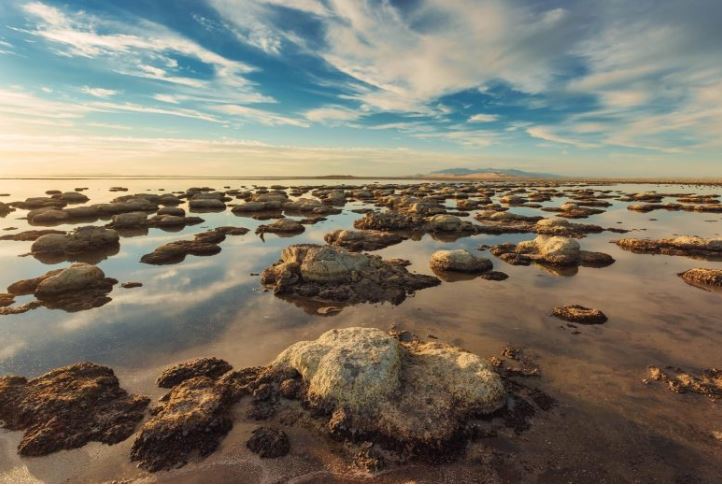
Utah geoscientists begin characterizing newly discovered mountain-sourced groundwater that extends thousands of feet beneath the playa.
New research from University of Utah geoscientists suggests that a large, pressurized body of freshwater may be hidden beneath the Great Salt Lake playa. The water is believed to have built up over thousands of years as snowmelt flowed down from nearby mountains and seeped deep into the subsurface. This groundwater fills tiny pore spaces within sediments that occupy the basin west of the Wasatch Mountains and lies beneath a salty layer roughly 30 feet thick.
In most places, this salt layer acts as a barrier that traps the freshwater below. However, there are natural openings in the form of unusual, circular mounds covered with reeds. These small islands appear where the pressurized freshwater finds a path upward and reaches the lake bed in Farmington Bay. Much of this area is now dry because of prolonged drought and upstream water diversions, making these features stand out even more against the exposed playa.
The research is supported by the Utah Department of Natural Resources and the Great Salt Lake Commissioner’s Office. The project is led by University of Utah hydrologists Bill Johnson and Kip Solomon, who are collaborating with scientists from the U.S. Geological Survey Water Science Center and the Utah Geological Survey. Together, the team is carrying out a wide-ranging study of this hidden groundwater system.
By combining multiple tools and techniques, they aim to map how deep and extensive the water is, analyze its chemical makeup, determine its age, and trace where it came from, along with documenting other key characteristics that could improve understanding of water resources beneath the shrinking lake.
“Fresh water exists under the periphery of the lake and maybe even under the lake itself. And we need to better characterize it to understand how we can use it as a resource,” said Johnson, a professor geology & geophysics. While he does not view the aquifer as a potential water source for replenishing the depleted lake, Johnson believes it could provide water for restoring lakebed crusts that naturally prevent exposed sediments from contributing to dust storms blowing into Wasatch Front cities.
Artesian water under the lake appears to be ancient
Great Salt Lake started taking its present shape about 8,000 years ago as a remnant of the vast freshwater Lake Bonneville that once covered most of northwestern Utah. Johnson suspects some of water contained in the aquifer dates back to the Bonneville era.
“The age of the water at depth is thousands of years old. It may be left over from the Ice Age,” he said. “That tells us that playa groundwater is not getting to the lake anytime soon. We know from complementary to-be-published studies that there is a big groundwater flux coming off the mountain front, but it seems to get to the lake via seepage to incoming rivers rather than via direct groundwater inflow in the playa.”
The research team recently shared the first in a series of expected papers tied to the project. Posted last month, the study presents results from piezometer measurements taken at newly forming mounds in Farmington Bay. This area lies between the southeast shoreline of the Great Salt Lake and Antelope Island. The data challenge long-held assumptions about how spring runoff moves through the landscape and ultimately enters the terminal lake.
According to lead author Ebenezer Adomako-Mensah, a graduate student working in Johnson’s lab, the measurements revealed an unexpected feature underground. Roughly 9 meters beneath the playa, researchers identified a boundary where freshwater meets saltwater. This previously unknown zone is now referred to as the “saltwater lens,” and its discovery is reshaping scientists’ understanding of subsurface water flow in the region.
What are these strange round spots?
Johnson and Adomako-Mensah have spent the last two years boring wells of varying depths into the mounds to install piezometers that measure water pressure and flow at depth. They regularly return by airboat or mountain bike to collect data, which now shows these mounds occur where freshwater is pushed under pressure through the saltwater lens to the surface of the playa.
This paper is part of a larger state-funded research effort involving several other senior members of the U’s geology faculty, including Kip Solomon, Mike Thorne, and Michael Zhdanov, aimed at fully characterizing the body of freshwater hidden under the salty lake.
Solomon’s lab is using isotope analysis to determine the age of the groundwater and its recharge elevation, or where it originated in the mountains. Thorne is constructing on-ground resistivity profiles. And Zhdanov and Michael Jorgensen are processing the electromagnetic data gathered in airborne geophysical surveys to construct a 3D image of the playa’s deep subsurface.
For Johnson, key questions begin with the mysterious round spots that have been called “phragmites oases” and “mystery islands” in recent news media accounts.
“Because you have water flowing from the mountains to the basin that can create pressure under Farmington Bay, it’s actually driving the water upwards. Before we got these numbers, no one knew there was artesian freshwater under the entire eastern playa, nobody knew how extensive this pressurized water under Farmington Bay was,” Johnson said. “This is a ton of work on Eben’s part, doing tests in the field and tests in the lab to get these numbers. They show that the conductivity range is pretty big, but conductivity is low except in a few special cases such as the ‘phragmites islands’ where the sediment is coarse.”
Why the sediment is coarser in these spots, and why these features are circular, and whether their existence is related to basement structure, remain unknown, and these questions warrant further investigation, the study states. Also needed is more analysis to understand whether the younger lakeward lateral flux of water from the mountains forms a continuous arc with the ancient upward vertical flux under the playa. Accordingly, this U-led project is generating more and more questions that will likely keep curious scientists busy for years.
Reality Of Islam |
|

Keeping sil
Two experim
Changing a
Plants are
 9:3:43
2018-11-05
9:3:43
2018-11-05
10 benefits of Marriage in Islam
7:5:22
2019-04-08
benefits of reciting surat yunus, hud &
9:45:7
2018-12-24
advantages & disadvantages of divorce
11:35:12
2018-06-10
6:0:51
2018-10-16
9:42:16
2022-10-19
5:58:12
2021-12-18
6:0:8
2023-03-19
4:26:43
2022-02-21
7:45:39
2018-06-21
10:35:40
2022-05-26
9:30:2
2021-11-12
5:41:46
2023-03-18
| LATEST |
 HOME
HOME