Detection of counterfeit materials
The ability of NIR spectroscopy to detect both physical and chemical differences between samples means it can be used like fingerprinting. For example, batch-to-batch variation of tablets, or tablets manufactured at different sites, can often be distinguished. Similarly, the detection of counterfeit products is possible (Scafi and Pasquini 2001). Spectra of a representative sample of the genuine product are compared to those of the suspected counterfeit. While spectral comparison methods such as maximum wavelength distance may be used, methods such as Principal Component Analysis (PCA) are often to be preferred (Fig. 1).
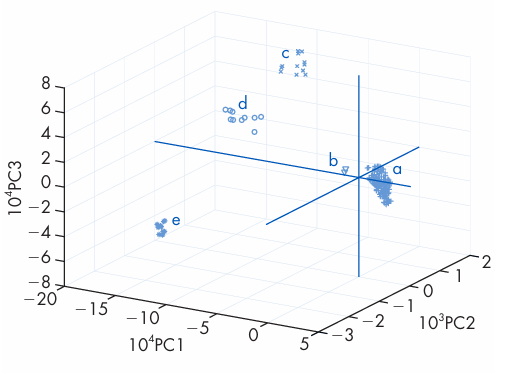
Figure 1 Principal components analysis score plot (first three principal components, PC1, PC2 and PC3) illustrating the detection of counterfeit tablets. (a) and (b) genuine product; (c), (d) and (e) counterfeit samples.
Materials and/or products must be handled with care. Tablets and the like often rapidly exchange moisture with the atmosphere and an apparently suspect product might simply have a different moisture content. If moisture differences are not important, then genuine and suspect samples should be allowed to equilibrate to ambient humidity before measurement.
When differences in moisture are important, measurements must be made as soon as the samples are opened (e.g. tablets should be measured immediately they are removed from a blister pack).








