Grammar
Tenses
Present

Present Simple
Present Continuous
Present Perfect
Present Perfect Continuous
Past
Past Simple
Past Continuous
Past Perfect
Past Perfect Continuous
Future
Future Simple
Future Continuous
Future Perfect
Future Perfect Continuous
Parts Of Speech
Nouns
Countable and uncountable nouns
Verbal nouns
Singular and Plural nouns
Proper nouns
Nouns gender
Nouns definition
Concrete nouns
Abstract nouns
Common nouns
Collective nouns
Definition Of Nouns
Animate and Inanimate nouns
Nouns
Verbs
Stative and dynamic verbs
Finite and nonfinite verbs
To be verbs
Transitive and intransitive verbs
Auxiliary verbs
Modal verbs
Regular and irregular verbs
Action verbs
Verbs
Adverbs
Relative adverbs
Interrogative adverbs
Adverbs of time
Adverbs of place
Adverbs of reason
Adverbs of quantity
Adverbs of manner
Adverbs of frequency
Adverbs of affirmation
Adverbs
Adjectives
Quantitative adjective
Proper adjective
Possessive adjective
Numeral adjective
Interrogative adjective
Distributive adjective
Descriptive adjective
Demonstrative adjective
Pronouns
Subject pronoun
Relative pronoun
Reflexive pronoun
Reciprocal pronoun
Possessive pronoun
Personal pronoun
Interrogative pronoun
Indefinite pronoun
Emphatic pronoun
Distributive pronoun
Demonstrative pronoun
Pronouns
Pre Position
Preposition by function
Time preposition
Reason preposition
Possession preposition
Place preposition
Phrases preposition
Origin preposition
Measure preposition
Direction preposition
Contrast preposition
Agent preposition
Preposition by construction
Simple preposition
Phrase preposition
Double preposition
Compound preposition
prepositions
Conjunctions
Subordinating conjunction
Correlative conjunction
Coordinating conjunction
Conjunctive adverbs
conjunctions
Interjections
Express calling interjection
Phrases
Sentences
Clauses
Part of Speech
Grammar Rules
Passive and Active
Preference
Requests and offers
wishes
Be used to
Some and any
Could have done
Describing people
Giving advices
Possession
Comparative and superlative
Giving Reason
Making Suggestions
Apologizing
Forming questions
Since and for
Directions
Obligation
Adverbials
invitation
Articles
Imaginary condition
Zero conditional
First conditional
Second conditional
Third conditional
Reported speech
Demonstratives
Determiners
Direct and Indirect speech
Linguistics
Phonetics
Phonology
Linguistics fields
Syntax
Morphology
Semantics
pragmatics
History
Writing
Grammar
Phonetics and Phonology
Semiotics
Reading Comprehension
Elementary
Intermediate
Advanced
Teaching Methods
Teaching Strategies
Assessment


The circumstantial roles associated with the process
 المؤلف:
Angela Downing
المؤلف:
Angela Downing
 المصدر:
ENGLISH GRAMMAR A UNIVERSITY COURSE
المصدر:
ENGLISH GRAMMAR A UNIVERSITY COURSE
 الجزء والصفحة:
P157-C5
الجزء والصفحة:
P157-C5
 2026-05-19
 24
24




+
-
20
The circumstantial roles associated with the process
These include the well-known circumstances of time, place, manner and condition, as well as a few others. They are typically optional in the semantic structure, just as their adjunctive counterparts are in the syntactic structure. Circumstances can, however, be inherent to the situation: for instance, location is obligatory with certain senses of ‘be’, as in the ice-cream’s over there, and with ‘put’ in its sense of ‘placing’ as in let’s put it in the freezer.
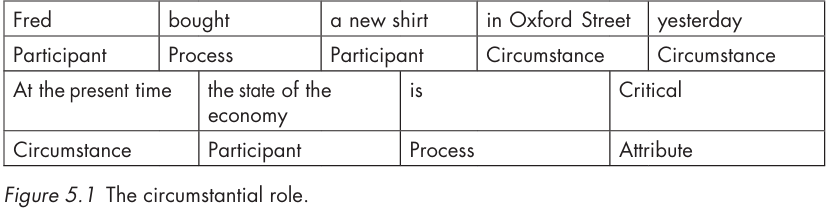
We have now outlined the framework that will serve to carry the different configurations of semantic functions that go to make up semantic structures. It is not the case, however, that any particular configuration is inherently given in nature. There are various ways of conceptualizing a situation, according to our needs of the moment and what the lexico-grammatical resources of a language permit.
For instance, on the day planned for a river picnic we may look out of the window and say it’s cloudy, specifying simply a state (is) and an Attribute (cloudy); alternatively, that the sky is cloudy, adding a participant (the sky) for the Attribute. More ominously, someone might say the clouds are gathering, in which the situation is represented as a dynamic happening rather than as a state, with a participant (clouds) and a dynamic process (are gathering), leaving implicit the circumstance of place (in the sky).
There is no one-to-one correlation between semantic structures and syntactic structures; rather, the semantic categories cut across the syntactic ones, although with some correlation. Semantic structures and syntactic structures do not, therefore, always coincide; rather, they overlap. In both cases, however, it is the process, expressed by the verb, that determines the choice of participants in the semantic structure and of syntactic elements in the syntactic structure. The possible syntactic combinations are discussed from the point of view of verb complementation and verb type. We shall start from the semantics; at the same time we shall try to relate the choice of semantic roles to their syntactic realizations.
One obvious problem in the identification of participants and processes is the vastness and variety of the physical world, and the difficulty involved in reducing this variety to a few prototypical semantic roles and processes. All we can attempt to do is to specify the paradigm cases, and indicate where more detailed specification would be necessary in order to account semantically for the varied shades of our experience.
 0
0
 0
0
لا توجد تعليقات بعد
ما رأيك بالمقال : كن أول من يعلق على هذا المحتوى
 الاكثر قراءة في Grammar
 اخر الاخبار
اخبار العتبة العباسية المقدسة

الآخبار الصحية


مواضيع ذات صلة
 قسم الشؤون الفكرية يصدر كتاباً يوثق تاريخ السدانة في العتبة العباسية المقدسة
 "المهمة".. إصدار قصصي يوثّق القصص الفائزة في مسابقة فتوى الدفاع المقدسة للقصة القصيرة
 (نوافذ).. إصدار أدبي يوثق القصص الفائزة في مسابقة الإمام العسكري (عليه السلام)