







Grammar
Tenses
Present

Present Simple
Present Continuous
Present Perfect
Present Perfect Continuous
Past
Past Simple
Past Continuous
Past Perfect
Past Perfect Continuous
Future
Future Simple
Future Continuous
Future Perfect
Future Perfect Continuous
Parts Of Speech
Nouns
Countable and uncountable nouns
Verbal nouns
Singular and Plural nouns
Proper nouns
Nouns gender
Nouns definition
Concrete nouns
Abstract nouns
Common nouns
Collective nouns
Definition Of Nouns
Animate and Inanimate nouns
Nouns
Verbs
Stative and dynamic verbs
Finite and nonfinite verbs
To be verbs
Transitive and intransitive verbs
Auxiliary verbs
Modal verbs
Regular and irregular verbs
Action verbs
Verbs
Adverbs
Relative adverbs
Interrogative adverbs
Adverbs of time
Adverbs of place
Adverbs of reason
Adverbs of quantity
Adverbs of manner
Adverbs of frequency
Adverbs of affirmation
Adverbs
Adjectives
Quantitative adjective
Proper adjective
Possessive adjective
Numeral adjective
Interrogative adjective
Distributive adjective
Descriptive adjective
Demonstrative adjective
Pronouns
Subject pronoun
Relative pronoun
Reflexive pronoun
Reciprocal pronoun
Possessive pronoun
Personal pronoun
Interrogative pronoun
Indefinite pronoun
Emphatic pronoun
Distributive pronoun
Demonstrative pronoun
Pronouns
Pre Position
Preposition by function
Time preposition
Reason preposition
Possession preposition
Place preposition
Phrases preposition
Origin preposition
Measure preposition
Direction preposition
Contrast preposition
Agent preposition
Preposition by construction
Simple preposition
Phrase preposition
Double preposition
Compound preposition
prepositions
Conjunctions
Subordinating conjunction
Correlative conjunction
Coordinating conjunction
Conjunctive adverbs
conjunctions
Interjections
Express calling interjection
Phrases
Sentences
Clauses
Part of Speech
Grammar Rules
Passive and Active
Preference
Requests and offers
wishes
Be used to
Some and any
Could have done
Describing people
Giving advices
Possession
Comparative and superlative
Giving Reason
Making Suggestions
Apologizing
Forming questions
Since and for
Directions
Obligation
Adverbials
invitation
Articles
Imaginary condition
Zero conditional
First conditional
Second conditional
Third conditional
Reported speech
Demonstratives
Determiners
Direct and Indirect speech
Linguistics
Phonetics
Phonology
Linguistics fields
Syntax
Morphology
Semantics
pragmatics
History
Writing
Grammar
Phonetics and Phonology
Semiotics
Reading Comprehension
Elementary
Intermediate
Advanced
Teaching Methods
Teaching Strategies
Assessment


DIRECTIVES: GETTING PEOPLE TO CARRY OUT ACTIONS DIRECTIVES AND THE IMPERATIVE
 المؤلف:
Angela Downing
المؤلف:
Angela Downing
 المصدر:
ENGLISH GRAMMAR A UNIVERSITY COURSE
المصدر:
ENGLISH GRAMMAR A UNIVERSITY COURSE
 الجزء والصفحة:
P141-C4
الجزء والصفحة:
P141-C4
 2026-05-18
 54
54




+
-
20
DIRECTIVES: GETTING PEOPLE TO CARRY OUT ACTIONS
DIRECTIVES AND THE IMPERATIVE
Although the basic speech act associated with imperative clauses is commonly held to be that of expressing a command, the imperative is used more frequently in English for less mandatory purposes. It can imply attitudes and intentions that are not actually formulated in the clause, and which can only be interpreted through a knowledge of the background context and of the relationships that exist between the persons involved.
In fact, the difference between commands and other directives such as requests, invitations and advice is, as we have already seen, not clear-cut. It depends on such factors as the relative authority of the speaker towards the addressee and whether the addressee is given the option of complying or not with the directive: in the case of a command there is no option, whereas with a request there is.
Other factors include which of the two interlocutors is judged to benefit from the fulfilment of the action: a piece of advice benefits the addressee, whereas a request benefits the speaker. Good wishes (Get well soon!) rarely refer to agentive acts and so aren’t directives.
Politeness is also a major factor. The more the action is likely to benefit the addressee, the more socially acceptable an imperative will be. Otherwise, an imperative is likely to sound abrupt or demanding in English.
Consider the following cost–benefit scale on which the imperative is kept constant. The utterances at the lower end of the scale sound more polite than those at the top, even though there are no specific markers of politeness present:
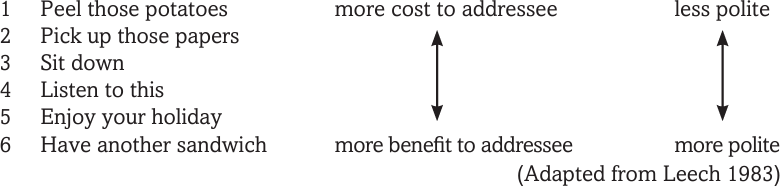
Other factors override politeness, however, such as emergency (Help!) or attention- seeking in conversation (Look, what I meant was . . .); the imperative can also be used when the speaker and hearer are carrying out a joint task (Pass me the spanner), when the hearer’s interests are put first (Don’t worry! Cheer up! Take care!), and even as a discourse initiator or topic introducer (Guess who I saw this morning at the bank).
The speech-act force of imperatives has, therefore, to be worked out by the addressee from the logical meaning of the sentence combined with the inferences made on the basis of context and the speaker–hearer relationship. Isolated examples can simply illustrate some typical interpretations:
Get out of here! command
Keep off the grass. prohibition
Please close the window! request
Don’t tell me you’ve passed your driving test! disbelief
Do that again and you’ll be sorry. condition of threat
Pass your exams and we’ll buy you a bike. condition of promise
Don’t forget your umbrella! reminder
Mind the step!/ Be careful with that hot plate! warning
Feel free to take as many leaflets as you like. permission
Just listen to this! showing interest/involvement
Try one of these! offer
Let’s go jogging! suggestion
Come on now, don’t cry!/ Go on, have a go! encouragement
Sleep well! Have a safe journey! good wishes
Suppose he doesn’t answer. considering a possible happening
Think nothing of it. rejecting thanks
[Some people make easy profit.] Take drug handlers. illustrative example of a claim
 0
0
 0
0
لا توجد تعليقات بعد
ما رأيك بالمقال : كن أول من يعلق على هذا المحتوى
 الاكثر قراءة في Grammar
 اخر الاخبار
اخبار العتبة العباسية المقدسة

الآخبار الصحية


مواضيع ذات صلة
 قسم الشؤون الفكرية يصدر كتاباً يوثق تاريخ السدانة في العتبة العباسية المقدسة
 "المهمة".. إصدار قصصي يوثّق القصص الفائزة في مسابقة فتوى الدفاع المقدسة للقصة القصيرة
 (نوافذ).. إصدار أدبي يوثق القصص الفائزة في مسابقة الإمام العسكري (عليه السلام)






