Nouns and verbs
The fourth layer: demonstratives, adpositions, aspects, and negation
It is hard to find a common semantic denominator for categories of the fourth layer of grammaticalization. What they have in common is their grammaticalization behavior, that is, the fact that they tend to be derived from categories of the first three layers and that they provide sources for categories of subsequent layers. In fact, three of the four categories of this layer, demonstratives, adpositions, and verbal aspects, exhibit rich grammaticalization behavior, while negation does not: Negative markers do not normally grammaticalize to other functional categories.
Demonstrative > pronoun Demonstrative pronouns provide perhaps the most common source for third person pronouns. Desemanticization has the effect that the spatial deixis of the demonstrative is bleached out, giving way to contextual or co-textual deixis, while decategorialization means that the inflectional structure that the demonstrative may have is reduced, the result being, as a rule, that an invariable personal pronoun emerges, which is no longer part of the paradigm of demonstrative categories but becomes part of the paradigm of personal pronouns (Heine and Kuteva 2002a: 112–13).
A paradigm example is provided by the Latin distal demonstrative ille (masculine), illa (feminine) ‘that’, which provided the source for third person pronouns in the modern Romance languages (see Vincent 1995: 442), for example French il ‘he’, elle ‘she’. Erosion had the effect that the disyllabic Latin source items were reduced to monosyllabic personal pronouns in the Romance languages. A similar development appears to have taken place in Ancient Egyptian: The proximal demonstrative pro noun pw ‘this’ was also used as a general third person pronoun (‘he’, ‘she’, ‘it’, ‘they’; Gardiner 1957: 85 f., 103). Lezgian offers another example, where the distal demonstrative a ‘that’ in combination with the absolutive case serves as a third person singular pronoun am ‘he’, ‘she’, ‘it’ (Haspel math 1993: 190, 401).
Demonstrative > definite marker Crosslinguistically this appears to be the most common way in which definite articles arise (Greenberg 1978, 1991; Diessel 1999b; Heine and Kuteva 2002a: 109–11). The transition from demonstrative attribute to definite article appears typically to lead from exophoric to endophoric demonstrative and finally to definite marker (Diessel 1998: 7–8), and it is both proximal and distal demonstrative attributes that can be recruited.
In this process, desemanticization has the effect that the demonstrative loses its deictic (locative) content, such as the ability to express relative distance (e.g. proximal vs. distal). Via decategorialization, the demonstrative loses its independent status, becoming an appendage of its head noun, it changes from free word to clitic, and eventually it may turn into an affix. Finally, erosion may enter the process as well, in that the erstwhile demonstrative tends to be shortened and loses the ability to carry stress. A canonical instance of such a process can be observed in Chinook Jargon: the general demonstrative u̒kuk ‘this, that’ (deictic pronoun) was grammaticalized to a definite article uk- in Grand Ronde Chinook Jargon. This process involved three of the parameters distinguished above: The demonstrative lost its deictic semantics (desemanticization), its status as an independent word, becoming an NP-prefix (decategorialization), and it also lost in phonetic substance (erosion), in that u̒kuk was reduced to uk-.1
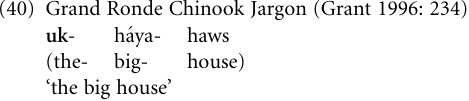
In the development of the French definite article, erosion meant that the Latin distal demonstrative ille (masculine), illa (feminine) ‘that’ was reduced to le and la, respectively (see e.g. Vincent 1995: 442), and the Old Norse postposed demonstrative *hinn ‘that’ (e.g. *u̒lfr hinn ‘that wolf’) ended up in Danish as a definite singular marker for common gender-en, as in dreng-en ‘the boy’ (Hopper and Traugott 1993: 9).
Observations made in a number of creoles suggest that this is a ubiquitous process. For example, Bruyn observes that the demonstrative da ‘that’ (presumably derived from English that) of the English-based creole Sranan assumed roughly the function of a definite article: ‘‘The 18th century determiner da could convey demonstrative force. Over the course of time, it increased in frequency, lost some of its deictic value, and has been reduced in form, via na to a’’ (Bruyn 1996: 39; see also Boretzky 1983: 97).
Demonstrative > relative clause marker Demonstrative pronouns are presumably the most frequent source of markers introducing (restrictive) relative clauses, English that being a paradigm example (O’Neil 1977; Hopper and Traugott 1993: 190 V.; see also “The demonstrative channel”). In contradistinction to the pathway from demonstrative to definite article, the present pathway concerns demonstratives used as pronouns rather than as nominal determiners, but as in the former case, both proximal and distal demonstratives may be used. Since we will return to this pathway, a few observations may be enough to illustrate this grammaticalization process. The process involves on the one hand desemanticization, in that the spatial deixis of the demonstrative is bleached out, and on the other hand decategorialization, in that the demonstrative pronoun loses its freedom to occur on its own as an argument of the clause and is restricted to the function of presenting relative clauses.
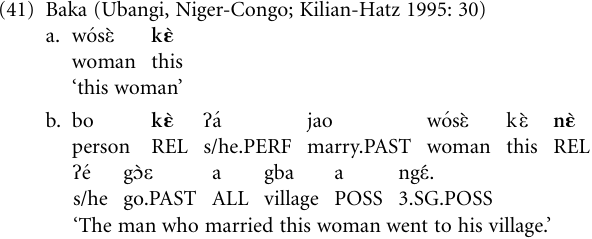
The following example from the Central African language Baka illustrates the grammaticalization process. In example (41a), the proximal demonstrative kὲ ‘this’ serves as a nominal determiner, which like all other modifiers follows its head noun. In (41b), the same item serves as a pronoun that is used to present the following clause. The resulting relative clause is bracketed in that in addition to the clause-initial relativizer there is a clause-final marker nὲ, diachronically an adverb meaning ‘here’.
Demonstrative > complementizer We will deal in some detail with this pathway of grammaticalization in “The demonstrative channel”; suffice it to cite an ex ample from English, where that was originally a distal demonstrative pro noun (þæt) but was—already by the stage of Old English—grammaticalized to an object clause complementizer and, beginning with the fourteenth century, also to a subject clause complementizer (see Hopper and Traugott 1993: 185–9). Roughly the same process happened in German, where the singular neuter form of the demonstrative thaƷ of Old High German developed into the complementizer dass (distinguished orthographically, though not phonetically, from the Modern High German neuter article das, the successor of the demonstrative thaƷ). The process from demonstrative pronoun to complementizer is universally attested; it is most commonly found in Africa, where several hundred or more languages appear to have undergone this development.
Aspect > tense All the available crosslinguistic data suggest that the structuring of events is directional in that there appears to be a unidirectional process whereby linguistic expressions for linguistic aspect, such as completive or perfect markers, highlighting the boundary behavior of events, may gradually develop into tense markers, that is, expressions for deictic time such as past tense, while we are not aware of any convincing evidence to show that a past tense marker turned into an aspect marker such as a perfect (see Bybee, Perkins, and Pagliuca 1994). The evidence that is available essentially concerns two pathways of development, namely that from perfect (anterior) to past tense markers, and from progressive to present tense markers.
A number of European languages are experiencing a process from perfect expressing current relevance (= present anteriors) to past tense markers, and this development can be described in terms of the following four-stage model (see Heine and Kuteva 2006 for details).
Stage 0: This stage is characterized by the presence of a perfect, that is, a present anterior form
expressing current relevance but having no aorist/preterite function.
Stage 1: The perfect spreads into the domain of the past, assuming functions of an
aorist/preterite, and it competes with the already existing markers expressing past
time reference. At a more advanced stage, aorist/preterite is marginalized.
Stage 2: Aorist/preterite is completely lost, there is now only one form for the semantic Welds
of current relevance, perfective past and imperfective past. The erstwhile perfect can
no longer be combined with past time markers to form pluperfects.
Stage 3: The erstwhile perfect marker starts to take over other typical features of past time
markers. It can no longer be combined with future markers to form future perfects,
and it acquires modal uses.
Adposition > case marker When discussing the development from noun to case marker we observed that there is an intermediate stage where the relevant form serves as an adposition (see also Noun > adposition); accordingly, there is a more extensive development noun > adposition > case marker (see Lehmann 1982: 79–86, 1985: 304). However, since adpositions are not only derived from nouns but also from other categories (see Verb > adposition, Adverb >adposition), the present pathway is not restricted to case markers of nominal origin. When turning into case markers, adpositions lose most or all of the semantic content they may have had, such as expressing spatial deixis (desemanticization), they become restricted in their occurrence to contexts where they express a syntactic function, they develop into noun phrase clitics or even affixes (decategorialization), and they tend to lose in phonetic substance (erosion). The following general remarks on western European languages also apply in some way or other to many languages in other parts of the world:
Thus the prepositions Engl. of, French de, German von all had a fuller ablative meaning, but are now largely devoid of it and mostly used as attributors. The fate of English to, Romance a is similar: they have been grammaticalized from directional prepositions to case markers of the dative and, in Spanish, even the accusative. (Lehmann 1982: 82)
In many languages, like the ones just cited, the resulting case markers do not develop into case affixes but rather remain clitics, or clitics bordering affixation, and rather than cliticizing on the noun, they can also merge with a determiner, as has happened in a numberof languages that use both prepositions and pre-posed determiners, such as French (à le > au ‘to the’) or German (zu dem > zum ‘to the’).
There is massive evidence that this development is essentially unidirectional. For example, in its preliterary period before 1200 AD, Hungarian had postpositions; but as from the beginning of the literary tradition, the postpositions appear as case suffixes (Lehmann 1982: 85).
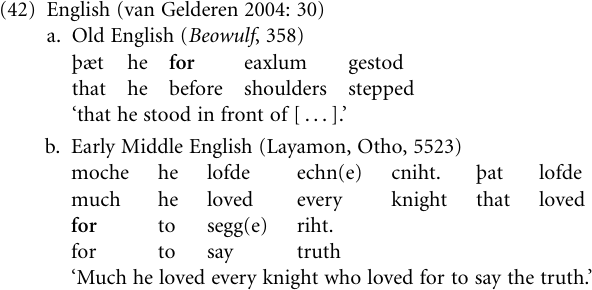
Adposition > complementizer As we will see in more detail in “Expansion”, prepositions and postpositions, being heads of noun phrases, commonly develop into markers of complement clauses, that is complementizers. For example, for was a preposition of location and purpose in Old English, as in (42a), but came to be used as a complementizer by early Middle English, cf. (42b) (van Gelderen 2004: 30).
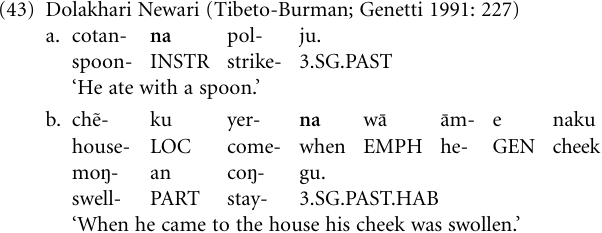
Adposition > subordinator Adpositions becoming case markers may develop further into markers of adverbial clause subordination (see Case marker > subordinator), but they may as well move straight to marking adverbial clauses without an intervening stage of case marker. This will be discussed in “Expansion”. The following example illustrates this pathway: The ergative/instrumental marker-na of the Tibeto-Burman language Newari, described as a postposition of nouns (43a), is hypothesized to have given rise to the temporal clause subordinator-na suffixed to verbs (43b).
1 The definite article of Grand Ronde Chinook Jargon is used in broadly the same contexts as the definite article in English, which suggests that contact-induced replication played a role in the process (see Heine and Kuteva 2005).








