Nouns and verbs
The third layer: adjectives and adverbs
We saw in “Nouns and verbs” how nouns and verbs give rise to minor categories, including categories that are widely treated as lexical categories, such as adjectives and adverbs. In the present section we are concerned with the latter two, that is, with lexical modifiers of nouns (adjectives) and of verbs or clauses (adverbs).
Adjectives may develop into all kinds of functional markers, into clitics and affixes. The English adjective full has acquired some productivity as a nominal suffix-ful, as in joyful, shameful, beautiful, etc. But more so than in English, adjectives in German have provided the source for a number of derivational suffixes, such as-frei ‘free from’ (< frei ‘free’),-leer ‘devoid of’ (< leer ‘empty’),-voll ‘full of’ (< voll ‘full’), etc.
That adjectives may also give rise to adpositions has been mentioned in a number of studies. König and Kortmann (1991: 109), for example, observe: ‘‘That adjectives may develop into prepositions is shown by German examples such as fern, unweit, längs, entlang, frei, and English examples such as along, near, worth, subsequent to, precious to, etc.’’ Quantifying adjectives such as ‘some’ or ‘all’, in particular, have experienced various grammaticalizations. For example, words for ‘some’ have occasionally given rise to indefinite articles, as has happened with some in earlier forms of English. Words for ‘all’ have developed into number markers in some languages, as in the French-based creole Tayo of New Caledonia, where French tous les ‘all the’ provided the source for the nominal plural proclitic or prefix tule (frequently reduced to tle or te) (Heine and Kuteva 2002a: 36).
Furthermore, in a number of languages, words for ‘all’ have given rise to comparative markers of superlative, as for example in the Finnic language Estonian, where the form koı̃k ‘all’ serves as a superlative marker (‘of all’), and in the Baltic language Latvian, the quantifier viss ‘all’ has developed into the superlative prefix vis- (Stolz 1991b: 50–4).
Adjectives may give rise to adverbs. When this happens, adjectives are decategorialized in losing the ability to be inflected for number, gender, and/or case and turn into invariable forms that modify verbs or clauses rather than nouns. Latin adjectives are inflected for all these functions, but in those cases where they gave rise to adverbs, they were frozen in one of the possible inflectional forms. In this way, the adjective ver-us ‘true’ provided the source for the adverb vero ‘truly, in fact’, and prim-us ‘first’ for the adverb primō ‘in the first place’, and the degree adverbs multum ‘much’ and quantum ‘how much’ are accusative case forms of adjectives that have been decategorialized to invariable adverbs (Janson 1979: 101; Blake 1994: 182). In the Bantu language Swahili, adjectives are inflected for noun class gender; but those adjectives that developed into adverbs became unanalyzable morphemes, having the frozen noun class markers such as ki- (class 7) or vi- (class 8) on them, for example-dogo ‘small’ (adjective) > kidogo ‘a little’ (adverb), -zuri ‘nice’ (adjective) > vizuri ‘nicely, well’. On the basis of such data one might argue that there is a pathway adjective > adverb. However, the overall evidence is not entirely conclusive and we have therefore decided not to postulate such a pathway, which is in need of further investigation.
So far, no crosslinguistically regular grammaticalization patterns leading from adjectives to minor functional categories have been identified; their potential for grammaticalization appears to be limited. Our focus in this section therefore is on adverbs.
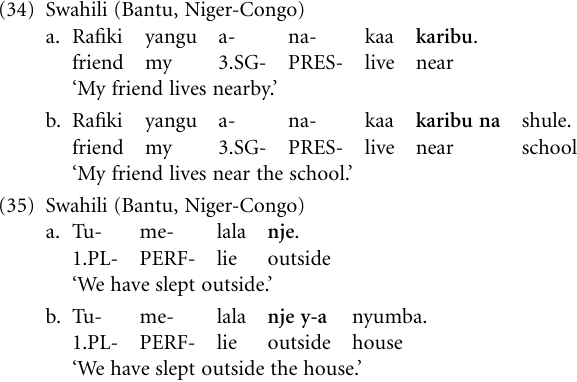
Adverb > adposition Next to nouns and verbs, adverbs form the third major source of adpositions. Adverbs belong to those categories that show a particularly free word order behavior; with their grammaticalization to adpositions they are decategorialized in that they lose that freedom and become tied to the position next to a noun (phrase). Normally it is not the adverb on its own that develops into an adposition; rather, it tends to require some linking element, such as a case inflection or an adposition. In Swahili, for example, it is the comitative preposition na ‘with’ or the gender-sensitive possessive/genitive particle-a which link the adverb with the noun. Thus, the adverb karibu ‘nearby’, illustrated in (34a), requires na to form an adposition (34b), while the adverb nje ‘outside’ in (35a) requires the genitive particle-a for the same purpose (35b).
Adverb > demonstrative It has been argued that demonstratives are diachronically basic or ,,semantic primitives‘‘, in that they may give rise to other kinds of grammatical categories, while they themselves cannot be historically derived from other entities such as lexical items (see Plank 1979; Diessel 1999b: 150 V.). This view is in need of revision: There is massive evidence to show that demonstrative determiners have locative adverbs as their primary diachronic source; in addition, verbs such as ‘go’ or ‘see’ may also form the source of demonstratives (see Heine and Kuteva 2002a: 172–3, 159, 294–5; see also “The second layer: verbs”).
The way that the process from adverb to demonstrative determiner is likely to happen is that ad-verbial modifiers typically denoting proximal (‘here’) and distal (‘there’) location are added appositionally to nouns (e.g. ‘the house here/there’) and grammaticalize to nominal determiners (‘this/that house’). This process usually does not involve desemanticization, in that the markers concerned retain their locative semantics, but decategorialization has the effect that the markers become restricted in their occurrence to the position next to the noun; they are no longer part of the paradigm of adverbs, and tend to change from free words to nominal clitics, sometimes even to affixes.
In a number of languages, the locative adverb is added while the already existing determiner is retained, thereby giving rise to double marking. In French, the locative adverbs ici ‘here’ and la̒ ‘there’ have been added to the noun. The earlier demonstratives ce(t) (masculine), cette (feminine), and ces (plural) have not been lost, but the semantic distinction proximal vs. distal is expressed by the erstwhile adverbs, for example cet homme-ci ‘this man’ vs. cet homme-là ‘that man’. In Afrikaans, the locative adverbs hier ‘here’ and daar ‘there’ precede the determiner to form demonstratives, for example hier-die wa (here-the car) ‘this car’ vs. daar-die wa (there-the car) ‘that car’.
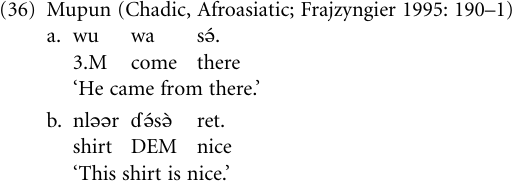
As a rule, the adverb developing into a demonstrative is simply juxtaposed to the noun; there are however also languages where the adverb requires some linking morphology to assume the role of a demonstrative. In the Chadic language Mupun of Cameroon, a relative clause structure is used: The adverbs (called deictics by Frajzyngier 1995: 190) sə̒ ‘here’ and sə̒ ‘there’, cf. (36a), require the relative clause marker ɗə̒ to form demonstratives, cf. (36b).
Creole languages offer a wide range of examples of this grammaticalization. For example, the Portuguese-based creole Angolar has developed a second series of demonstrative attributes derived from the locative adverbs aki (< Port. aqui ‘here’) ‘here’, nha ‘there’, nhala ‘there’, and nge ‘here’, which are added in apposition after a noun or adjective, for example:

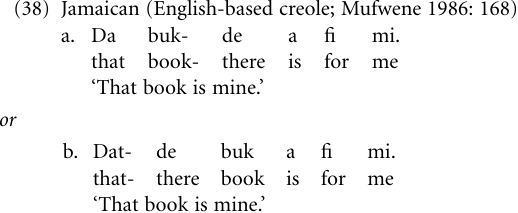
In a similar fashion, Kouwenberg and Murray (1994: 49) report that in the Spanish-based creole Papiamentu, the adverbs aki ‘here’, ei ‘there’, and aya ‘yonder’ can take the final position in a definite noun phrase to mark demonstrative deixis. Note that the adverb-derived demonstrative is not necessarily restricted to nouns but may in some languages also be added to adjectives or determiners, as in the English-based creoles Jamaican and Guayanese:
There are, however, a few counterexamples to the directionality adverb > demonstrative. In Bantu languages, demonstratives usually consist of a combination of noun class marker, agreeing with its head noun in gender, plus demonstrative stem. Now, the demonstrative can also occur without its head noun, and in some cases—when used with the agreement markers of the locative noun classes—such demonstratives can be reinterpreted as locative adverbs. For example, the locative adverb hapa ‘here’ of Swahili is historically a demonstrative consisting of the demonstrative stem ha-plus the agreement marker-pa of the locative noun class 16.
Adverb > subordinator It is mostly locative and temporal adverbs that provide the source for adverbial clause subordinators. We will deal with this pathway later, where we are concerned with patterns of clause combining. By way of illustration, one historically attested case may be mentioned. In early Latin there was a temporal adverb dum ‘now’ which was grammaticalized to the temporal clause subordinator dum ‘while, as long as’. While the adverb was lost, except for a few relics, the subordinator survived in classical Latin (Janson 1979: 104–5).
Adverb > tense Clearly the most widespread source of tense markers is provided by verbs turning into auxiliaries of other verbs (see Verb > tense). While being less common than verbs, temporal adverbs never the less constitute a crosslinguistically significant source for tense markers. Desemanticization has the effect that the adverb loses its specific temporal significance, its temporal function as a tense marker being defined with reference to the verb to which it is attached. For example, in some languages, adverbs meaning ‘tomorrow’ have given rise to future tense markers, whereby their specific meaning (‘one day later than now’) gave way to the more general meaning ‘later than now’. This process can be observed, for example, in a number of West African Kru languages, for example in Neyo, where the adverb kεεlε ‘tomorrow’ developed into the future marker lε (Marchese 1984: 206–7, 1986: 257). As this example shows, the process from adverb to tense marker may trigger erosion, whereby the phonetic substance of the form is reduced, even if not all instances of this process involve erosion.
Perhaps the most common instance of this pathway concerns adverbs meaning ‘then’ which are grammaticalized to future tense markers. In the East Nilotic language Bari of the Sudan, the adverb (e)de̒ ‘then, afterwards’ appears to have given rise to the future tense marker de̒, and in the Bantu language Lingala, the adverb nde̒ ‘then’ turned into the future tense prefix nde̒-. One may also mention that in the English-based pidgin/creole Tok Pisin the adverb baimbai ‘afterwards, later’ (historically derived from English by-and-by) developed into a future tense marker (see Heine and Kuteva 2002a: 293–4, 299).
Adverbs are fairly uncommon as sources for verbal aspect markers. However, there are occasionally grammaticalizations of adverbs as aspect markers. In American Sign Language (ASL), an adverb preceded by the (optionally) modulated verb can be used to express habituality:









