Grammar
Tenses
Present

Present Simple
Present Continuous
Present Perfect
Present Perfect Continuous
Past
Past Simple
Past Continuous
Past Perfect
Past Perfect Continuous
Future
Future Simple
Future Continuous
Future Perfect
Future Perfect Continuous
Parts Of Speech
Nouns
Countable and uncountable nouns
Verbal nouns
Singular and Plural nouns
Proper nouns
Nouns gender
Nouns definition
Concrete nouns
Abstract nouns
Common nouns
Collective nouns
Definition Of Nouns
Animate and Inanimate nouns
Nouns
Verbs
Stative and dynamic verbs
Finite and nonfinite verbs
To be verbs
Transitive and intransitive verbs
Auxiliary verbs
Modal verbs
Regular and irregular verbs
Action verbs
Verbs
Adverbs
Relative adverbs
Interrogative adverbs
Adverbs of time
Adverbs of place
Adverbs of reason
Adverbs of quantity
Adverbs of manner
Adverbs of frequency
Adverbs of affirmation
Adverbs
Adjectives
Quantitative adjective
Proper adjective
Possessive adjective
Numeral adjective
Interrogative adjective
Distributive adjective
Descriptive adjective
Demonstrative adjective
Pronouns
Subject pronoun
Relative pronoun
Reflexive pronoun
Reciprocal pronoun
Possessive pronoun
Personal pronoun
Interrogative pronoun
Indefinite pronoun
Emphatic pronoun
Distributive pronoun
Demonstrative pronoun
Pronouns
Pre Position
Preposition by function
Time preposition
Reason preposition
Possession preposition
Place preposition
Phrases preposition
Origin preposition
Measure preposition
Direction preposition
Contrast preposition
Agent preposition
Preposition by construction
Simple preposition
Phrase preposition
Double preposition
Compound preposition
prepositions
Conjunctions
Subordinating conjunction
Correlative conjunction
Coordinating conjunction
Conjunctive adverbs
conjunctions
Interjections
Express calling interjection
Phrases
Sentences
Clauses
Part of Speech
Grammar Rules
Passive and Active
Preference
Requests and offers
wishes
Be used to
Some and any
Could have done
Describing people
Giving advices
Possession
Comparative and superlative
Giving Reason
Making Suggestions
Apologizing
Forming questions
Since and for
Directions
Obligation
Adverbials
invitation
Articles
Imaginary condition
Zero conditional
First conditional
Second conditional
Third conditional
Reported speech
Demonstratives
Determiners
Direct and Indirect speech
Linguistics
Phonetics
Phonology
Linguistics fields
Syntax
Morphology
Semantics
pragmatics
History
Writing
Grammar
Phonetics and Phonology
Semiotics
Reading Comprehension
Elementary
Intermediate
Advanced
Teaching Methods
Teaching Strategies
Assessment

Natural classes
 المؤلف:
April Mc Mahon
المؤلف:
April Mc Mahon
 المصدر:
An introduction of English phonology
المصدر:
An introduction of English phonology
 الجزء والصفحة:
46-4
الجزء والصفحة:
46-4
 17-3-2022
 3974
3974




+
-
20
Natural classes
The major class features identify several categories of sounds which recur cross-linguistically in different phonological rules. Feature notation can also show why certain sounds behave similarly in similar contexts, within these larger classes. For instance, English /p/, /t/ and /k/ aspirate at the beginnings of words. All three may also be glottally reinforced at the ends of words. All three are unaspirated after /s/; and no other English phoneme has the same range of allophones, in the same environments. In feature terms, although /p/, /t/, /k/ differ in place of articulation, all three are obstruent consonants, and within this class, are [– voice, – nasal, – continuant]. A group of phonemes which show the same behavior in the same contexts, and which share the same features, constitute a natural class. More formally, a natural class of phonemes can be identified using a smaller number of features than any individual member of that class. As (12) shows, the class of voiceless plosives, /p/, /t/ and /k/, can be defined uniquely using only three features. If we subtract one of the plosives, we need more features, since we must then specify the place of articulation; and the same is true in defining a single plosive unambiguously.
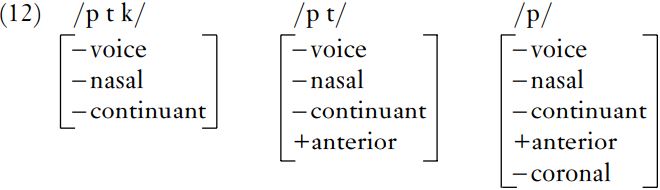
Phonological rules very typically affect natural classes of phonemes. For example, medial voicing of /f/ to [v] in Old English, did not only affect that labial fricative, but also the other members of the voiceless fricative class, /s/ and /θ/. If we wrote a rule for /f/ alone, it would have to exclude the other voiceless fricatives, so that the input would have to include [+anterior, – coronal]; however, the more general fricative voicing rule in (13) requires fewer features to characterize the input, as we would expect when a natural class is involved.

This rule also neatly captures the connection between the process and its conditioning context, and therefore shows the motivation for the development: the fricatives, which are generally voiceless, becomes voiced between voiced sounds. This will often mean between vowels, as in heofon and hlaford; but it may also mean between a vowel and a voiced consonant, as in hæfde. If voicing takes place between voiced sounds, instead of having to switch off vocal fold vibration for a single segment and then switch it back on again, the vocal folds can continue vibrating through the whole sequence. Voicing the fricative in this context is therefore another example of assimilation, where one sound is influenced by another close to it in the utterance.
 الاكثر قراءة في Phonology
 اخر الاخبار
اخبار العتبة العباسية المقدسة

الآخبار الصحية


مواضيع ذات صلة
 قسم الشؤون الفكرية يصدر كتاباً يوثق تاريخ السدانة في العتبة العباسية المقدسة
 "المهمة".. إصدار قصصي يوثّق القصص الفائزة في مسابقة فتوى الدفاع المقدسة للقصة القصيرة
 (نوافذ).. إصدار أدبي يوثق القصص الفائزة في مسابقة الإمام العسكري (عليه السلام)