Grammar
Tenses
Present

Present Simple
Present Continuous
Present Perfect
Present Perfect Continuous
Past
Past Simple
Past Continuous
Past Perfect
Past Perfect Continuous
Future
Future Simple
Future Continuous
Future Perfect
Future Perfect Continuous
Parts Of Speech
Nouns
Countable and uncountable nouns
Verbal nouns
Singular and Plural nouns
Proper nouns
Nouns gender
Nouns definition
Concrete nouns
Abstract nouns
Common nouns
Collective nouns
Definition Of Nouns
Animate and Inanimate nouns
Nouns
Verbs
Stative and dynamic verbs
Finite and nonfinite verbs
To be verbs
Transitive and intransitive verbs
Auxiliary verbs
Modal verbs
Regular and irregular verbs
Action verbs
Verbs
Adverbs
Relative adverbs
Interrogative adverbs
Adverbs of time
Adverbs of place
Adverbs of reason
Adverbs of quantity
Adverbs of manner
Adverbs of frequency
Adverbs of affirmation
Adverbs
Adjectives
Quantitative adjective
Proper adjective
Possessive adjective
Numeral adjective
Interrogative adjective
Distributive adjective
Descriptive adjective
Demonstrative adjective
Pronouns
Subject pronoun
Relative pronoun
Reflexive pronoun
Reciprocal pronoun
Possessive pronoun
Personal pronoun
Interrogative pronoun
Indefinite pronoun
Emphatic pronoun
Distributive pronoun
Demonstrative pronoun
Pronouns
Pre Position
Preposition by function
Time preposition
Reason preposition
Possession preposition
Place preposition
Phrases preposition
Origin preposition
Measure preposition
Direction preposition
Contrast preposition
Agent preposition
Preposition by construction
Simple preposition
Phrase preposition
Double preposition
Compound preposition
prepositions
Conjunctions
Subordinating conjunction
Correlative conjunction
Coordinating conjunction
Conjunctive adverbs
conjunctions
Interjections
Express calling interjection
Phrases
Sentences
Clauses
Part of Speech
Grammar Rules
Passive and Active
Preference
Requests and offers
wishes
Be used to
Some and any
Could have done
Describing people
Giving advices
Possession
Comparative and superlative
Giving Reason
Making Suggestions
Apologizing
Forming questions
Since and for
Directions
Obligation
Adverbials
invitation
Articles
Imaginary condition
Zero conditional
First conditional
Second conditional
Third conditional
Reported speech
Demonstratives
Determiners
Direct and Indirect speech
Linguistics
Phonetics
Phonology
Linguistics fields
Syntax
Morphology
Semantics
pragmatics
History
Writing
Grammar
Phonetics and Phonology
Semiotics
Reading Comprehension
Elementary
Intermediate
Advanced
Teaching Methods
Teaching Strategies
Assessment

Phoneme–Grapheme Correspondences in English Vowels
 المؤلف:
Mehmet Yavas̡
المؤلف:
Mehmet Yavas̡
 المصدر:
Applied English Phonology
المصدر:
Applied English Phonology
 الجزء والصفحة:
P236-C8
الجزء والصفحة:
P236-C8
 2025-03-21
 2016
2016




+
-
20
Phoneme–Grapheme Correspondences in English Vowels
The phoneme-to-grapheme correspondences for the vowels are as follows:
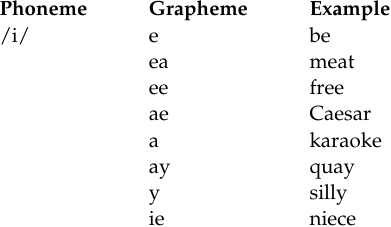
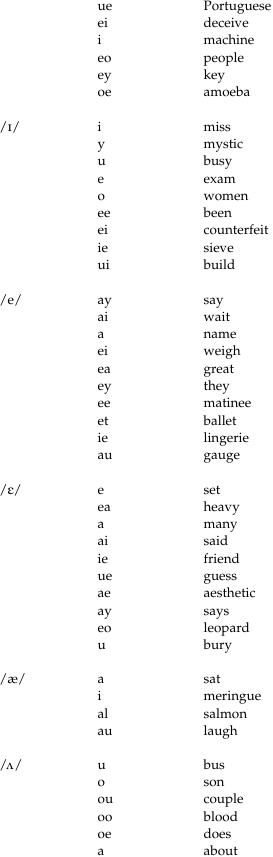
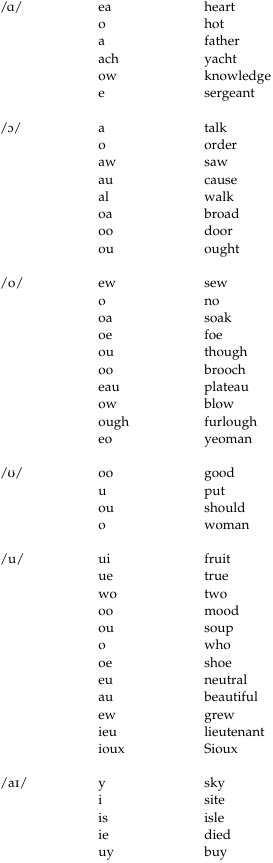
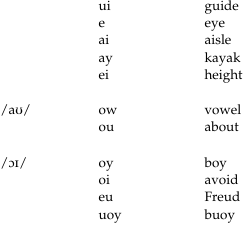
As in the case of the consonants, if we look at the grapheme-to-phoneme relationship of the vowels, we can find more regular correspondences. The five vowel letters and their sound values in monosyllabic words are given as follows:
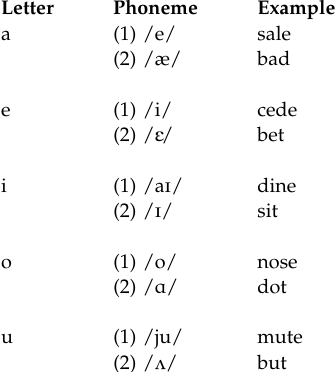
If the ‘vowel letter’ in a monosyllabic word is followed by a consonant, which is then followed by the letter e at the end of the word, the sound value for the vowel letter is the one given in (1) (the well-known ‘silent e’ rule taught in schools); otherwise, the sound value is the one given in (2).
The situation is more complicated in polysyllabic words. For example, how do we know the sound values of a in mutation and of u in reduction? Both in [mjuteʃən] and in [ɹ̣ədΛkʃən] the stress is on the syllable before the suffix. The rule is first to ignore the ending -ion, and then to count the consonants that follow the vowel letter in question. In mutation, the vowel letter a is followed by a single consonant, and thus the sound value will be the one given in (1), namely /e/ as in [mjuteʃən]. In reduction, the vowel u is followed by two consonants and thus the sound value is the one given in (2), namely /Λ/ as in [ɹ̣ədΛkʃən]. Although this is quite workable, and indeed valid for many words with a suffix with the letter i followed by a vowel and then by anything else (e.g. -ial, -ious, -iary), it is not problem-free. Specifically, there are problems with the letter i in the root. While in submission and addiction, the non-suffixal i is followed by two consonant letters and has the predicted value (2), namely /ɪ/, in revision and provision, it is followed by one consonant letter, but does not have the predicted sound value of (1), /aɪ/, as the pronunciations are [ɹ̣əvɪʒən] and [pɹ̣əvɪʒən]. Unlike the examples discussed here, in some of the examples we looked at earlier, we saw that the vowel letters represented the two possible sounds (i.e. long/short vowels), which cannot be accounted for by the number of following consonants. For example, in pairs such as grateful /e/ - gratitude /æ/, mine /aɪ/ - mineral /ɪ/, the first words have the bold-type focal vowel letter representing the long vowel/diphthong, which is in accordance with expectations because the vowel letter is followed by a single consonant. The second words in these pairs, however, employ short vowels despite the fact that they are followed by a single consonant, and, according to expectations, should employ long vowels.
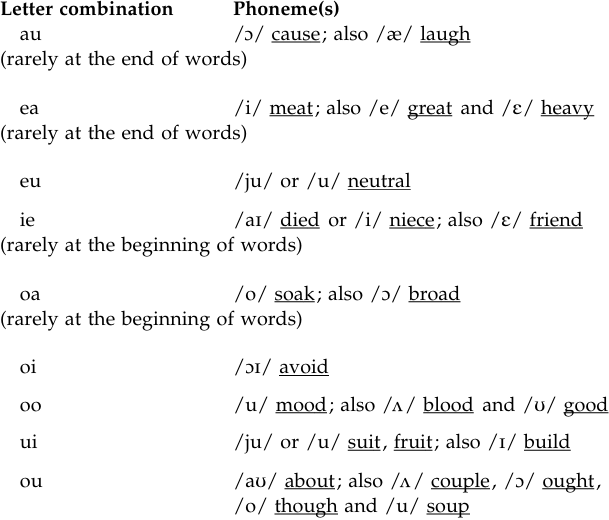
Besides the single vowel letters, English uses several vowel-letter combinations for certain sound correspondences. The alphabet, which was borrowed from the Romans, provides five vowel letters, i, e, a, o, u, which were sufficient for Latin. However, English has many more vowels, and thus several vowel-letter combinations, called ‘digraphs’, are utilized to meet this demand. The values of the vowel-letter combinations do not change in stressed/unstressed syllables (most common values are given first, and then the secondary values are listed):
We should also mention the letters y and w, which have sound correspondences related to consonants and vowels. We saw earlier that, as syllable onsets (e.g. in yesterday and week), they stand for the glides /j/ and /w/, respectively. The letter y, after a vowel letter, as in ay, ey, uy, oy, stands for /e/ (e.g. day), /i/ (e.g. key), /aɪ/ (e.g. buy), /ɔɪ/ (e.g. boy). The letter w, in the same position, represents /ɔ/ (e.g. saw), /o/ (e.g. sew), and /aʊ/ (e.g. vowel). The letter y, occurring in final position after a consonant, represents /i/ (e.g. happy, baby) or /aɪ/ (e.g. fly, sky), and usually changes to i when a suffix is added (e.g. defy– defiant; duty– dutiful; happy – happiness; lively – livelihood). This change does not apply with a suffix starting with i (to avoid two i’s. Thus, we get baby– babyish, lobby– lobbyist, defy– defying). Finally, when an -s suffix is added, y turns into -ie (e.g. deny – denies; fly– flies). This rule has the following two exceptions: (a) y as part of an oy, ay, ey combination (e.g. employ– employs; obey– obeys), and (b) -s as the possessive suffix (e.g. Tommy’s, anybody’s).
 الاكثر قراءة في Phonology
 اخر الاخبار
اخبار العتبة العباسية المقدسة

الآخبار الصحية


مواضيع ذات صلة
 قسم الشؤون الفكرية يصدر كتاباً يوثق تاريخ السدانة في العتبة العباسية المقدسة
 "المهمة".. إصدار قصصي يوثّق القصص الفائزة في مسابقة فتوى الدفاع المقدسة للقصة القصيرة
 (نوافذ).. إصدار أدبي يوثق القصص الفائزة في مسابقة الإمام العسكري (عليه السلام)