Constructing Theoretical Notions of L2 Writing Through Metaphor Conceptualization
RESULTS AND DISCUSSION
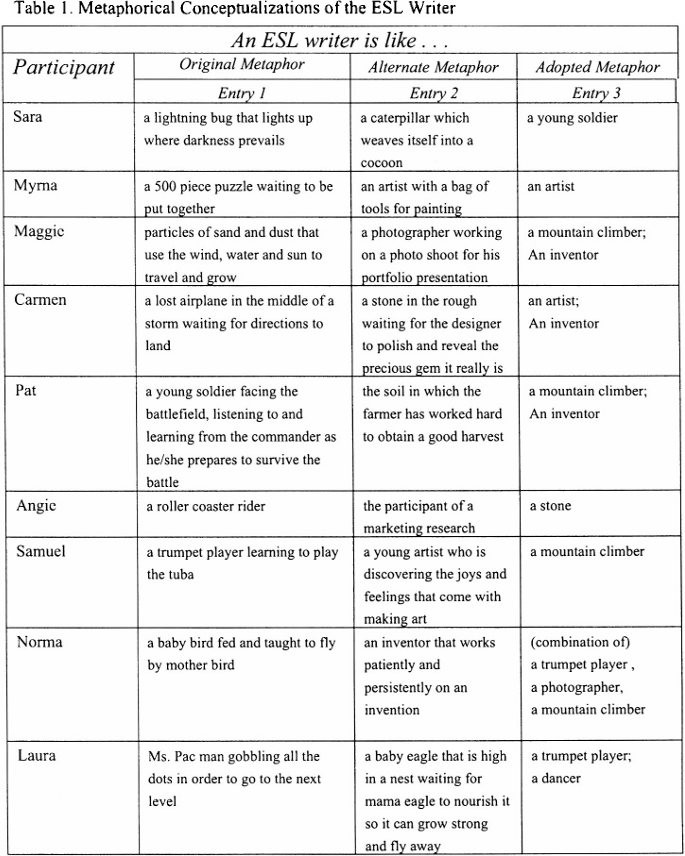
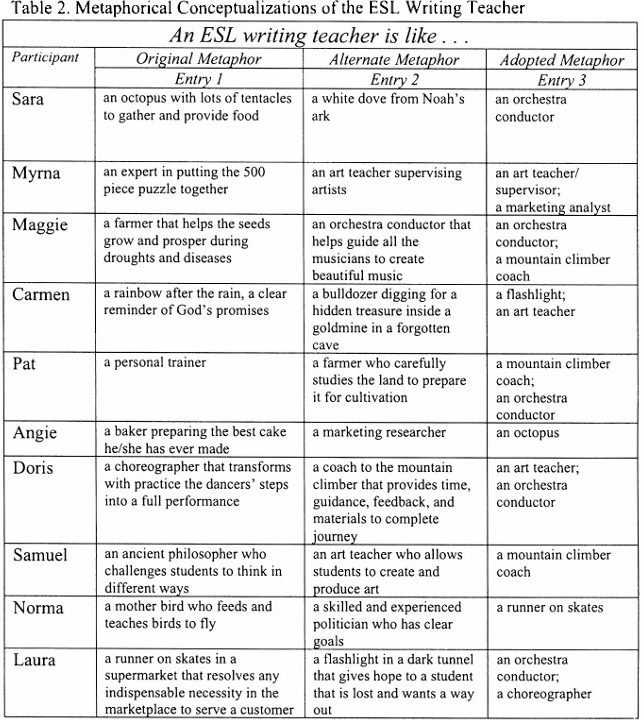
Our first focus was to observe significant changes in our participants’ metaphorical conceptualizations by means of comparing the original metaphors in Entry 1 to alternate metaphors in Entry 3 and adopted metaphors in Entry 4. This comparison allowed us to observe the following. As Table 1 presents, five participants (Myrna, Maggie, Angie, Doris, and Norma–names are pseudonyms) revised their view of the ESL writer from someone passive and highly dependent on the teacher to someone who has the potential to grow and develop as a writer. Norma’s change from a baby bird fed and taught to fly by mother bird in Entry 1 to an inventor that works patiently and persistently on an invention in Entry 3 is a good example of this development in conceptualization. Interestingly, as shown in Table 2, the same participants modified their vision of the teacher, departing from a view of teacher as dispenser of knowledge to that of being a guide or leader in a shared activity. Myrna’s movement from a metaphor of teacher as an expert in putting a 500 piece puzzle together to an art teacher supervising artists demonstrates progression in her conception of the writing teacher. Her new metaphor envisaged both the teacher and the writer as co-creators of meaningful texts, a view that takes into account current instructional writing approaches.
Some students proposed alternate metaphors in Entry 3 that depicted the same vision of a passive ESL writer as in the earlier entry: Carmen’s lost airplane and stone in the rough, Pat’s young soldier and soil in which farmer works, or Laura’s Ms. Pac man and baby eagle waiting for mama. However, their perspective of the ESL writer changed in their adopted metaphors in Entry 4. All of them chose metaphors–artist, inventor, mountain climber, dancer and trumpet player–that gave the student a central role in his/her own learning. These participants (Carmen, Pat, and Laura) who had also proposed similar metaphors to portray the teacher in both Entry 1 and Entry 3, changed their view of the teacher in Entry 4. Their adopted metaphors–mountain climber, orchestra conductor, art teacher, and choreographer–show that the teacher has evolved from the sole provider of knowledge to someone who can lead writers through the writing process and enhance their learning. The participants’ views expressed in these metaphors acknowledge the social nature of the process as well as the cognitive and affective dimensions of learning to write. These preliminary results, mid-way through the course, led us to think that there was some development in the participants’ way of thinking about the teaching of writing.
An examination of the adopted metaphors revealed that the inventor, mountain climber, and trumpet player metaphors were the most popular for the writer and that orchestra conductor, mountain climber coach, and art teacher were the most favored for the teacher. The adoption of these metaphors implies the internalization of two important aspects related to writing conceptualization. First, these metaphors delineated a congruent vision of learning and teaching writing. For the participants, learning to write meant: (a) working actively in a community toward the creation of knowledge/text; (b) having the potential capabilities to reach their goal; and (c) transferring L1 processes and strategies to a new medium, as the trumpet player learning to play the tuba metaphor suggests. Teaching writing meant: (a) leading students to achieve their goals; (b) collaborating in the co-construction of text; and (c) recognizing students’ cognitive efforts as well as the social contexts for writing. Second, the above theoretical notions on learning and teaching writing reflect a cognitivist view of the process of writing (Grabe & Kaplan, 1996). Participants were thus able to demonstrate, via metaphor, the influence of theoretical paradigms and approaches discussed throughout the course.
This study also provided data from the participants’ perspective on their own views of conceptualizing writing. Analysis of the metaphors adopted in Entry 4 gave clues as to the reasons why students adopted certain metaphors proposed by their classmates. In most cases, the participants’ process of selecting metaphors from their classmates’ repertoire was based on agreement with the ideas expressed in the metaphors. Frequently, the participants recognized important elements in their classmates’ metaphors: “I adopted these metaphors because they gather many of the characteristics that L2 writers have” (Norma). Sometimes, the classmates’ metaphors captured ideas the participants could identify with: “My peers wrote metaphors that adequately represented my feelings about being an ESL writing teacher and an ESL writing student” (Maggie); “the metaphors depict the student in a way that I can actually perceive and accept” (Pat).
In some cases, the classmates’ metaphors helped the participants clarify their ideas about writing teacher-student relations and about the process of writing. For instance, the idea of the emotions involved in writing became very clear for Samuel in his classmate’s metaphor of the ESL writer as a mountain climber. “It [the idea] jumps out at me and helps me to relate to how an ESL writer might feel.” For Laura, her classmates’ metaphors (teacher as orchestra conductor and choreographer) helped her “refocus” her vision: “The writing teacher must first be in the position of student.”
Other times, the metaphors adopted from classmates’ examples helped students see new dimensions of the ESL writing classroom. Doris, for example, became more aware of writing as a creative endeavor as she reflected on her classmates’ metaphors of the ESL writer as an inventor and of the writing teacher as an orchestra conductor who to help my students envision themselves as these images describe.” Similarly, Samuel envisioned himself as a new teacher: “I now see the role of the teacher as that of a person who introduces students to the process of writing and then allows them the freedom to create and write. I want to be that kind of teacher.”
The process of sharing metaphors among the students led to appropriation as students made their classmates’ metaphors their own: “I decided to adopt them as my own and I wrote them on my teacher’s desk in order to read them constantly and remind myself why I decided to become an ESL teacher . . . . I adopted these metaphors because they reflect what my goal is as an ESL writing teacher” (Laura). Appropriation of others’ metaphors seemed to be motivated in some cases by the participants’ identification with the classroom situations reflected in their classmates’ metaphors. Carmen, for instance, liked her peers’ metaphors of writer as artist and writing teacher as art teacher because she could relate them to her deaf students, who “have so many talents inside; they are just waiting to come out. In my classroom, I let them express those feelings they have inside in English.”
According to Ball (2000), appropriation involves reconstruction and reflective commitment and not mindless repetition of others’ words. In this study, there was evidence of reflection and reconstruction as students oftentimes saw new meanings in their classmates’ metaphors or interpreted them differently. For example, Myrna adopted the metaphor of teacher as marketing analyst but she expanded the concept of investigating population needs to include the idea of cultural issues not present in her classmate’s metaphor: “Students come from different cultural backgrounds and the ESL writing teacher needs to investigate and know which they are.”
Furthermore, as Ball (2000) indicates, internalization among teachers also implies the articulation of plans of action reflecting personal commitment (p. 253). In this case, internalization was evident as participants not only reconstructed or transformed their classmates’ metaphors but also formulated plans of action based on newly adopted roles or insights. For example, adoption of the metaphor of teacher as mountain climber coach prompted Samuel to say: “Students need freedom to grow. I can see this in both climbing and writing. I would like to apply these concepts by allowing my students more freedom in their writing activities.” Norma stated a series of classroom strategies to be implemented in the classroom based on the idea that writers, like mountain climbers and trumpet players, need to learn to write by writing and not just by being told how to do it.
To observe the participants’ own views on the impact of metaphorical conceptualization on their understanding of writing and the teaching of writing in the L2 classroom, Entry 5 was analyzed. All students stated that the metaphor exercise had been insightful and beneficial. Most students elaborated and explained how the exercise had helped them. Conceptualizing and reflecting through metaphor moved students to concretize beliefs and make them explicit. In Norma’s words, “writing metaphors and explaining them is like playing with abstract and concrete levels at the same time.” As this participant “looked for the best metaphors,” she reflected on the process of writing and on her daily practices. She also pondered whether her beliefs matched her practices. Metaphor conceptualization helped students “crystalize and condense thinking” (Samuel); it forced them to “look for exact words to say many things in one sentence” (Carmen). And, as Pat said, “by establishing a comparison to other elements, I acquired a perspective of what I was doing as a teacher.” Interestingly, the process of conceptualizing through metaphor evoked visual images in the participants which helped them concretize and synthesize their thoughts. Several participants reported that using metaphors helped them “visualize” concepts. For instance, for Samuel, metaphors “help you to express your thoughts in visual pictures that everyone can understand and relate to.”
Most of the participants indicated in their final entry the ways in which the metaphor exercise had contributed to a different view of writing in the ESL classroom. Maggie, for example, realized that her original metaphor of the writer as “particles of sand and dust that use the wind . . . to travel” portrayed the student as too passive and thus changed it [in Entry 3] to a more active image as “a photographer working on a photo shoot.” Angie explained how her view of the writing process changed throughout the course:
When we started the semester, I viewed the writing process as a train in a one-way rail or a one-way non-stop ticket to perfect writing. Now I know that writing is indeed a process but it may take a few stops before arriving to the final destination. Writing cannot be a one-way rail because the student should have the confidence that he/she may go back and then continue the travel. But the most important lesson I learned is that every student is riding in a different ‘train caboose’ (writing phase).
In this reflection, the participant has changed her view of writing as an inflexible, straightforward movement directed by the teacher to recursive, multiple-stop movement directed by the own learner.
The act of reflecting on metaphors throughout the course and, in particular, the social process of sharing and considering classmates’ metaphors was critical for the students to progress within their ZPDs. As they wrote and shared their metaphors and reflections, the participants “learned from each other” (Samuel). For Myrna, the metaphor exercise represented a personal growing experience. In Entry 5, she voiced her realization that she had always viewed writing as “a complicated process that can cause headaches and frustration.” She had always been “afraid to write.” This view was expressed in her first-entry metaphor of the writer as solver of a 500 piece puzzle and of the teacher as an expert puzzle maker who knows and can fix everything. Her new metaphors (writer as artist and teacher as art teacher) offer a “totally different” view: “Writing is not cold . . . difficult or frustrating anymore. Writing is creation now. Writing metaphors [in the class] was very important. Metaphors created by the students allow them to realize how they view things.”
Pat renders an eloquent account of her progress throughout the course and the impact of metaphor in her reconceptualization process:
My concept about the writing process has evolved through this semester. I used to see it as a way students had to produce texts that evidenced their skills in the language. I used to focus on the final product. I wanted perfection and accuracy from the very beginning . . . . I never even thought of asking my students for more than the final, polished version of their writing . . . . As I participated in class discussions, I realized how much I had to change as a teacher. There were moments when I felt bad about the harshness with which I had graded my students. As the semester progressed so did my concepts of teaching writing . . . . The thing that helped me most in this growing process was the exercise on metaphors. By looking at [my classmates’] list of metaphors I could venture an analysis of each participant’s style of teaching. Those metaphors reflect who we are as teachers and what we think about our students. The metaphors [I adopted] reflect the way I see myself now as a writing teacher.








