Crime Scene Investigation: FIRST ON THE SCENE
The success of any crime scene investigation depends in large part on the actions taken in the first few minutes after the First Officer (or FO) or CSI arrives. This sounds odd, to be sure. “How can a few minutes matter to a crime scene that’s just been sitting there for hours or days?” one may ask. But crime scenes are a complex mix of static and dynamic information, a scene fixed in time like a photograph but slowly degrading, much like poorly archived historical photographs. The majority of the physical evidence will be generated by the processing of the crime scene, and the relationships between the people, places, and things (the context) will tell the story of what happened. Remember, facts alone are not sufficient; by themselves, they explain nothing. Facts must be interpreted in light of the circumstances or context surrounding the crime. Once an item is moved, it can never be placed back exactly as it was: The context is disturbed, and the subsequent interpretation may be biased and inaccurate. The primary task of the FO at a crime scene is to secure the scene and prevent destruction or alteration of the critical and sometimes fragile context of a crime scene. The assumption is that the perpetrator has left physical evidence at the crime scene. Therefore, the FO’s duties are simple in concept but complex in execution:
1. Detain any potential suspects.
2. Render medical assistance to those who need it. 3. Do not destroy, alter, or add any evidence at the scene.
4. Prevent others, even superiors, from doing the same.
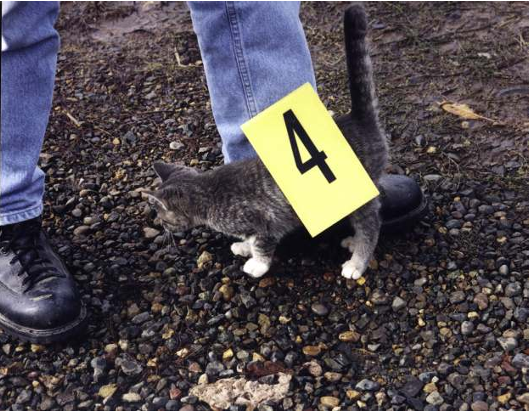
FIGURE 2.1 This little fellow, along with three of its littermates, was at the scene of a triple homicide in the northwest United States. Before they could be rounded up, they tracked blood around the crime scene; this photo was taken as a reminder. The cats were adopted by various agency personnel.
But not all crime scenes are equal. A homicide in a small house’s bedroom is certainly easier to seal and guard than a body found in the middle of a wooded park or a busy highway. The FO should not simply rush into a scene but approach it carefully, thoughtfully. Sometimes the best thing to do is just prevent further entry until additional agency staff arrive. Once the immediate scene is secured, the lead investigator further defines and evaluates the scene. The scene may be large or small, extensive, or discrete, made up of several locations or centered in one area. With the crime scene defined and its borders identified, the initial surveyor begins to develop an overview and devise a plan of action.








