Concepts and decomposition
Like many semantic theories, Jackendoff claims that a decompositional method is necessary to explore conceptualization. Just as one of the ways a physical scientist tries to understand matter is by breaking it down into progressively smaller parts, so a scientific study of conceptualization proceeds by breaking down, or decomposing, meanings into smaller parts. Clearly, however, this decomposition cannot go on forever: we must ‘reach bottom’ at some stage. This is the level of conceptual structure, the level of mental representations which encode the human understanding of the world, containing the primitive conceptual elements out of which meanings are built, plus their rules of combination. Just as generative syntax posits a finite set of syntactic categories and rules for combining them, so Conceptual Semantics posits ‘a finite set of mental primitives and a finite set of principles of mental combination’ governing their interaction (Jackendoff 1990: 9). Jackendoff refers to this set of primitives and the rules governing them as the ‘grammar of sentential concepts’ (Jackendoff 1990: 9). His starting point is a close analysis of the meanings of lexemes, dedicated to bringing out parallelisms and contrasts which reveal the nature of the conceptual structures underlying them. What his method shows, he says, is that the psychological organization on which meaning rests ‘lies a very short distance below the surface of everyday lexical items – and that progress can be made in exploring it’ (1991: 44).
Since the primitives revealed by decomposition are designed to characterize thought, they are universal, not language-specific (Jackendoff 1991: 11). They are also not in themselves meaningful. This is a major point of difference between Jackendoff’s approach and many others, including Wierzbicka’s NSM (2.5) or those discussed in the previous chapter. Jackendoff draws a parallel between semantic and phonological analysis to explain this aspect of his system. In the analysis of phonology, we start with a level of ordinary words. This level is decomposed into a level of phonemes like English /k/, /i:/, /w/, etc., most of which cannot be words in their own right. This level of phonemes is then decomposed into a further, more abstract level of phonological features ([± voice], [± coronal], etc.). None of these features can constitute a word; furthermore, none can even be independently pronounced. Semantic decomposition for Jackendoff shows a similar logic. We start with the actual meanings of whole words. But when we break these meanings down, we soon ‘find layers of structure whose units cannot individually serve as possible word meanings’ (Jackendoff 2002: 335). This has important methodological consequences: it means that we must instead develop a set of technical primitives to analyse word-meanings with. The words of ordinary language are not themselves basic enough.
As a sample of the type of analysis done in Conceptual Semantics, consider the analysis of the sentence Bill went into the house. This has the syn tactic structure shown in (1), and the underlying conceptual structure given in (2):

The square brackets in (2) identify the sentence’s conceptual constituents – the actual ‘bits’ of meaning or semantic content which the sentence expresses. Each of these constituents can be assigned to a major ontological category, such as Thing, Event, State, Action, Place, Path, Property and Amount, coded in subscript capitals. Jackendoff describes these ontological categories as conceptual ‘parts of speech’. Just as parts of speech like Noun, Verb and Adjective constitute a con strained set of categories to which words can be assigned on the basis of distributional criteria (see 9.1.2.1), so the ontological categories constitute the major groupings to which our concepts can be assigned on the basis of what they mean. Each major syntactic category in (1) corresponds to a conceptual constituent: the NPs Bill and the house correspond to Thing slots in the conceptual structure, the verb went corresponds to the Event slot, the prepositional phrase into the house corresponds to the Path slot.
Each conceptual category can, like logical predicates (see 6.4), take arguments – other elements of conceptual content which have to be inserted into positions in the formalism in order to make them complete. Every argument belongs to one of the major conceptual categories. This is illustrated in (3):
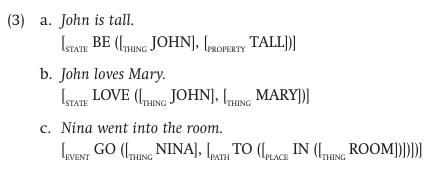
As these decompositions illustrate, the conceptual structure of a lexical item is an element with zero or more open argument slots, which are filled by the syntactic complements of the lexical item: is in (3a) expresses the major conceptual category State, whose arguments are found in the subject (John) and predicate adjective position (tall); love in (3b) also expresses a State function, with the arguments supplied by the grammatical subject (John) and object (Mary); went in (3c) expresses an Event-function whose arguments are the subject Nina and the path phrase into the room and so on.
Let’s concentrate on (3c). Jackendoff (1991: 13) gives the following explanation of the formalism. The capitalized expressions denote conceptual content. (NINA and ROOM are left unanalysed for the moment, though we assume that each does have a conceptual analysis which will need to be given for the theory to be complete.) The other three elements are the ‘functions’ IN, TO and GO. IN is a one-argument function: it maps a single object (here, the room) into a region or place that encompasses the interior of that object. TO is also a one-argument function: it maps a Thing or Place into a Path that terminates at that Thing or Place. Thus the constituent ‘[PATH TO ([PLACE IN ([THING ROOM])])]’ in (3c) can be read roughly as ‘a trajectory that terminates at the interior of the room’. GO is a two-argument function that maps a Thing and a Path into an Event consisting of the Thing traversing the Path. Thus the entire Event in (3c) can be read roughly as ‘Nina traverses a path that terminates at the interior of the room’.
Recall that Jackendoff’s framework presupposes a strict division between syntax and semantics. This means that a mechanism is needed in order to associate the conceptual structure in (3c) with its syntactic realization. This is accomplished by the lexical entries of into and go, given in (4), which each contribute part of the overall conceptual structure (Jackendoff 1991: 14):
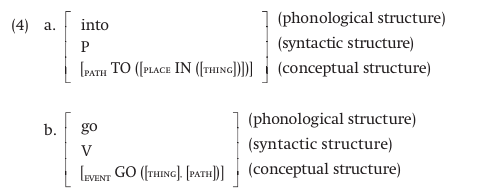
The bottom line gives the LCS (Lexical conceptual structure) associated with each lexical item. The conceptual structure of go includes a Path slot as one of its arguments; this allows the Path element of (4a) to be incorporated into it; adding the subject argument into the first Thing position generates the full conceptual structure as given in (3c).








