THEME IN NON-DECLARATIVE CLAUSES
All the examples seen so far are of declarative clauses. In these the unmarked Theme is Subject. Non-declarative clauses, that is, interrogatives and imperatives, have unmarked Themes derived from their respective clause type, as illustrated in the examples below.
In examples, 4 to 7, the starting-point of the clause is the expected one, which announces the clause-type. Theme is marked when any other but the expected one is placed in initial position, as in examples 8 to 10. Marked Themes in non-declarative clauses are relatively uncommon.
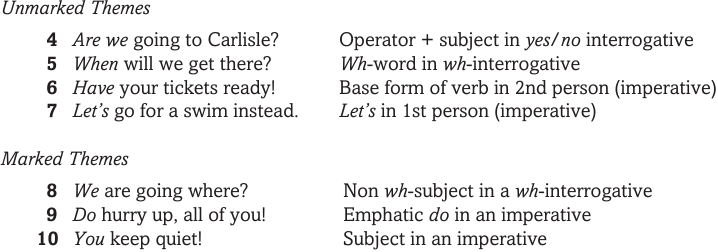
In yes/no interrogatives in English, unmarked Theme is the Finite operator, together with the Subject, as in 4. In wh-interrogatives, the Theme is the wh-word as in 5. In 2nd person imperative clauses, unmarked Theme is the verb, as in 6, and let’s in first person imperatives, as in 7. Any other order is marked. When the wh-element is displaced, as in 8, the element that remains as Theme (we) is marked for a wh- interrogative. Emphatic do, as in 9, and the Subject you, as in 10, are marked Themes in the imperative.








