Prototype categorization
The idea that category membership is graded is at the heart of the proto type theory of categorization, most strongly associated with the psychologist Eleanor Rosch and her colleagues (Rosch 1975, 1978; Rosch and Mervis 1975). Rosch was impressed by one of the many observations about meaning made by the philosopher Ludwig Wittgenstein in his Philosophical Investigations (1953: §66):
Consider for example the proceedings that we call ‘games’. I mean board games, card-games, ball-games, . . . and so on. What is common to them all? – Don’t say: There must be something common, or they would not be called “games” – but look and see whether there is anything common to all. – For if you look at them you will not see something that is common to all, but similarities, relationships, and a whole series of them at that. To repeat: don’t think, but look! – Look for example at board games, with their multifarious relationships. Now pass to card games; here you find many correspondences with the first group, but many common features drop out, and others appear.
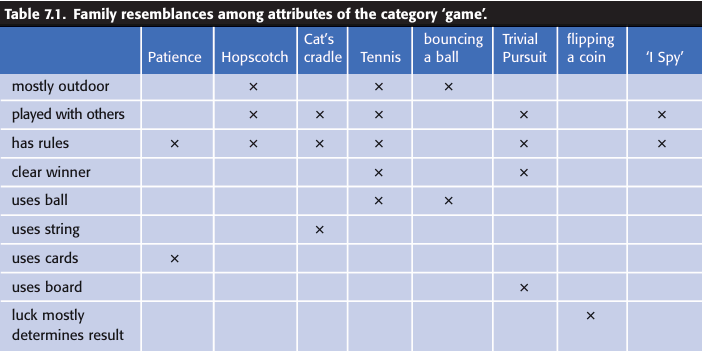
The result of comparison between different types of game, Wittgenstein says, is that ‘we see a complicated network of similarities overlapping and criss-crossing’ (1953: §66), and he compares the relationships between different games to the family resemblances that exist in the outward appearances of members of the same family. Members of a single family might be identifiable by certain characteristic features – prominent cheek bones, a certain hair colour, a certain type of walk or laugh, and so on – without any single member of the family necessarily having all of these attributes. (In fact, it might even be the case that a particular member had none of the characteristic attributes.) In the same way, Wittgenstein suggests, members of the category ‘game’ might not be defined by any core of shared attributes that we could capture by listing necessary and sufficient conditions, but by a network of ‘family resemblances’: there is a certain set of possible attributes which tie together the members of the category GAME, but not every member of the set need possess every attribute. This is displayed in Table 7.1.
Rosch generalized the family resemblance structure which Wittgenstein saw in GAME to other categories. She and her colleagues conducted experiments in which subjects were asked to consider examples of different natural language categories like FRUIT, BIRD, VEHICLE, and CLOTHING, and rate them on a scale of representativity for each category. These experiments demonstrated convincingly the truth of the initial belief that some members are better examples of their category than others. For the category BIRD, for instance, subjects consistently rated robin and sparrow as better examples than penguin or emu. Rosch described this situation as one in which robin and sparrow are more prototypical examples of the category BIRD than emu or penguin. Prototypicality judgements for this type of category proved to be remarkably consistent across different speakers: subjects consistently converged on the same members when asked to say what the best examples of different categories were.
QUESTION Consider the categories PROFESSION, LADDER and PLANE. What are the best examples of each? Why? What are some marginal examples?
The prototype of a category, for Rosch, is not any one of its members, no matter how good an example of the category this might be. Rather than one of the members, the prototype of a category can be thought of as the central tendency of that category’s members (see Barsalou et al. 1993). Any particular member of the category will be closer to or further from the prototype. What are these degrees of prototypicality based on? According to Rosch, prototypical category members are those which share the most attributes with other members of their category, and the fewest with members of other categories. BIRD, for instance, might be defined through attributes such as ‘egg-laying’, ‘flying’, ‘small’, ‘vertebrate’, ‘pecks food’, ‘winged’, ‘high-pitched call’, ‘builds nests’ and so on. Not every member of the category, however, has to possess all these attributes: emus, for instance, are neither small nor flying, but they are still birds. But the more attributes an example possesses the better an example of the category it appears.
Categories are not structured, then, by a set of necessary and sufficient conditions; instead, they consist of entities with various shared attributes. We can illustrate this with the category COAT, whose members might include trenchcoats, overcoats, raincoats, duffel coats, parkas, fur coats, labcoats, topcoats and frockcoats. The attributes of this category presumably include the following features:
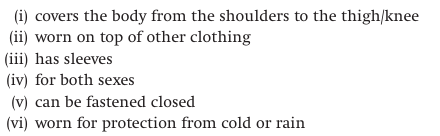
Certain examples of the category, like trenchcoats or overcoats, possess all or most of these attributes: these are the most prototypical. Less prototypical examples have fewer: a labcoat, for example, is not worn for protection from the weather, and a parka does not extend to the thigh. The more attributes a member shares with other, different categories, the less typical it is of its own category. Think of the difference between the categories COAT and JACKET. These categories share a certain number of attributes, such as being sleeved, being able to be fastened closed, and being worn on top of other clothing. They are distinguished principally in terms of length and purpose; coats extend below the waist and are principally worn for protection from cold or wet weather, whereas jackets typically end around waist level and are not principally worn for protection against the elements. This distinction is clearly true of the most typical examples of each category: for example, it is a correct description of the difference between a woollen overcoat and a suit jacket. But when we consider less representative examples of coats and jackets, we find that they are less distinct. Parkas, for instance, which are less typical examples of coats, have a jacket attribute: they do not extend below the waist. Similarly, a light linen thigh-length jacket is not a typical example of a jacket, because it does extend beyond the waist: this is, of course, a coat-attribute. So as we move away from the central members, the differences between categories become less marked.
Prototype theory was originally developed as a theory of how concrete, visual objects, like furniture, colour or fish, are categorized. But several studies have revealed prototype effects in domains involving activities. Thus, Coleman and Kay (1981) discuss the nature of the prototype of the category LIE. Pulman (1983: 113) analysed the members of the categories KILL, SPEAK and WALK with respect to prototypicality (the leftmost verb is the most prototypical member, the rightmost the least):

QUESTION Consider the structure of the category EAT. What verbs are its members? Assume that the category is arranged around a prototype, and try to specify the appropriate attributes.
The hypothesis that categories are structured in terms of prototypes is consistent with a number of experimental results. In fact, Rosch says that ‘the prototypicality of items within a category can be shown to affect virtually all of the major dependent variables used as measures in psycho logical research’ (1978: 38). For instance, Rosch and her colleagues per formed experiments in which subjects were asked to verify statements about category membership of the form ‘An [exemplar] is a [category name]’ (e.g. ‘a robin is a bird’) as quickly as they could. Response times were shorter when the exemplar was a representative member of the category; subjects took less time, in other words, to confirm that a robin is a bird, than they did to confirm that an emu is. Prototype effects like these are systematic and have been confirmed widely in the experimental literature (Mervis and Rosch 1981: 96). Second, Mervis and Rosch (1981: 96–97) report experiments by Battig and Montague (1969) in which sub jects were asked to list exemplars of each of 56 superordinate categories such as furniture, fruit, weapons, sports or parts of the human body. Prototypical members of the categories were found to be mentioned more frequently than non-prototypical ones. Lastly, natural languages possess mechanisms for expressing the extent to which an exemplar of a category is typical. In English, for example, a sentence like A sparrow is a true bird is perfectly normal, unlike A penguin is a true bird: sparrows, not penguins, are prototypical exemplars of the category BIRD. Conversely, technically can only be applied to non-prototypical category members: A penguin is technically a bird is acceptable, but A sparrow is technically a bird is not (Lakoff 1973).
Many linguists have seen the graded structure of categories discovered by Rosch as an indication of the nature of the meanings of natural language category terms. The idea that categories are structured by attributes and degrees of membership solves some difficult problems in semantic analysis. As commented by Lehrer (1990: 380), ‘When we look at some of the detailed lexical descriptions that have been done, the data themselves often have forced the investigator to posit fuzzy boundaries and partial class inclusion, implicitly acknowledging something like prototype theory.’ Consider the problems associated with the definition of game as ‘contest played according to rules and decided by skill, strength or luck’. As noted earlier, this does not apply to card games like patience (solitaire), which involve a single participant and are thus not contests, nor to a game in which a child throws a ball against a wall. Problems like this might constitute a reason to reject the definition as inaccurate, but a prototype interpretation of category membership allows us to save it. On the proto type approach, the definition can be rephrased as an identification of the most prototypical attributes of the category GAME: the most typical, best examples of games are precisely those which can be defined as ‘contests played according to rules and decided by skill, strength or luck’. This covers football, hide-and-seek and many other games: the fact that it does not obviously apply to other activities like patience, etc., can be explained by the fact that these are not central members of the category.








