









Grammar
Tenses
Present

Present Simple
Present Continuous
Present Perfect
Present Perfect Continuous
Past
Past Simple
Past Continuous
Past Perfect
Past Perfect Continuous
Future
Future Simple
Future Continuous
Future Perfect
Future Perfect Continuous
Parts Of Speech
Nouns
Countable and uncountable nouns
Verbal nouns
Singular and Plural nouns
Proper nouns
Nouns gender
Nouns definition
Concrete nouns
Abstract nouns
Common nouns
Collective nouns
Definition Of Nouns
Animate and Inanimate nouns
Nouns
Verbs
Stative and dynamic verbs
Finite and nonfinite verbs
To be verbs
Transitive and intransitive verbs
Auxiliary verbs
Modal verbs
Regular and irregular verbs
Action verbs
Verbs
Adverbs
Relative adverbs
Interrogative adverbs
Adverbs of time
Adverbs of place
Adverbs of reason
Adverbs of quantity
Adverbs of manner
Adverbs of frequency
Adverbs of affirmation
Adverbs
Adjectives
Quantitative adjective
Proper adjective
Possessive adjective
Numeral adjective
Interrogative adjective
Distributive adjective
Descriptive adjective
Demonstrative adjective
Pronouns
Subject pronoun
Relative pronoun
Reflexive pronoun
Reciprocal pronoun
Possessive pronoun
Personal pronoun
Interrogative pronoun
Indefinite pronoun
Emphatic pronoun
Distributive pronoun
Demonstrative pronoun
Pronouns
Pre Position
Preposition by function
Time preposition
Reason preposition
Possession preposition
Place preposition
Phrases preposition
Origin preposition
Measure preposition
Direction preposition
Contrast preposition
Agent preposition
Preposition by construction
Simple preposition
Phrase preposition
Double preposition
Compound preposition
prepositions
Conjunctions
Subordinating conjunction
Correlative conjunction
Coordinating conjunction
Conjunctive adverbs
conjunctions
Interjections
Express calling interjection
Phrases
Sentences
Clauses
Part of Speech
Grammar Rules
Passive and Active
Preference
Requests and offers
wishes
Be used to
Some and any
Could have done
Describing people
Giving advices
Possession
Comparative and superlative
Giving Reason
Making Suggestions
Apologizing
Forming questions
Since and for
Directions
Obligation
Adverbials
invitation
Articles
Imaginary condition
Zero conditional
First conditional
Second conditional
Third conditional
Reported speech
Demonstratives
Determiners
Direct and Indirect speech
Linguistics
Phonetics
Phonology
Linguistics fields
Syntax
Morphology
Semantics
pragmatics
History
Writing
Grammar
Phonetics and Phonology
Semiotics
Reading Comprehension
Elementary
Intermediate
Advanced
Teaching Methods
Teaching Strategies
Assessment

Compounding
 المؤلف:
Mark Aronoff and Kirsten Fudeman
المؤلف:
Mark Aronoff and Kirsten Fudeman
 المصدر:
What is Morphology
المصدر:
What is Morphology
 الجزء والصفحة:
P112-C4
الجزء والصفحة:
P112-C4
 2026-04-07
 11
11




+
-
20
Compounding
One derivational process we have already discussed is compounding. Here are some basic examples:
(3) English compounds
tool + bar
amusement + park
puppy + love
coffee + house
To give a more extreme example, if someone asks us what Violet does for a living, we might respond:
(4) She’s a high voltage electricity grid systems supervisor.
There is evidence that high voltage electricity grid systems supervisor is a single noun. First, its distribution matches that of any other noun, so we can insert it into phrases like [a good N] or [N for hire]. Second, high voltage electricity grid systems supervisor behaves as a single unit for the purposes of wh-movement. Question–answer pairs that break it up are at the very least awkward. We related this characteristic of words to the notion of lexical integrity:
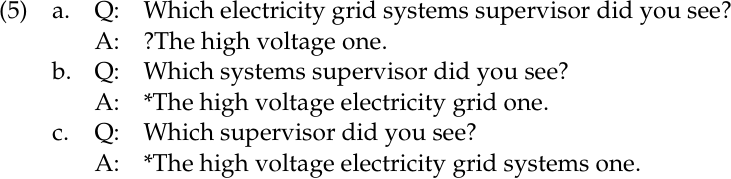
Contrast these with syntactic strings of modifier plus noun which are easily broken up, as shown in (6):
(6) Q: Which supervisor did you see?
A: The tall one.
Continuing with the notion of lexical integrity, we can ask whether it is possible to describe part of the string high voltage electricity grid systems supervisor with a modifier. When we try, the result is very awkward (7):
(7) ?A very high voltage electricity grid systems supervisor
The most natural interpretation of (7) is the figurative one whereby very high voltage is used as an adjectival phrase modifying a smaller compound [electricity grid] giving the intermediate form very high voltage electricity grid, which in turn modifies [systems supervisor], giving the entire form in (7).
Finally, we can point to the structure of high voltage electricity grid systems supervisor as evidence that it is a single noun formed by com pounding. Words in English are generally head-final, meaning that the lexical category of the form as a whole matches that of its final constituent. A dogsled is a kind of sled, not a kind of dog; the Red River Valley is a valley, not a color or a body of water; and affixed words like pollution take on the lexical category of the suffix (in this case, noun) rather than that of the stem (pollute, a verb).1 As speakers of English we know this, and without ever having heard high voltage electricity grid systems supervisor before, we know it designates a type of supervisor. Phrases, in contrast to words, are less likely to be head-final. The head of [NP John’s walking into work without a tie] is walking, not tie, and the head of [NP the house on the hill] is house, not hill.
Having established that high voltage electricity grid systems supervisor is a single word of the category N, we can ask ourselves, “Is this noun in my lexicon?” Probably not. This compound is formed by a very productive process and there is nothing irregular involved in it. It is absolutely compositional and fully motivated.
Words like this that are used but not stored are called nonce forms or hapax legomena (hapax legomenon in the singular). Nonce means ‘a particular occasion’, and hapax legomena is a Greek term meaning ‘said once’ that is used to refer to words that occur only once in the recorded corpus of a given language. These are words that somebody made up, used, and then threw away. The existence of nonce forms is one type of evidence that speakers create words on the fly as they speak.
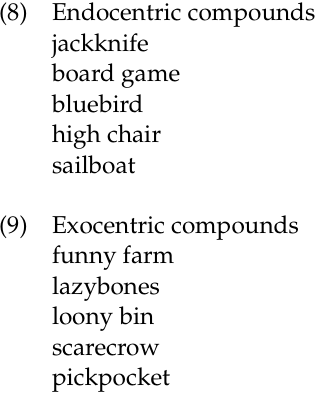
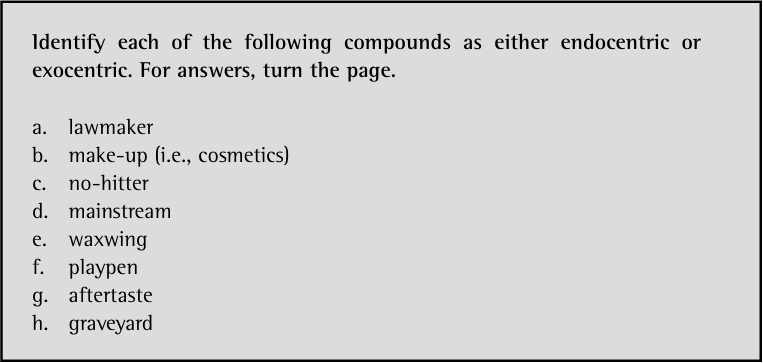
In discussing compounds, linguists sometimes use the terms endocentric and exocentric. These terms are related to the notions of motivation and compositionality presented earlier. An endocentric compound is one that has a head. The head expresses the core meaning of the compound, and it belongs to the same lexical category as the compound as a whole. For example, goldfish is an endocentric compound. It has a head, fish, which determines both the meaning and the lexical category – noun – of the compound as a whole. Compounds whose lexical category or meaning are not determinable from the head are exocentric. Figurehead is just such a compound, because it is not a type of head. Whether a compound is endocentric or exocentric is sometimes a matter of opinion. Fabb (1998: 67) gives the example of greenhouse, which is endocentric if you think of it as a type of house, but exocentric if you do not.
1 There are exceptions to this generalization, e.g., entomb.
 الاكثر قراءة في Morphology
 اخر الاخبار
اخبار العتبة العباسية المقدسة

الآخبار الصحية


مواضيع ذات صلة
 قسم الشؤون الفكرية يصدر كتاباً يوثق تاريخ السدانة في العتبة العباسية المقدسة
 "المهمة".. إصدار قصصي يوثّق القصص الفائزة في مسابقة فتوى الدفاع المقدسة للقصة القصيرة
 (نوافذ).. إصدار أدبي يوثق القصص الفائزة في مسابقة الإمام العسكري (عليه السلام)






