









Grammar
Tenses
Present

Present Simple
Present Continuous
Present Perfect
Present Perfect Continuous
Past
Past Simple
Past Continuous
Past Perfect
Past Perfect Continuous
Future
Future Simple
Future Continuous
Future Perfect
Future Perfect Continuous
Parts Of Speech
Nouns
Countable and uncountable nouns
Verbal nouns
Singular and Plural nouns
Proper nouns
Nouns gender
Nouns definition
Concrete nouns
Abstract nouns
Common nouns
Collective nouns
Definition Of Nouns
Animate and Inanimate nouns
Nouns
Verbs
Stative and dynamic verbs
Finite and nonfinite verbs
To be verbs
Transitive and intransitive verbs
Auxiliary verbs
Modal verbs
Regular and irregular verbs
Action verbs
Verbs
Adverbs
Relative adverbs
Interrogative adverbs
Adverbs of time
Adverbs of place
Adverbs of reason
Adverbs of quantity
Adverbs of manner
Adverbs of frequency
Adverbs of affirmation
Adverbs
Adjectives
Quantitative adjective
Proper adjective
Possessive adjective
Numeral adjective
Interrogative adjective
Distributive adjective
Descriptive adjective
Demonstrative adjective
Pronouns
Subject pronoun
Relative pronoun
Reflexive pronoun
Reciprocal pronoun
Possessive pronoun
Personal pronoun
Interrogative pronoun
Indefinite pronoun
Emphatic pronoun
Distributive pronoun
Demonstrative pronoun
Pronouns
Pre Position
Preposition by function
Time preposition
Reason preposition
Possession preposition
Place preposition
Phrases preposition
Origin preposition
Measure preposition
Direction preposition
Contrast preposition
Agent preposition
Preposition by construction
Simple preposition
Phrase preposition
Double preposition
Compound preposition
prepositions
Conjunctions
Subordinating conjunction
Correlative conjunction
Coordinating conjunction
Conjunctive adverbs
conjunctions
Interjections
Express calling interjection
Phrases
Sentences
Clauses
Part of Speech
Grammar Rules
Passive and Active
Preference
Requests and offers
wishes
Be used to
Some and any
Could have done
Describing people
Giving advices
Possession
Comparative and superlative
Giving Reason
Making Suggestions
Apologizing
Forming questions
Since and for
Directions
Obligation
Adverbials
invitation
Articles
Imaginary condition
Zero conditional
First conditional
Second conditional
Third conditional
Reported speech
Demonstratives
Determiners
Direct and Indirect speech
Linguistics
Phonetics
Phonology
Linguistics fields
Syntax
Morphology
Semantics
pragmatics
History
Writing
Grammar
Phonetics and Phonology
Semiotics
Reading Comprehension
Elementary
Intermediate
Advanced
Teaching Methods
Teaching Strategies
Assessment

Nouns and verbs The second layer: verbs
 المؤلف:
Bernd Heine and Tania Kuteva
المؤلف:
Bernd Heine and Tania Kuteva
 المصدر:
The Genesis of Grammar
المصدر:
The Genesis of Grammar
 الجزء والصفحة:
P71-C2
الجزء والصفحة:
P71-C2
 2026-02-26
 388
388




+
-
20
Nouns and verbs
The second layer: verbs
Like nouns, verbs provide a rich source for a range of functional categories. In the present section we give an outline of the main pathways leading straight from lexical verbs to items serving some grammatical function.
Verb > adposition The primary source for prepositions and postpositions is provided by nouns (see above and also under Adverb > adposition). But verbs, as well, are a common source for adpositions, usually involving a process whereby a structure [verb þ complement] is reinterpreted as a structure [adposition þ noun phrase].
How this grammaticalization affects the structure of the verb undergoing the process has been shown in more detail by Matsumoto (1998) for Japanese. This language has a wide range of postpositions which are historically derived from verbs used in the participial-te-construction; Matsumoto (1998: 27–8) provides a list of 26 such postpositions. The following is a typical example of such a postposition. In (13a) the verb tuku (participial form: tuite) is exemplified, having the lexical meanings ‘stick to, follow, take the post of’, while (13b) illustrates the same item in combination with the dative marker ni as a functional category, namely as a postposition meaning ‘about, concerning’. Since the verb follows its complement in Japanese, the resulting forms develop into postpositions rather than prepositions.
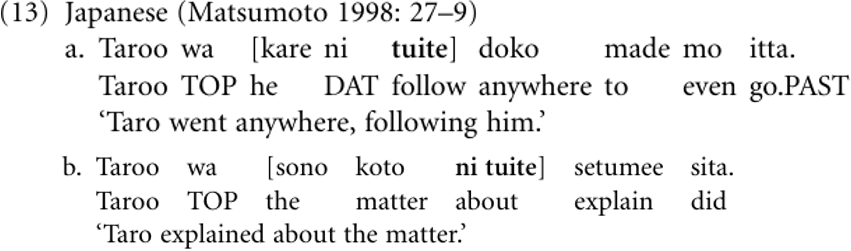
Desemanticization had the effect that the verbal semantics was reduced to a schematic function, in the case of tuku to a theme function. Decategorialization entailed the following changes in particular (see Matsumoto 1998: 29–33 for more properties): The verb lost the ability to be immediately preceded by particles such as mo ‘too, even’ or dake ‘only’, to be modified by manner adverbials, to take subjects and head clauses, or to take tense, negation, and other markers, and the verb can no longer be inflected for causativization, passivization, etc. The result is an invariable postposition ni tuite, where the erstwhile verb has merged with the dative postposition ni.
As a rule it is not finite verbs, inflected for person, tense, etc., that are grammaticalized but non-finite verb forms, such as infinitival or gerundival/participial verbs, as in our Japanese example. In English, prepositions are most commonly derived from present participle forms (barring, concerning, considering, during,1 excepting, failing, following, notwithstanding, pending, preceding, regarding) or past participle verb forms (given, granted); in the Bantu language Swahili, it is generally the infinitive prefix ku- that turns verbs into prepositions, for example ku-pitia ‘to pass by’ > kupitia ‘through, via’, ku-toka ‘to come from’ > kutoka ‘from’, ku-husu ‘to give a share to’ > kuhusu ‘concerning, about’, for example:

Depending on the particular contextual frame that is used for grammaticalization, however, a verb developing into an adposition may take other morphosyntactic forms. For example, this pathway may involve imperative singular verb forms, such as English bar or come (König and Kort mann1991: 117), in which case the resulting adposition may consist of the bare verb stem only.
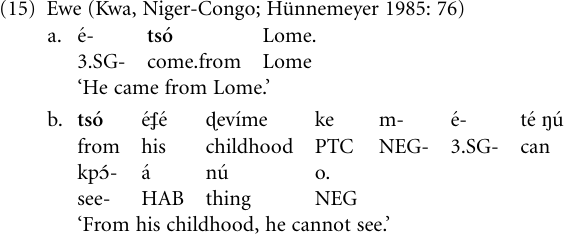
Paradigm cases of the verb-to-adposition pathway can be found in analytic-isolating languages of, for example, southeastern Asia and western Africa: In these languages, the verb is uninflected both in its lexical-verbal and in its adpositional uses. The following example illustrates the process concerned. In the Ewe language of Ghana and Togo, the verb tso̒ ‘to come from’ has been grammaticalized to a source preposition ‘from’. Example (15a) shows tso̒ in its lexical use as a motion verb, while (15b) exhibits its grammaticalized use as a functional category: Verbs in Ewe cannot occur without a formal subject (except for imperatives), nor can they appear sentence-initially; in its use as a preposition, however, the item tso̒ can, as (15b) shows.
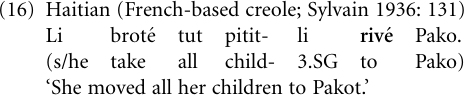
Evidence for this pathway can also be found abundantly in creole languages, such as the following example from Haitian, where the allative preposition rive̒ ‘to’ is historically derived from the French motion verb arriver ‘arrive’:
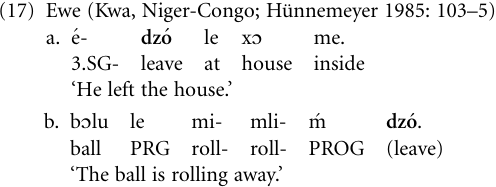
Verb > adverb One common way in which lexical verbs develop into adverbs is via the serialization of two verbs where one of them comes to assume a modifying function for the other and gradually turns into an adverbial modifier of the other verb. This grammaticalization is therefore particularly common in languages having serial verb constructions, even if it is not restricted to them. In the following example (17a), the Ewe item dzo̒ ‘to leave’ is a lexical verb, while in (17b) it follows the verb mli ‘to roll’ and modifies the meaning of the latter. That dzo̒ is no longer a verb in (17b) is suggested, for example, by the fact that it is not inflected for tense–aspect: It is invariable, exhibiting a morphosyntactic structure characteristic of adverbs.
The verb developing into an adverb may take various morphosyntactic shapes; it can take a non-finite or a finite form. In Latin, a number of finite verb forms have given rise to adverbs; for example, the verb form scilicet, a compound of scire ‘to know’ and licet ‘it is permitted’, had the meaning ‘one can know (that)’ and took infinitival complements in early Latin. But from the earliest times, it was also used as an adverb meaning ‘of course, naturally’, and ‘namely’, mostly however by no means always used in the second position of the clause. And much the same applies to videlicet (composed of videre ‘to see’ and licet), which was used in the same construction with infinitival complements and developed into an adverb with much the same meaning as scilicet (Janson 1979: 97–8).
For more examples of this kind from verb to adverbial modifier from languages in other parts of the world, see Heine and Kuteva (2002a). What all these cases have in common is that the second verb in a verb–verb construction is desemanticized, whereby its lexical meaning is reduced to some specific schematic function (like ‘away’ in example (17b)), and decategorialized, in that that verb loses most or all of the verb properties characterizing its lexical use (like the ability of dzo̒ to be used in the progressive aspect).
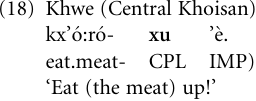
Verb > aspect Most languages of the world have undergone this process, whereby lexical verbs assume the function of an auxiliary of other verbs and turn into markers for aspect functions such as progressive, durative, habitual, completive, perfective, iterative, and the like. There is a rich literature on this grammaticalization process (e.g. Bybee, Perkins, and Pagliuca 1994; Kuteva 2001). We briefly discussed an example from English in “The present approach” concerning the item keep, which is a lexical verb in most of its uses (e.g. He kept the money), but has also been grammaticalized to a durative aspect auxiliary when combined with main verbs (He kept complaining). In the following example from the Khoisan language Khwe (or Kxoe̒), the verb xŭ ‘to leave, abandon, loosen’ has been grammaticalized to a completive (terminative) aspect marker when serving as an auxiliary of another verb: It has lost its lexical meaning in favor of a schematic aspectual function, and it has been decategorialized to a verbal derivational suffix-xu:
But crosslinguistically verbs meaning ‘finish’ that give rise to completive, perfect, and perfective aspect markers are more common (Bybee, Perkins, and Pagliuca 1994; Heine and Kuteva 2002a). This is also a process that has happened in a number of signed languages, such as American Sign language (ASL),2 and Italian Sign Language (Janzen 1995; Sexton 1999; Morford 2002: 331; Pfau and Steinbach 2006), for example:

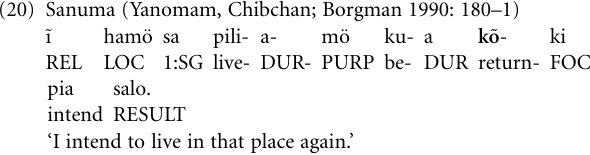
Suffice it to add an example of a specific but widespread pathway of grammaticalization whereby verbs meaning ‘to return, come back’ develop into iterative (or repetitive) markers when combined with other verbs. In the Central American Chibchan language Sanuma, the lexical verb kõ ‘return’ has given rise to a repetitive marker when in combination with other verbs:
Verb > case marker Verbs are a common source of adpositions (see above), and in some cases they may further develop into case markers. Givo̒n (2006: 24) observes that the Uto-Aztecan language Ute derives all locative case markers from historically-still-traceable precursor verbs which have turned into noun suffixes, no longer carrying any discernible residue of verbal properties; a few examples are provided in (21).
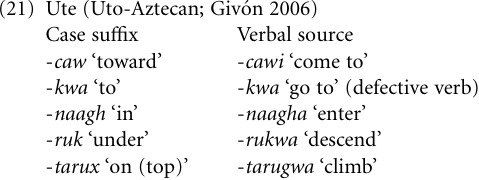
Since case affixes derive almost invariably from adpositions and, next to nouns, verbs provide a major source for adpositions (see Verb > adposition), this grammaticalization appears to be part of the more general pathway (22).
(22) verb > adposition > case marker
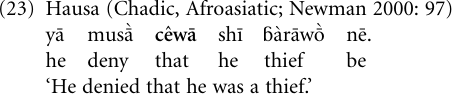
Verb > complementizer Next to demonstratives (see below), lexical verbs provide one of the most important sources for the development of markers introducing complement clauses. Since we will be dealing with this pathway of grammaticalization in more detail in “The verb channel”, we are confined here to one example. Speech act verbs meaning ‘say’ or similative verbs meaning ‘be like’, ‘be equal’, or ‘resemble’ are the ones that commonly give rise to complementizers (see Heine and Kuteva 2002a: 257–8; 261–5; 273–5). The following example from the West African language Hausa illustrates the use of a ‘say’-verb as a complementizer: The verb cê ‘say’ is used in its nominalized form cêwā to present complement clauses (though not when the main clause verb is cê):
Verb > demonstrative This is a pathway, which appears mainly to concern verbs meaning ‘to go’,3 to a lesser extent also verbs for ‘see’ (Heine and Kuteva 2002a: 172–3, 159, 294–5), for which Frajzyngier (1995: 197) proposes the following pathway: ‘go’ > remote deictic > demonstrative > pronoun.
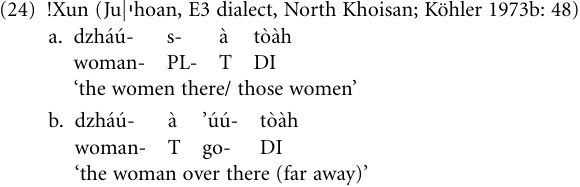
Archaic Chinese provides one example: The motion verb ZHI ‘to go’ has developed into a proximal demonstrative ‘this’ (Heine and Kuteva 2002a: 159). But clearly cases where the resulting demonstrative function is distal rather than proximal are more common. For example, in the Chadic language Mupun (or Mopun), the verb ’dı̀ ‘go’ appears to have given rise to a distal demonstrative (Frajzyngier 1987), and similar examples can be found in the Khoisan family. In the E3 dialect of !Xun (Ju ǀˡhoan) of the North Khoisan family, the verb tȍ ’à ‘go’ seems to have provided the source for the distal demonstrative tòàh ‘that’, cf. (24a). That this hypothesis is correct is supported by the fact that there is another verb for ‘go’, ˡu̒u̒, which is also used as a demonstrative marker, added to the distal demonstrative to form another demonstrative denoting extreme distance (‘that, far away’), cf. (24b).
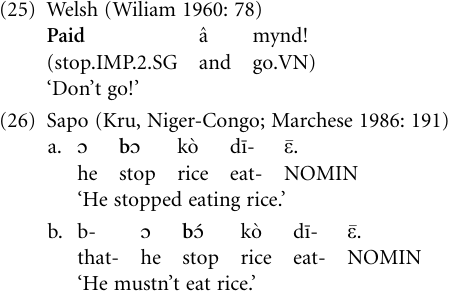
Verb > negation The development of negation in French, where the noun pas ‘step’ (as well as a set of other nouns) was introduced as an optional pseudo-object reinforcing the inherited pre-verbal negative particle ne, later turning into the primary means of expressing verbal negation (Schwegler 1988; Hopper and Traugott 1993: 58–9), is usually cited as a paradigm example of how negation markers arise. Crosslinguistically, however, this pathway, leading from noun to negative particle is not really common, even if it is widespread in European languages (Ramat and Bernini 1990); perhaps the main way in which new negation markers evolve is via the grammaticalization of verbs. In many cases, the process is confined to modally marked contexts, especially to prohibitive or negative imperative constructions, where verbs meaning ‘stop’ are reinterpreted as negation markers. The following example from Welsh illustrates this case of restricted grammaticalization: The verb peidio ‘cease, stop’ has acquired the function of a prohibitive auxiliary, as in (25). Similar cases abound in the Kru languages of West Africa (Marchese 1986; Heine and Kuteva 2002a: 283–4); example (26) is representative of this situation, where (26a) shows the lexical and (26b) the functional use of the verb.
Negative imperatives and prohibitives have a number of other verbal sources in addition, in particular verbs of negated volition, that is, negative verbs of desire, such as Latin nōlı̄, the imperative of ‘not want, be unwilling’ which introduces negative imperatives. In the following example from the Philippine language Tagalog, the item huwag expresses negative desire in a declarative sentence such as (27a), but a negative imperative in (27b) (see Croft 1991: 14–16 for more details).
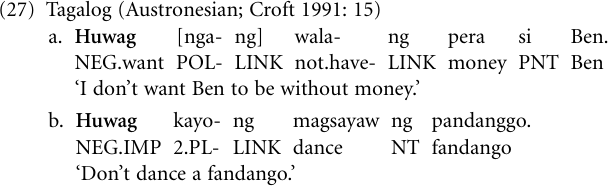
This grammaticalization process does not involve any dramatic degree of desemanticization; what appears to happen in most cases is that a negative verb of desire is extended from a modally unmarked to a modally marked context and in this process loses its volition meaning. Not uncommonly, such verbs are historically derived from a combination of a negation marker plus a verb of volition.
Otherwise, verbs giving rise to negation markers are in particular ‘lack’, ‘miss’, ‘leave’, and ‘fail’ (Heine and Kuteva 2002a: 188, 192–3). For example, the verbs WU and WANG of Archaic Chinese, both meaning ‘lack’, developed into negative markers (Alain Peyraube, p.c.). Once again, there are a number of Kru languages which underwent this grammaticalization (Marchese 1986: 183), and in the Khoisan language !Xun (W2 dialect), the negation marker in modally marked sentences is nǀǀȁ (or nǀǀȁn), which is likely to be derived from the verb nǀǀȁn ‘leave, abandon’, for example:

Worldwide perhaps the most common manifestation of the Verb > negation pathway is provided by negative existential verbs (‘not to exist’) gradually developing into markers of verbal negation (for a detailed description of this process, see Croft 1991). Extension has the effect that the negative existential spreads from nominal complements to verbal complements; desemanticization leads to the bleaching out of the predicate function and the ‘existence’ meaning, and decategorialization means that the negative existential loses all the verbal properties it may have had and be restricted in its occurrence to the position next to the other verb.
Frequently, these negative existentials have only a limited number of verbal properties, or they may even be invariable particles; historically it is not unusual for them to be combinations of a positive existential plus a negation marker. At the initial stage, the negative existential may simply serve as an emphasizing device for an already existing negative construction. The final stage is reached when the negative existential replaces the earlier negation marker, or becomes the main exponent of negation.
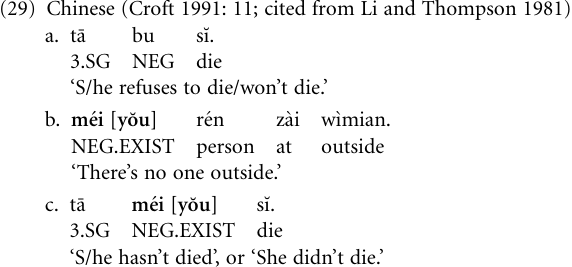
In a number of languages, however, the new negation marker is not generalized to all contexts but remains restricted to certain tenses or aspects. The negative existential bâ ‘there is not’ of the Saharan language Kanuri of Nigeria, for example, seems to have developed into a negation marker of the imperfective aspect, while in the perfective there is a different negation marker (-nyi). In Chinese, the ‘‘normal’’ declarative negation marker is bu, illustrated in (29a), while the negative existential me̒i [yŏu] (cf. (29b)), consisting of the special negator me̒i and the existential/possessive verb yŏu, appears to have been grammaticalized to a negation marker of completed actions, cf. (29c).
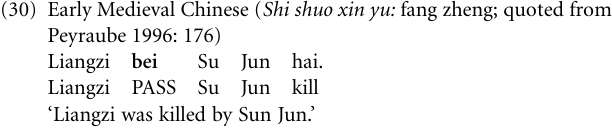
Verb > passive Passives are the result of a wide range of different conceptual sources and constructions (Haspelmath 1990; Givo̒n 2004; see Pronoun > passive for one of these sources). In a number of these constructions, there is a verb that is grammaticalized to a passive marker, either in combination with some other morphological exponent (cf. English be plus participle, or German werden ‘become’ plus participle), or on its own. In a number of East Asian languages, such as Thai, Vietnamese, Mandarin Chinese, or Korean, there is a verb meaning ‘suffer’ that has assumed the function of a passive marker (see Heine and Kuteva 2002a: 284). For example, the Chinese verb bei ‘to receive’, ‘to suffer’, ‘to be aVected’4 of the Warring States period turned into a passive marker bei in Early Medieval Chinese (second–sixth century AD), for example:
Verbs meaning ‘get, acquire’, including English get, crosslinguistically provide a common source for passive markers. For example, in the French-based Indian Ocean creoles, the French verb gagner ‘to gain’ has turned into a passive marker gaŷ:

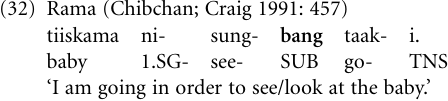
Verb > subordinator Subordinators, that is, markers introducing adverbial clauses, can be derived from a wide range of verbs depending on their particular function (see Heine and Kuteva 2002a for examples). Since we will deal with this issue in more detail, one example may suffice to illustrate this pathway. In this process, the parameter of extension has the effect that the use of the verb is extended from nominal complements to adverbial clauses, the lexical meaning of the verb is desemanticized, what remains is the syntactic ability of the verb to take a complement, and via decategorialization the verb loses most, if not all, verbal properties. The following example illustrates the grammaticalization of the verb bang ‘go’ to-bang, a subordinating conjunction of goal or purpose in the Central American language Rama.
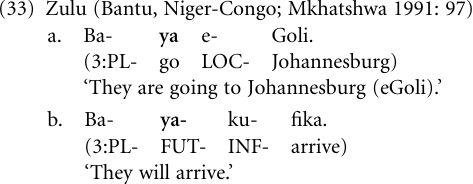
Verb > tense In the same way as they give rise to markers of verbal aspect, lexical verbs combine with other verbs, assume the role of auxiliaries and turn into tense markers. In this way, English acquired two future tense categories, will and be going to, by grammaticalizing a verb of volition (will-an) and of motion (go to) to tense markers. Similar processes have occurred in a wide range of languages all over the world, whereby verbs meaning ‘want’, ‘come to’, or ‘go to’ turned into future markers. The following example from the South African Zulu language is a case in point: The lexical verb-ya ‘go’ (33a) has developed into a remote future prefix (33b).
The reader is referred in particular to Bybee, Perkins, and Pagliuca (1994) for ample illustration of the ways in which verbs give rise to tense categories, either directly or via an intermediate stage of an aspect category (see Verb > aspect). Evidence for this pathway is also found in signed languages (see Pfau and Steinbach 2005, 2006).
And in much the same way as lexical verbs commonly develop into tense and aspect markers, they also give rise to markers of modality—both in spoken languages (Bybee, Perkins, and Pagliuca 1994) and in signed languages (Pfau and Steinbach 2006).
1 During is derived from an obsolete verb meaning ‘to last, endure’.
2 Janzen (1995) observes that FINISH in ASL has acquired a wide range of tense–aspect meanings, namely completive, perfect (or anterior), perfective, past, as well as a conjunctive function.
3 Frajzyngier (1995: 1991–2) argues that in Chadic languages there is evidence for verbs meaning ‘say’ to form the source of demonstratives, but the data provided are not entirely satisfactory to strengthen this hypothesis.
4 Originally, bei was a noun meaning ‘blanket’, later it turned into a verb meaning ‘to cover’, ‘to wear’, before it acquired the meanings ‘to receive’, ‘to suffer’, ‘to be affected’ (Peyraube 1996: 176).
 الاكثر قراءة في Verbs
 اخر الاخبار
اخبار العتبة العباسية المقدسة

الآخبار الصحية


مواضيع ذات صلة
 قسم الشؤون الفكرية يصدر كتاباً يوثق تاريخ السدانة في العتبة العباسية المقدسة
 "المهمة".. إصدار قصصي يوثّق القصص الفائزة في مسابقة فتوى الدفاع المقدسة للقصة القصيرة
 (نوافذ).. إصدار أدبي يوثق القصص الفائزة في مسابقة الإمام العسكري (عليه السلام)






