Nouns and verbs
The first layer: nouns
There are cases where nouns, or noun-like entities, are derived from other structural units. Such units can be whole sentences (e.g. forget-me-not), minor words (e.g. the ifs and buts), affixes (Her ex is a monster), or even ‘‘quasi’’-forms (I want an ade). However, these tend to be idiosyncratic instances of lexicalization rather than being suggestive of regular processes leading towards grammatical categorization. In the present section we will outline the main pathways leading from nouns to other grammatical categories.
Noun > adjective Nouns typically denote tangible and/or visible things that refer, while adjectives denote qualities relating to such conceptual domains as dimension (‘large’, ‘small’), age (‘old’, ‘young’), color (‘green’), or value (‘good’, ‘bad’). In many languages a diachronic process can be observed whereby specific groups of nouns are grammaticalized to adjectives, such groups concerning nouns stereotypically associated with some specific quality. Groups commonly recruited include nouns denoting plants (or plant parts), specific animals, and metals. Thus, we find in English names of fruits such as orange, or metal names such as bronze, brass, or silver that have been grammaticalized to adjectives. This process involves on the one hand the parameter of desemanticization, whereby the nominal meaning is bleached out except for some salient property, refer ring to the color of the item concerned. On the other hand it involves decategorialization, in that nouns in such uses lose morphosyntactic properties characteristic of nouns, such as taking modifiers, determiners, and inflections and occurring in all the contexts commonly associated with nouns.
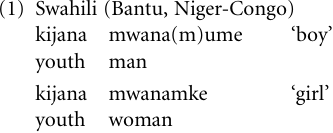
Another group of nouns widely grammaticalized to adjectives concerns sex-specific human items such as ‘man’ and ‘woman’ or ‘father’ and ‘mother’, which in many languages are recruited to express distinctions in sex. Thus, in the Swahili examples in (1), the nouns mwana(m)ume ‘man’ and mwanamke ‘woman’ are desemanticized and decategorialized in that their meaning is restricted to denoting the qualities ‘‘male’’ and ‘‘female’’, respectively, and they occur in the syntactic slot reserved for adjectives, namely after the noun they modify, and they agree in number with their head noun.
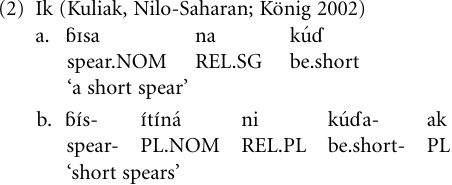
Adjectives tend to be closed-class categories, that is, unlike nouns and verbs, their number is severely limited in many languages. A number of languages lack adjectives altogether; however, such languages tend to have productive mechanisms to form what corresponds to adjectives in other languages. Not uncommonly, it is verbs of state (‘be big’, ‘be bad’) that are used for this purpose. The Ik language of northeastern Uganda is such a language: There are no adjectives whatsoever, even if state verbs introduced with the relative clause marker na, PL ni can be viewed as a weakly grammaticalized means of expressing recurrent distinctions of size, quality, etc.1 But there is also a morphological distinction: Unlike other verbs of state, verbs expressing ‘‘adjectival’’ notions relating to dimension, weight, age, or color take an optional plural suffix-ak when used as nominal attributes, cf. (2b), while other verbs of state never use this suffix.
To be sure, adjectives can be used in many languages as substitutes for nouns, typically by omitting the head noun in adjective–noun constructions. Such usage, however, does not normally lead to productive patterns of development from adjective to noun.
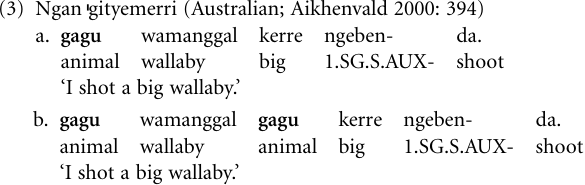
Noun > agreement marker Agreement markers may arise in a number of ways; the main pathways will be discussed below. One pathway, however, not to be analyzed further here, concerns the development from nouns to noun classifiers, overt noun class markers, and eventually to agreement markers (Aikhenvald 2000: 91). One possible development is discussed by Aikhenvald with reference to the noun class system of the Australian language Nganˡgityemerri, where the noun gagu ‘animal’ is used as a noun classifier in a pairing generic noun–specific noun, as in (3a), and the classifier use in this pairing may spread to the construction noun modifier, where the generic noun is repeated on the modifier, as in (3b), paving the way for an obligatory agreement marker.
Noun > adposition One of the main sources of adpositions, that is, prepositions and postpositions, is provided by nouns (or noun phrases), frequently but not necessarily in combination with some adposition and/ or case inflection; we are not aware of any language which has not undergone such a process. This pathway of grammaticalization is well documented (Svorou 1986, 1994; Heine, Claudi, and Hünnemeyer 1991; Bowden 1992; Heine 1997b); we are therefore confined here to a few examples. The process almost invariably involves constructions of attributive possession [X of Y], where the head noun (phrase) X is grammaticalized to an adposition of the modifier noun (phrase) Y. New adpositions may be built on already existing adpositions or case markers, and in some languages, including English, this is the primary way in which new adpositions evolve, for example in spite of, on behalf of, by means of.
Desemanticization has the effect that the nominal meaning of X is reduced to some salient property, which in most cases is a spatial concept. Via decategorialization, X develops from a fully-fledged noun or noun phrase into an invariable functional category, that is, an adposition; accordingly, morphologically complex forms, such as by means of, turn intounanalyzablemono-morphemic functional markers. Finally, there may also be erosion, whereby the phonetic substance used for the expression is reduced in the process, as in the development of English on gemang > among, be sedan > beside(s), in steede > instead (König and Kortmann 1991: 110). The overall development of this pathway is described by Lehmann (1985: 304) thus:

While relational nouns are in fact the major nominal source of adpositions, there may be other nouns as well; for example, the German causal preposition wegen ‘because of’ has the dative plural form of the non-relational noun Wegen ‘ways’ as its source. Note further that once a noun has entered the pathway from noun to adposition, it may (but need not) proceed further to developing into a case marker—as a matter of fact, in the vast majority of instances it does not; the grammaticalization process can be arrested at any stage in its development.
Perhaps the most salient group of nouns undergoing this grammaticalization concerns body parts, English in back of and in front of being typical examples of this process. Another group of nouns concerns what is technically known as environmental landmarks. Nouns for ‘boundary’ are instances of landmarks which not uncommonly give rise to delimitive adpositions (‘until’). For example, the noun te̒ka ‘boundary, end’ of the Gur language More̒ of Burkina Faso has developed into a temporal postposition te̒ka ‘until’, ‘since’, and in a similar fashion, the Swahili noun m-paka ‘border, boundary’ gave rise to a locative and temporal preposition mpaka ‘up to, until’ (Heine and Kuteva 2002a: 279–80).
Once the grammaticalization from noun to spatial adposition is concluded, that item may further develop into a temporal adposition. For example, the Icelandic body-part noun bak ‘back’ was grammaticalized to a locative preposition bak(i) ‘behind’, but also to a temporal preposition ‘after’, for example bak jo̒l-um (after Christmas-DAT.PL) ‘after Christmas’ (Heine and Kuteva 2002a: 46–7).
In addition to body-part and landmark nouns there is a wide range of other nouns serving as sources for adpositions, acquiring adpositional functions other than locative and temporal ones, as can be seen in English prepositions such as instead of, in spite of, by means of, on behalf of, etc. One common group of nouns, expressing meanings such as ‘matter’, ‘ground’, ‘cause’, tends to give rise to cause or reason adpositions. An example is provided by the noun mùqo̒a̒-sı̀ ‘matter’ (matter-F.SG) of the Khoisan language ǀǀAni of Botswana, which developed into a cause postposition:

While constructions of attributive possession provide the most frequent source for adpositions, there may be alternative constructions as well. In English, for example, there are relational elements such as the prepositions to and for instead of the possessive particle of, as in in addition to, contrary to, thanks to, or in exchange for.
Noun > adverb When used in adverbial phrases, nouns or noun phrases may be grammaticalized to adverbs. One group of nouns undergoing this grammaticalization in many languages concerns concepts relating to spatial orientation, where desemanticization has the effect that the meaning of the noun is bleached out except for the property of denoting spatial orientation, and decategorialization means that most, if not all, nominal properties are lost and the item concerned turns into an invariable adverbial modifier of verbs or clauses. Thus, in the Gur language More̒ of Burkina Faso, the noun nyı̈ngri ‘sky, firmament’ has developed into an adverb nyı̈ngri ‘above, over, up’, and so has the noun yŏ p ‘sky, firmament’ of the Cameroonian Bantu language Bulu, which has turned into an adverb ‘above, up’ (Heine and Kuteva 2002a: 279–80). This group also includes nouns meaning ‘home(stead)’, ‘house’, etc., which may develop into locative adverbs meaning ‘(at) home’, as well as nouns for body parts which, on account of some salient spatial characteristic, may be grammaticalized to locative adverbs, English back (e.g. Go back!) being a case in point.
Another group of nouns that may develop into adverbs includes temporal items such as ‘time’, ‘day’, or ‘hour’ which are grammaticalized to temporal adverbs. Examples are Italian ora ‘hour’, a noun which gave rise to the temporal adverb ora ‘now’, or the Basque noun ordu ‘hour’, which is the base of the form orduan ‘then’ (with the locative case-ending-an; Heine and Kuteva 2002a: 176).
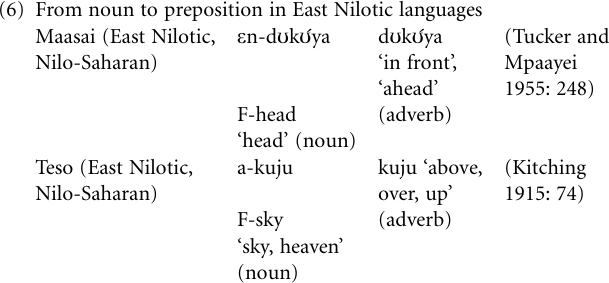
Decategorialization may have the additional effect that the relevant noun loses some or all of its morphological trappings in the process. For example, in East Nilotic languages such as Maasai and Teso, nouns are generally used with gender prefixes. But when grammaticalized to adverbs, they lose their prefixes, cf. (6).
Not uncommonly, it is nouns headed by an adposition that grammaticalize into adverbs. For example, the Latin adverb ergo ‘consequently, thus’ is said to be historically derived from *e rego (or *e rogo) ‘from the direction of’ (Janson 1979: 99).
Noun > case marker Nouns (or noun phrases) provide one of the main sources for case markers, that is, grammatical forms, usually affixes or clitics, which have no function other than assigning a case property to the noun (phrase) they govern.2 This process, which involves an intermediate stage where the noun (phrase) serves as an adposition (see Noun > adposition), entails most of all desemanticization, whereby the semantics of the noun is lost or, more precisely, is reduced to expressing a case property. Decategorialization has the effect that the noun loses its combinatorial potential and its internal morphological complexity and is reduced to an invariable grammatical form serving some specific syntactic function.
Possessive (genitival) case markers tend to occupy crosslinguistically a marginal position in case paradigms. One source for such markers can be seen in nouns meaning ‘property’, ‘part’, or ‘thing’. The process underlying this development is based on the reinterpretation of a structure [X property (of) Y] as [X of Y], whereby the noun is desemanticized and decategorialized to a functional marker expressing a syntactic relation.
In the Aztecan language Pipil of El Salvador, the relational noun-pal ‘possession’ has turned into a preposition pal, and a case marker of attributive possession (Harris and Campbell 1995: 126–7). The Arabic noun bita:ʕ ‘property’ has provided the source for the genitive marker in the Arabic-based creole Nubi; in the process, the noun underwent erosion to ta. A similar process has taken place in the fellow Semitic language Maltese, where the noun ta’ ‘possession’, ‘property’, has given rise to a case marker of a new pattern of attributive possession (Heine and Kuteva 2002a: 245–6; see there for more examples).
But there is also a more general process whereby nouns develop into adpositions, and some of the latter may turn into case clitics and case inflections. Most instances that have been documented involve nouns that turn into locative adpositions and finally into locative case inflections, although the use of the latter may be extended to also denote temporal, causal, and other case relations. But it is not only the spatial domain that is involved. The following examples illustrate an alternative pathway of grammaticalization. The Balto-Finnic noun *kansa ‘people’, ‘society’, ‘comrade’ developed into the comitative postposition kanssa in Finnish and kaas (‘together with’, ‘in the company of’) in Estonian, and eventually it turned into a comitative-instrumental marker-ga/-ka in Estonian. In a similar fashion, the comitative marker-(gu)in of the fellow Finnic language Sami appears to be etymologically derived from the Sami noun guoibmi ‘comrade’, ‘fellow’, ‘mate’ (Stolz 2001: 599–600; see Heine and Kuteva 2002a: 91–2 for additional evidence for this grammaticalization). A similar development appears to have happened in Basque, where the noun kide ‘companion’, ‘fellow’, ‘mate’, applied to both people and things, appears to be the source of the comitative case suffix-ekin (Heine and Kuteva 2002a: 91–2).
Rather than the meaning of the noun, it may be inflections on the noun that determine the function of the resulting case affix. The Hungarian case suffixes-ben/-ban ‘in’ (inessive) and -bo̒l/-bol̋ ‘away from’ (elative) are both historically derived from a relational locative noun be̒l meaning ‘interior’. The difference in case functions is due to the fact that the final segments n and l are themselves relics of the case suffixes (-n locative;-öl ablative) on the locative noun (Comrie 1981: 119; Lehmann 1982: 84–5; Hopper and Traugott 1993: 107–8).
Noun > complementizer Crosslinguistically, nouns form one of the main sources for complementizers, that is markers introducing complement clauses. It is general nouns such as ‘thing’, ‘person’, ‘matter’, and ‘place’ in particular which, when having argument status in the main clause, are reinterpreted as markers presenting complement clauses. Desemanticization has the effect that the nominal meaning disappears, giving way to the syntactic function of serving as the head of a subordinate clause. Decategorialization means that the erstwhile noun may no longer take modifiers or determiners and is restricted in its occurrence to the complementizer slot. Since we will deal in more detail with the process from noun to complementizer, a few examples may suffice to illustrate it. The following example from a modifier–head language illustrates such a situation, where the noun !xa̒i-sa ‘matter’, ‘story’ (oblique case) of the Khoisan language Nama has given rise to the complementizer !xa̒i-sà ‘that’, ‘whether’:
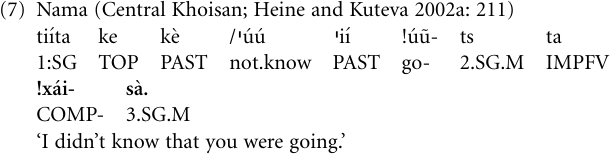
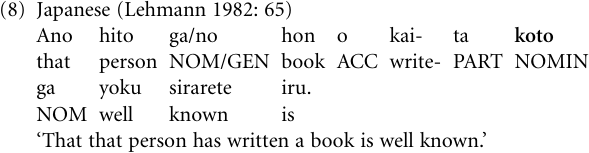
Note that the complementizer exhibits an inflectional ending. The example is suggestive of an early stage of grammaticalization. At a more advanced stage, the complementizer is likely to be decategorialized to the extent that it loses its nominal properties and turns into an invariable grammatical marker. The following example from Japanese may illustrate this situation. The complementizer koto appears to be historically derived from a noun ‘thing’ (Lehmann 1982: 65). koto is no longer available as a noun, but it has survived as a complementizer (or nominalizer) that has lost essentially all its nominal properties, that is, it may no longer take case markers or any other elements associated with the use of nouns. Like Nama, Japanese has a rigid modifier–head word order; accordingly, the complementizer follows the subject complement clause in the following example:
Noun > pronoun The process from noun to pronoun is a crosslinguistically widespread one, and it may take a number of different pathways. What all these pathways have in common is that they involve the same parameters of grammaticalization. This is on the one hand desemanticization, whereby the lexical semantics of the noun is lost; what remains is a schematic grammatical function. On the other hand, it involves decategorialization, having the effect that the noun loses its categorial properties, such as taking nominal inflections and modifiers.
One of these pathways leads from nouns meaning ‘man’ to impersonal or indefinite animate pronouns. Much discussed examples concern the Latin noun homo ‘man, person’ which gave rise to the French impersonal pronoun on, or the German noun Mann ‘man’, which developed into the indefinite subject pronoun man. Another example is provided by Icelandic maður ‘man, person’, which assumed the function of an indefinite pronoun (‘someone’; Heine and Kuteva 2002a: 208–9).
Other examples involve nouns meaning ‘person’ or ‘people’ that acquire uses of and may develop into indefinite pronouns (Heine and Kuteva 2002a: 232–3). This is a widespread process in the Chadic languages of the Afroasiatic family, where nouns for ‘person’ or ‘people’ have developed into indefinite subject pronouns, for example Margi mjı̀ ‘people’, Kapsiki mbelı̒ ‘people’, Guduf u̒dè ‘person’, Gude ənji ‘people’ (Kim 2000). The following is an example from the Cameroonian language Baka, where the noun wo̒ ‘person, man’ has been grammaticalized to an impersonal pronoun.

European examples include Albanian njeri ‘person’, which has uses of an indefinite pronoun (‘somebody’), or Portuguese pessoa ‘person’, as the following example illustrates:

In a parallel fashion, nouns meaning ‘thing’ commonly grammaticalize into inanimate indefinite pronouns. For example, the Nahuatl noun itlaa ‘thing’ developed into an indefinite pronoun tlaa ‘something’, and the phrase ohun kan (‘thing one’) of the Niger-Congo language Yoruba of Nigeria turned into the indefinite pronoun nkan ‘something’; for more examples, the reader is referred to Heine and Kuteva (2002a: 295–6; see also Lehmann 1982: 51–2; Heine and Reh 1984; Haspelmath 1997a: 182).
Evidence for a process from noun to indefinite pronoun also comes from signed languages, for example from German Sign Language (DGS) and Netherlands Sign Language (NGT), which both appear to have undergone a development from noun for ‘person’ to indefinite pronoun (Pfau and Steinbach 2006).
Another major pathway from noun to pronoun concerns the rise of personal pronouns. Nouns (or noun phrases) constitute one of the main sources for personal pronouns; we are confined here to illustrating the major lines of development. Perhaps the most salient line concerns general human nouns which develop into animate personal pronouns. Such pronouns have third person reference; in the Central Khoisan language kAni of Botswana, the noun kho̒(e)-mà (person-M.SG) ‘male person, man’ has developed into a third person masculine singular pronoun kho̒(e)-mà or kho̒-m̀ ‘he’.
In a few African languages, both singular and plural forms of nouns have provided the source for third person pronouns. The following example concerns a language that has suppletive forms for human beings: In the Central Sudanic language Lendu there is a singular noun ke ‘man’ while the plural form is either ndru̒ or kpà ‘people’. These exact forms appear to have given rise to markers of third person deixis: ke is also the third person singular pronoun, while ndru or kpa is the third person plural pronoun.
On the other hand, nouns for ‘person’ or ‘people’ can develop into first person plural pronouns. For discussion, see Heine and Kuteva (2002a: 233–4); two examples may suffice to illustrate this pathway. In the Central Sudanic language Ngiti of the Nilo-Saharan family, the noun alε ‘person, people’ appears to have given rise to a first person plural inclusive pronoun àlὲ ‘we’. In the process, the erstwhile noun was adapted to the phonological paradigm of pronouns, taking the same tonal pattern as the other first- and second-person plural pronouns, and it underwent erosion, being shortened to lὲ or l- in fast speech (Kutsch Lojenga 1994: 195). A similar development is reported from the Spanish-based creole Palenquero of Colombia, where the noun (ma) hende ‘people’, ultimately derived from Spanish gente ‘people’, has given rise to a pronoun (h)ende, which serves both as an impersonal pronoun ‘one’ and as a Wrst person plural pronoun ‘we’ (Schwegler 1993: 152–3).
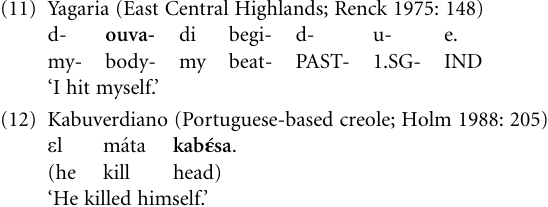
Finally, mention should be made that nouns meaning ‘body’, ‘head’, etc. have given rise to reflexive pronouns; there are hundreds of languages that have been documented to have undergone this grammaticalization process (Schladt 2000; Heine 2000, 2005). As a rule, this process involves noun phrases consisting of a body or body-part noun plus a possessive modifier, as in example (11) from the Papuan language Yagaria of New Guinea; but there are also cases where the noun on its own turns into a reflexive marker, or where the possessive modifier is lost. Accordingly, there are a number of languages where the reflexive pronoun consists of the bare noun, as in (12):
To conclude, there is robust evidence to show that nouns, used either on their own or in combination with some modifier, commonly develop into markers of personal deixis. Most commonly, it is third person pronouns that arise, but given the right social and linguistic context, it may also be first- or second-person pronouns. Conversely, personal pronouns are unlikely to develop into nouns or noun phrases.
Noun >subordinator Similar to the process for complementizers, general locative and temporal nouns provide a common source for subordinators of adverbial clauses. We will discuss more detailed evidence on this grammaticalization process, suffice it here to illustrate the process with a couple of examples.
Like its etymological German counterpart weil ‘because’, English while is historically derived from a phrase having a temporal noun as its semantic nucleus, which was al di wila daz ‘all the time that’ in Old High German and þa hwile þe ‘that time that’ in Old English. The main difference between the two languages is that in German the process resulted in a cause/reason subordinator while in English it gave rise to a temporal and concessive subordinator.
To conclude, there is a ubiquitous process whereby nouns forming the semantic nucleus of noun or adverbial phrases are grammaticalized to adverbial clause subordinators; desemanticization leads to the loss of their lexical semantics, and decategorialization has the effect that the erstwhile noun loses most or all of its nominal properties, ending up as an invariable marker of clause subordination. In a number of cases, although not always, the process also involves erosion, in that part of the phonological and/or morphological substance of the phrase is lost; the German and English examples that we mentioned illustrate the effect of this loss.
1 Only numerals and a few quantifiers do not use relative clause markers in Ik.
2 We will not propose any rigid boundary between adpositions and case markers; this is an issue that is notoriously controversial in both typological works and grammatical descriptions. We will say that case markers are typically (though not necessarily) affixes whose function includes that of marking core participants (subject, object), while adpositions are typically free forms that serve the expression of a wider range of functional relations.








