









Grammar
Tenses
Present

Present Simple
Present Continuous
Present Perfect
Present Perfect Continuous
Past
Past Simple
Past Continuous
Past Perfect
Past Perfect Continuous
Future
Future Simple
Future Continuous
Future Perfect
Future Perfect Continuous
Parts Of Speech
Nouns
Countable and uncountable nouns
Verbal nouns
Singular and Plural nouns
Proper nouns
Nouns gender
Nouns definition
Concrete nouns
Abstract nouns
Common nouns
Collective nouns
Definition Of Nouns
Animate and Inanimate nouns
Nouns
Verbs
Stative and dynamic verbs
Finite and nonfinite verbs
To be verbs
Transitive and intransitive verbs
Auxiliary verbs
Modal verbs
Regular and irregular verbs
Action verbs
Verbs
Adverbs
Relative adverbs
Interrogative adverbs
Adverbs of time
Adverbs of place
Adverbs of reason
Adverbs of quantity
Adverbs of manner
Adverbs of frequency
Adverbs of affirmation
Adverbs
Adjectives
Quantitative adjective
Proper adjective
Possessive adjective
Numeral adjective
Interrogative adjective
Distributive adjective
Descriptive adjective
Demonstrative adjective
Pronouns
Subject pronoun
Relative pronoun
Reflexive pronoun
Reciprocal pronoun
Possessive pronoun
Personal pronoun
Interrogative pronoun
Indefinite pronoun
Emphatic pronoun
Distributive pronoun
Demonstrative pronoun
Pronouns
Pre Position
Preposition by function
Time preposition
Reason preposition
Possession preposition
Place preposition
Phrases preposition
Origin preposition
Measure preposition
Direction preposition
Contrast preposition
Agent preposition
Preposition by construction
Simple preposition
Phrase preposition
Double preposition
Compound preposition
prepositions
Conjunctions
Subordinating conjunction
Correlative conjunction
Coordinating conjunction
Conjunctive adverbs
conjunctions
Interjections
Express calling interjection
Phrases
Sentences
Clauses
Part of Speech
Grammar Rules
Passive and Active
Preference
Requests and offers
wishes
Be used to
Some and any
Could have done
Describing people
Giving advices
Possession
Comparative and superlative
Giving Reason
Making Suggestions
Apologizing
Forming questions
Since and for
Directions
Obligation
Adverbials
invitation
Articles
Imaginary condition
Zero conditional
First conditional
Second conditional
Third conditional
Reported speech
Demonstratives
Determiners
Direct and Indirect speech
Linguistics
Phonetics
Phonology
Linguistics fields
Syntax
Morphology
Semantics
pragmatics
History
Writing
Grammar
Phonetics and Phonology
Semiotics
Reading Comprehension
Elementary
Intermediate
Advanced
Teaching Methods
Teaching Strategies
Assessment

Stems, roots, and compounds
 المؤلف:
PAUL R. KROEGER
المؤلف:
PAUL R. KROEGER
 المصدر:
Analyzing Grammar An Introduction
المصدر:
Analyzing Grammar An Introduction
 الجزء والصفحة:
P248-C13
الجزء والصفحة:
P248-C13
 2026-01-28
 553
553




+
-
20
Stems, roots, and compounds
We discussed the difference between two different kinds of morphemes, namely roots and affixes. All of the words in example (1) in "Derivational morphology" share the same root, namely the morpheme believe. But we have suggested that some forms which contain this root (those in (1a)) belong to the same lexeme, while others (1b) do not. It is often helpful to be able to refer to the portion of a word which all forms of a given lexeme have in common. This unit is generally called the STEM.
A stem is the part of a word that contains no inflectional morphology; it consists of the root plus any derivational morphology. So, while a root is always a single morpheme (by definition, a morpheme which is not an affix), a stem may consist of one or more morphemes. If a given word contains both derivational and inflectional morphology, then the root, stem, and word are all different (2a). If a word contains no inflectional morphology, then the stem and word are the same (2b). If a word contains no affixation at all, then the root, stem and word are all the same (2c).
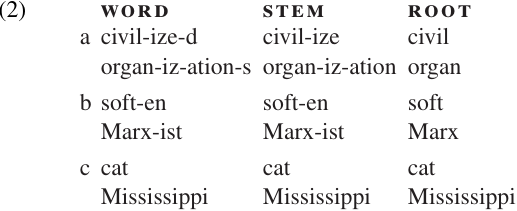
A root or stem is called BOUND if it cannot occur on its own without additional affixation; a FREE form is one that can occur as an independent word. In English, because there is relatively little inflectional morphology, most roots and stems are free, as illustrated in (2). Some examples which could be analyzed as bound roots are presented in (3).
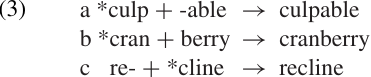
A stem which contains more than one root is called a COMPOUND. Compounding can be considered a special type of derivational morphology.1 At times, it can be difficult to distinguish a compound word (a word containing a compound stem) from a phrase (i.e. a group of two or more independent words). Some of the criteria which can help us to identify compounds include the following:
(i) A compound word normally contains only one main stress. In a phrase, however, each word may contain its own stress. (Note that English spelling is not always a reliable guide.)
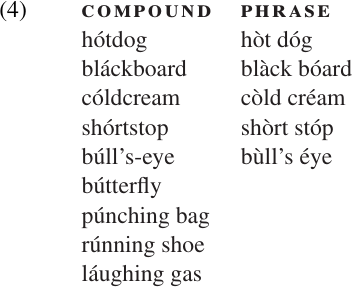
(ii) The original meanings of the roots may be lost in a compound. For example, a hotdog is not a dog, and it can be cold (or even frozen); a blackboard might be green; etc. But in a phrase, each word retains its original meaning; so, a hot dog must be both hot and a dog.
(iii) In a phrase, each individual word can take its normal range of affixes (5b). However, it is generally not possible to add extra suffixes to the first root of a compound in English, but only to the compound as a whole (5a).2
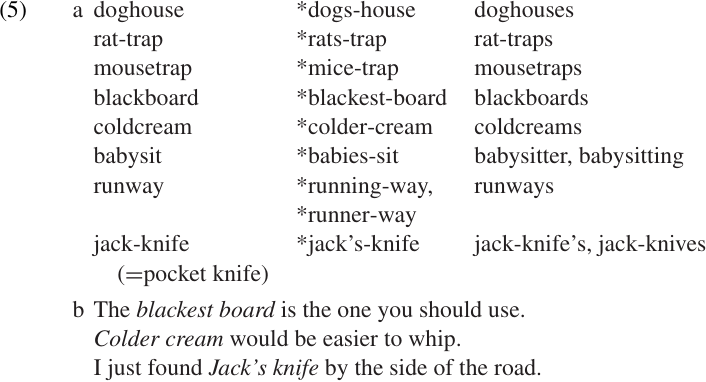
(iv) Words in a phrase can often be separated by inserting one or more other words between them. This is never possible with compounds. When any other word separates the two elements in the compound, the compound sense is lost, as illustrated in (6).
(6) a I watched a butterfly out the window.
I watched my butter suddenly fly out the window.
b I’ll have a skinless hotdog with mustard and onion.
I’ll have a hot, skinless dog with mustard and onion.
1. Some scholars prefer to treat compounding and derivational morphology as two different types of WORD FORMATION. We will not distinguish between word formation and derivation.
2. There are a few exceptional cases in English, such as brothers-in-law, passers-by, hangers-on, attorneys general, etc.
 الاكثر قراءة في Morphology
 اخر الاخبار
اخبار العتبة العباسية المقدسة

الآخبار الصحية


مواضيع ذات صلة
 قسم الشؤون الفكرية يصدر كتاباً يوثق تاريخ السدانة في العتبة العباسية المقدسة
 "المهمة".. إصدار قصصي يوثّق القصص الفائزة في مسابقة فتوى الدفاع المقدسة للقصة القصيرة
 (نوافذ).. إصدار أدبي يوثق القصص الفائزة في مسابقة الإمام العسكري (عليه السلام)






