Existential and possessive clauses
As the Tagalog example (6d) shows, possession is one of the relationships which can be expressed by the locative (i.e. prepositional) clause type. But the possessive relation involved in that example is of a particular kind: temporary physical possession, rather than ownership. The sentence tells us where the book is, rather than whom it belongs to; thus, the use of the locative clause pattern seems quite appropriate.
Compare(6d), repeated here as (18a), with the possessive constructions in (18b, c).11 While all three of these sentences express some kind of possessive relationship, each of them has a distinct function. Example (18a) describes temporary physical possession, as we have already mentioned, while (18b) describes ownership; but in both cases the possessed item is a definite, specific object (one particular book). Sentence (18c) may describe either temporary physical possession or actual ownership, but the possessed item is some indefinite or generic object; the hearer cannot tell which specific book is intended, and the speaker may not even know.
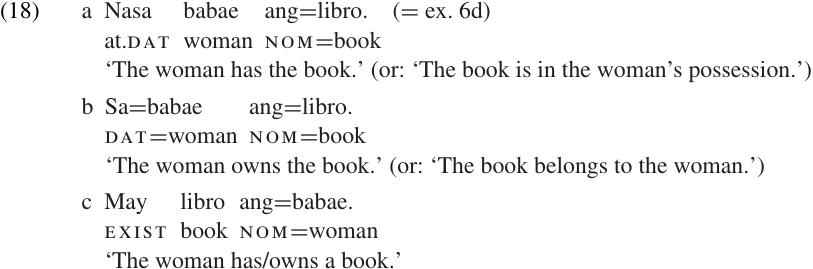
Corresponding to these semantic differences, we find differences in grammatical structure as well. In (18a) the subject (the possessed item) is a definite NP and the predicate (expressing the possessor) is a PP. In (18b) the subject again expresses the possessed item as a definite NP, and the predicate again expresses the possessor, but this time as a bare dative NP rather than a PP. Aside from this one difference, the two clauses are structurally identical. Example(18c), however, has a very different structure: the subject NP expresses the possessor, while the possessed item appears as part of the predicate phrase, which contains the EXISTENTIAL predicate may.
Compare the indefinite possessive example (18c) with the EXISTENTIAL CLAUSE in (19a). As you can see, both sentences contain the same existential predicate (may) followed by a bare NP, i.e. an NP with no case marker.12 (19b) is another example of an existential clause, but it contains a different existential predicate: in place of may, which expresses positive existence (something does exist), (19b) has wala̒, which expresses negative existence (something does not exist). These same two existential predicates can also be used to express positive and negative possession, respectively, as illustrated in (20).
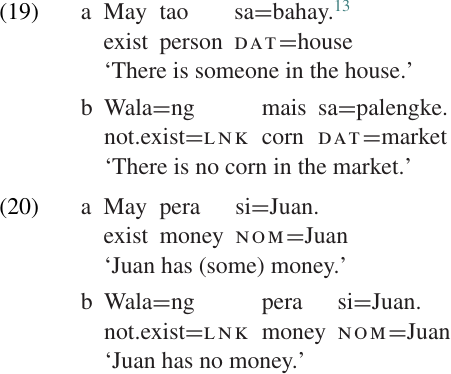
The existential predicates in (19–20) do not fit neatly into any syntactic category. Verbs in Tagalog take a rich assortment of inflectional and derivational affixes, but the existential may (or the longer form, mayroon) cannot take any of these affixes.14 On the other hand, existential may does not share the properties of any other lexical category either. (Such forms are found in many languages; often they are called DEFECTIVE verbs, meaning that they lack the normal range of inflected forms which most verbs in the language exhibit.) So it is difficult to say whether the existential constructions above are strictly speaking “non-verbal” clauses; but they are clearly different from normal verbal clauses.
11. Data from Schachter and Otanes (1972:257).
12. In fact, the possessed objects in (18c) and (19) are just bare nouns; but the NP complement of may can contain modifiers as well, as in: May tatlong bagong bahay sa aming kalye. ‘There are three new houses in our street.’ (English 1986).
13. (19a–b) are taken from Ramos (1971:160–161).
14. The negative existential root wala̒ occurs in a number of derived forms; but in its basic usage (i.e. in existential clauses) it is “defective” in the same sense as may (roon); it does not take any of the normal inflectional morphology which characterizes true verbs in Tagalog (e.g. for aspect, voice, and modality).








