Grammatical case vs. semantic case
The case marking of the nouns in (1) is determined by the Grammatical Relations which the NPs bear in the clause. Case affixes of this type are sometimes referred to as GRAMMATICAL CASE markers, to distinguish them from SEMANTIC CASE markers, which are determined on the basis of semantic roles.
Grammatical cases are normally used only for TERM relations (SUBJ, OBJ, OBJ2). A case form that is used to mark direct objects (like Malay alam–ye in examples (1c), (1g), and (1h)) is traditionally referred to as the ACCUSATIVE case. A case form like Malayalam-kkə(examples(1f), (1g), (1h)) that is used for “indirect objects,” i.e. recipient secondary objects, is traditionally referred to as the DATIVE case. A case form that is used for subjects is normally called the NOMINATIVE case; thus we could say that the nominative case is unmarked in Malayalam, because no suffix is added to the subject.
Malayalam also has semantic case markers; some examples are given in the following sentences:
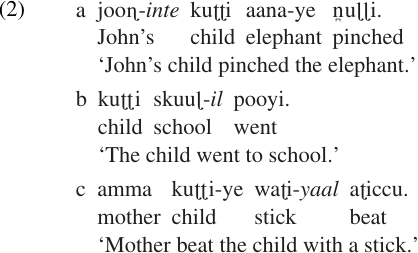
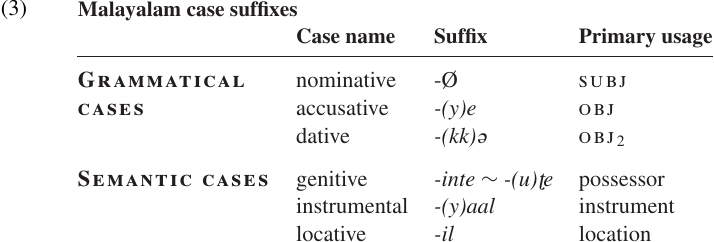
Semantic cases are normally used for oblique arguments (and perhaps some adjuncts). If a special case marker is used for possessors (like Malayalam–inte in (2a)), it is normally called the GENITIVE. If a special case marker is used for locations (like Malayalam-il in (2b)), it is often called the LOCATIVE. If a special case marker is used for instruments (like Malayalam-(y)aal in (2c)), it is normally called the INSTRUMENTAL. The Malayalam case suffixes are summarized in (3):1
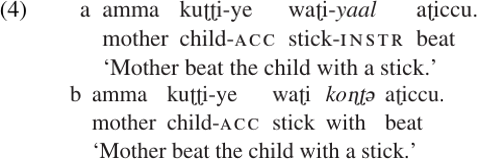
In addition to the use of semantic case, another common way of marking oblique arguments and adjuncts is through the use of prepositions or (as in Malayalam) POST-POSITIONS. Sometimes there are two different ways to indicate the same semantic role. For example, the instrument role is marked by semantic case in (4a), but by a post-position in (4b). The two sentences have the same meaning, but (4a) would be used primarily in formal speech, while (4b) would be preferred in informal speech (K. P. Mohanan, p. c.).
1. Some morphophonemic alternations are omitted from the table in (3). Mohanan (1982) refers to a second dative case category, “dative 2,” which is also omitted here.








